Andy’s six letters
FirestarterAndy’s six letters are both a bid to communicate and a trail the Shop can follow. Their passage through an ordinary rural mail system ends not in an answer to Andy but in the hands of the organization he fears: the letters establish that his appeal has been intercepted, and his suspicion that this has happened helps drive him and Charlie from Tashmore.
Preparation and the uncertain gesture
On March 10, Andy visits the general store in Bradford, New Hampshire, and asks Jake for six fifteen-cent stamps, which Jake tears carefully from an old black postage book. Andy does not explain what the letters are for. After buying the stamps, he picks out a large, ornate birthday card for his daughter, Charlie, whose special day falls on March 10. The card is a separate purchase, but its presence gives the errand a pointed domestic contrast: a father marks his daughter’s birthday while preparing a correspondence whose outcome he cannot see.
Outside, Andy adjusts his headband and stamps the letters one by one. His breath smokes in the cold as he walks around the building to the postbox. The people by the stove watch him go, but none could later testify whether he actually mails the letters. The narration lets the gesture remain uncertain at first: Andy returns to view, shoulders his pack, and leaves, while the store’s conversation moves on. The letters are present, prepared, and apparently sent, but their passage out of his hands is not yet confirmed.
The mail is intercepted
That uncertainty is resolved by the postal route. Bradford has no post office; the nearest is in Teller, New Hampshire. At 1:15 p.m. on March 10, a postal truck collects mail from the standing box beside the general store. The consignment includes Andy’s six letters and a postcard from a local resident to her sister in Tampa. The small, mixed collection makes the letters part of an unremarkable rural mail run, rather than a conspicuous or private channel.
After the truck continues through Williams and turns back toward Teller, a beige Chevrolet Caprice blocks the road. Two men show postal worker Robert Everett their credentials and explain what they want. Everett hands over the small sack of mail from Bradford and Williams. The men open it by the roadside and sort through it; Everett feels that the search is an invasion, and protests that they will hear about what they are doing. One of the men identifies Andy’s six letters by their matching, careful handwriting and takes them. The mailbag is left open on the road. The letters’ interception is thus not a failure of delivery but a deliberate act carried out before the ordinary sorting process can take them onward.
From intercepted mail to the Shop’s file
The letters later appear among the latest additions to the McGee file held by Cap Hollister. He has six of them, mailed less than two weeks earlier, and shuffles through them without reading: they are essentially the same letter, and he knows their contents almost by heart. This establishes both repetition and custody. Andy sent six copies of a substantially identical message; the Shop has collected them all and absorbed their contents into its surveillance of him.
The file places the letters beside glossy photographs of Andy and Charlie on the Tashmore side of the Pond. Some pictures were taken by Charles Payson, others by agents there. They record Andy walking along Bradford’s main street and shopping in the general store, as well as the pair at the camp boathouse. Another shows Charlie sliding downhill on a flattened cardboard box, with Andy behind her, laughing. The juxtaposition gives the letters a double function: they are an attempted communication from Andy, but, in the Shop’s file, they sit within a larger record of the family’s everyday movements. Cap studies the photographs and wants Andy and Charlie badly, making clear that the intercepted correspondence belongs to an active pursuit, not a detached administrative review.
Silence and flight
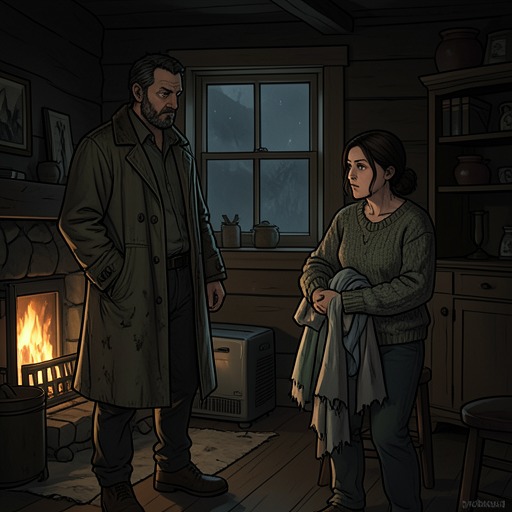
By March 27, more than two weeks after mailing the letters, Andy decides that he and Charlie cannot remain in Tashmore. Nothing has come of his attempt to reach someone, and the continuing silence around Granther’s camp unsettles him. He considers the possibility that every recipient dismissed him as a crackpot, but does not believe that is what happened. His deeper suspicion is that the letters were diverted—and that, if so, the people who took them know where he and Charlie are.
Andy does not present that suspicion to Charlie as a conclusion supported by a reply or an explicit warning. Instead, the missing response, the silence, and what he intuits about the letters become enough to trigger action: he tells her they are leaving and asks her to gather their things. The letters therefore change the family’s position even though they never produce the answer Andy sought. Their route also supplies the reader with knowledge Andy lacks at first: the mail was indeed taken, and the Shop has it. That gap between the visible quiet of the general store and the unseen interception gives the letters their narrative force. They are small, ordinary objects whose passage makes the surveillance system tangible—and whose failure as communication becomes a reason to run.