Carter and Falk’s Organization
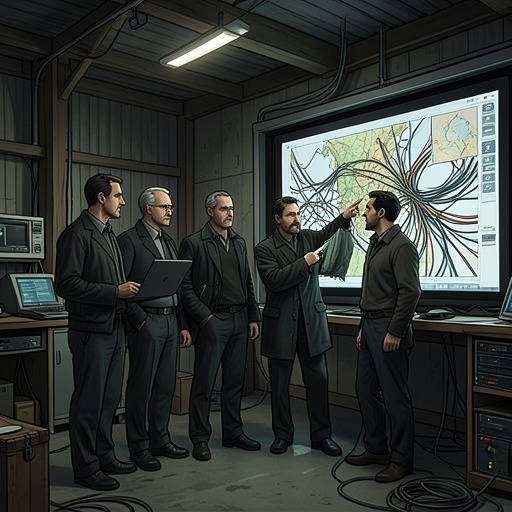
FirewallCarter and Falk’s Organization is a secretive conspiracy organized around a planned electronic attack on the global financial system. Founded on the complementary abilities of Carter, a former World Bank insider, and Tynnes Falk, a specialist in electronic systems, it sought to turn the connections among financial institutions into instruments of worldwide disruption. Its threat lies not in a visible army or a single weapon, but in the possibility that routine transactions and vulnerable networks could set a crisis in motion before anyone understood what had happened.
Formation and Ideological Origins
The partnership took shape in Luanda in the 1970s, after Carter and Falk met while Carter was working in Angola and Falk was there on a consulting project. Carter had once believed that the World Bank could help correct economic inequality. After nearly two years in Angola, he concluded that its policies protected the rich rather than enabling the country to rebuild and achieve genuine independence. His repeated attempts to persuade his superiors met with indifference; a senior mentor eventually told him that the bank’s policy mattered more than whether Carter was right. Carter returned to Luanda with a decision forming, and his conversations with Falk helped turn disillusionment into a plan.
Their bond rested on a shared conviction that power had to be approached from within the structures that wielded it. Carter had rejected civil disobedience and small, divided socialist groups as inadequate to remake the world. His experience in Vietnam had also helped form his belief in staying close to power’s source. Falk, meanwhile, brought knowledge of the electronic systems linking institutions and an understanding of how those systems might be attacked. Carter understood the financial world and its points of vulnerability; Falk could translate their political ideas into technical practice.
In their long discussions, Falk described a future in which electronic signals could disable stock markets and telecommunications, and computer viruses could undermine military systems. The two agreed to wait rather than act hastily. Over many months they refined their plans, and they remained in regular contact for roughly twenty years. Carter later called the proposed operation Jacob’s Marsh, a name drawn from Falk’s childhood memories of a marsh associated with chaos, drowning, and the end of hope. For Carter it was also a private gesture in memory of his dead friend.
Structure, Members, and Methods
The organization was hierarchical and tightly controlled, with Carter and Falk at its head and making its decisions. Its membership drew together people with very different roles, including Fu Cheng, Elvira Lindfeldt, and Jonas Landahl. The later police assessment described these members as having been drawn in, brainwashed, and caught in the group’s reach. Carter’s authority was reinforced by his cold calculation and his access to financial knowledge; Falk supplied the specialized technological capability needed to build the operation.
The network’s secrecy depended on more than keeping its members’ identities obscure. Falk’s computer contained a layered security system, with decoys and barriers protecting its inner material. When Martinsson tried to open a file, the machine appeared to notify someone elsewhere that it had been accessed. He also found evidence that another person had used it shortly before the police examined it. The computer therefore functioned as both a store of sensitive information and a live point of connection: investigating it could alert the people the police were trying to find.
The investigation gradually connected the group’s scheme to financial institutions that included the National Bank of Indonesia, the World Bank, and a stockbroker in Seoul. Robert Modin concluded that these institutions were cornerstones of the global financial network. If enough of them were compromised, the resulting failures could crash markets, provoke panic withdrawals, and destabilize currency exchanges. The breadth of that potential damage made the conspiracy more than a local computer crime, even though part of its planning and evidence was concentrated in Ystad.
The Trigger and the Threat to the Investigation
The plan was designed to depend on a trigger hidden inside an ordinary act. Modin’s notes referred to a commonplace mechanism that people used without thinking; Wallander recognized the possible significance of a cash-machine transaction after Martinsson left to withdraw money. A badly torn page, covered with drawings and calculations, contained a heavily underlined note about a workable trigger. The police could not initially identify the exact machine or determine precisely what would follow, but they feared that a transaction at the right place and time could activate the larger attack.
The date embedded in the countdown was October 20, not the year 2000. The distinction sharpened the urgency: the scheme was approaching a particular day, and the police did not know whether its triggering event had already occurred. Wallander responded by proposing that cash-machine transactions be suspended, despite the likely public anger and the need to confront banks and senior police officials. In the eventual reconstruction, the decisive time was 5:31 a.m. on October 20. Had Wallander or Modin inserted Carter’s Visa card into the machine at that moment, the transaction would have unleashed the planned electronic avalanche. Wallander did not do so, and the anticipated global attack did not happen. Cash machines across Skåne did malfunction for a day, but later returned to normal without a satisfactory explanation.
The threat also shaped the case’s violence. While Sonja Hökberg was in police custody, Höglund reasoned that someone feared what she might have learned from her associates, especially Jonas Landahl. She connected that risk to Modin’s subsequent danger and to the attacks on Wallander, suggesting that the perpetrators were trying to keep information inside Falk’s computer secret. The investigation later established that Hua Gang had killed both Hökberg and Landahl while acting under Carter’s direction, and possibly Falk’s. These killings were part of the organization’s effort to protect its work, though the police could not resolve every circumstance surrounding the crimes.
Exposure, Collapse, and Unresolved Evidence
Carter’s account of the organization reveals the tension between his original hopes and the destructive purpose he eventually embraced. He had once admired the dignity and joy he encountered amid hardship in Angola, but came to regard the country’s poverty and social disintegration as confirmation that the existing order had failed. By the time he was planning the attack, he believed that destroying the world could be preferable to preserving it. Falk’s unexpected death in Sweden disrupted their preparations and left Carter to carry the plan forward alone. The death was not something the partners had anticipated, and Carter regarded it as a blow to both their friendship and their carefully arranged timetable.
The police eventually assembled a partial account of the organization’s reach. Investigators identified Fu Cheng as Hua Gang, whose fingerprints connected him to crimes including bank robberies in Frankfurt and Marseilles. Wallander suspected that money from those robberies had helped finance the operation, though he could not prove it. Hua Gang had a long history in organized crime and was confirmed as the killer of Hökberg and Landahl; he had worked under Carter, and perhaps Falk. The organization’s full structure and activities were never completely mapped, but the police concluded that with Carter and Falk gone it had essentially ceased to exist.
That conclusion did not resolve every mystery. The police never established satisfactorily why Hökberg was thrown against the high-voltage wires at the power substation or why Falk possessed its blueprints. Hansson traced a possible route by which the station keys had been copied after a technician’s house was burgled, and a travel record placed Landahl in the United States afterward, but the larger purpose of the blueprints remained unclear. Falk’s journal was never recovered, nor were the fingers severed from his hand. The organization’s central design was exposed in time to prevent its intended financial catastrophe, but its history retained gaps—evidence of how much had been concealed within a network built to operate unseen.