World Bank
FirewallThe World Bank is presented as an institution founded to provide large loans to impoverished regions, but in the novel it also becomes the focus of Carter’s disillusionment and one of the financial networks implicated in his and Tynnes Falk’s plan. It connects Carter’s experience of institutional power in Angola to Falk’s technological expertise and to the investigators’ growing fear that a small number of compromised systems could destabilize global finance. The bank is not shown as a participant in the conspiracy; rather, it is an institution whose reach, policies, and computer systems become part of the plot’s examination of power and vulnerability.
Purpose and Carter’s Disillusionment
Carter began his career at the World Bank in Washington, convinced that it could do good by providing loans beyond the capacity of individual nations and banks, and perhaps shift the balance of justice in favor of the developing world. Although friends at the University of California challenged his faith in the institution, he believed that change had to be pursued from within existing structures. His maxim was to stay close to the source of power if he hoped to affect it. His experience in Vietnam had helped form that conviction, but his work at the bank tested what it meant in practice.
In Angola, Carter initially listened, observed, and admired the dignity and joy he encountered amid hardship. Over nearly two years, however, he concluded that the bank’s activities were not enabling genuine independence or rebuilding a country damaged by war. In his assessment, they protected the very rich. The deference accorded to his senior position, and the corruption, weakness, and greed he perceived behind radical rhetoric, sharpened the contradiction between the bank’s stated purpose and its effects. He repeatedly tried to persuade senior staff that its strategies were misguided, making transatlantic trips and writing countless memoranda. The responses conveyed, at most, well-meaning indifference.
A dinner with his longstanding mentor, the finance analyst Whitfield, made the institutional limit explicit. Carter asked whether he was alienating everyone by insisting that the bank was wrong. Whitfield told him that whether Carter was right was beside the point: what mattered was bank policy. Carter returned to Luanda understanding that proximity to power did not guarantee the ability to change it. His turn against the institution grew from this conflict, although the novel presents his later response not as reform but as a decision to destroy the world he believed the existing order had failed.
From Institutional Critique to Conspiracy
Carter’s encounter with Falk in Luanda gave his disillusionment a technological direction. Falk, a Swedish consultant working on a neglected state telecommunications project, brought engineering knowledge and an understanding of the electronic systems connecting institutions. In their long conversations, Carter supplied knowledge of finance and the way powerful organizations operated; Falk could translate their shared ideas into technical methods. The novel’s account makes their partnership complementary: institutional and financial knowledge on one side, technical capacity on the other.
Their discussions developed into plans for an attack on financial and communications systems. Falk explained how electronic signals might disrupt stock markets and telecommunications networks, while Carter understood how delicate the economic balance was. They agreed to wait rather than act hastily, and remained in regular contact over many years. Carter’s earlier position inside the World Bank thus matters not because the bank endorses or directs the scheme, but because his familiarity with financial structures helps him imagine how those structures might be attacked. The institution becomes part of the knowledge base from which the conspiracy is built.
The name Jacob’s Marsh, which Carter gave the operation, honored a place Falk had described from childhood and also carried a darker meaning: chaos and drowning. After Falk’s death, Carter treated the plan as both a continuing operation and a memorial to his partner. The bank’s original promise of lending for development stands in stark contrast to the conspirators’ intention to turn knowledge of financial interdependence into a weapon. Their project does not seek to correct the imbalance Carter condemned; it threatens systems on which people and institutions depend.
Computer Evidence and the Threat to Global Finance
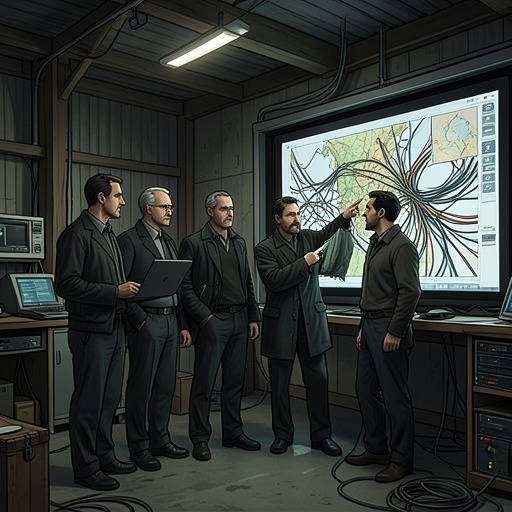
The investigation makes the World Bank’s place in the plot concrete when Martinsson and Robert Modin examine Falk’s computer. They find coded institutional references and discover that one is the Pentagon; further probing identifies the World Bank as another institution to which Falk had access. Modin believes its code refers to a branch dealing with global finance inspections. The files contain information that may have been classified or illegally obtained, though the investigators initially do not know exactly what Falk did with it. The discovery changes the case from a puzzling sequence of deaths and electronic clues into a possible international operation.
As Modin and the investigators compare the institutions in Falk’s files, they identify a shared significance: they are among the cornerstones of the global financial network. In their analysis, compromising enough of these institutions could precipitate a crisis, crash stock markets, provoke panic withdrawals, and make currency values unreliable. The World Bank is therefore important both as a specific system Falk had penetrated and as a representative node in a network whose connections could magnify damage. The novel leaves the exact technical mechanism and the full extent of the intrusion uncertain, but the threat is grounded in the investigators’ discovery of access to institutions with global reach.
Later, Hansson reports that Elvira Lindfeldt had worked for the World Bank in Pakistan during the 1970s and had expressed the view that the financial order needed to be restructured by first tearing down the existing arrangement. This information adds another personal and ideological connection to the institution. It suggests that the conspiracy involved people drawn together by radical opposition to the established financial order, while the investigators still lack a complete map of who was involved and how the plan would work.
Resolution and Significance
At the final review of the case, the investigators understand that Carter and Falk met in Luanda in the 1970s and combined Carter’s familiarity with financial organizations with Falk’s technological knowledge. Their operation involved a controlled organization and exposed major financial institutions to serious potential attack. Specialists around the world work to correct the vulnerabilities revealed by Falk’s infiltrations, while experts try to establish what would have happened if the plan had been triggered. The narrative does not claim that the World Bank itself caused the conspiracy or knowingly assisted it; it shows how knowledge of the institution and access to its systems could be turned toward an attack on the larger financial order.
The World Bank consequently holds two distinct roles in the story. For Carter, it is first an instrument he hopes can redress global inequality, then an institution whose policies he believes protect wealth and resist change. For the investigators, it is an exposed part of a transnational digital network, one whose compromise could have consequences far beyond a single office or country. That contrast links the novel’s political critique to its suspense: systems that appear remote and specialized are also connected to everyday economic stability, and the knowledge gathered inside them can serve either their stated purpose or a destructive scheme.