Sydkraft
FirewallSydkraft company is the utility at the center of the novel’s power-grid crisis: its Ystad power substation is both a crucial connection point for the regional network and the place where a burned body is found among the power lines. The resulting blackout makes the company’s infrastructure visible through its failure, while the investigation raises questions about access controls, copied keys, and a missing original blueprint.
Role in the Regional Power Network
Sydkraft company operates a round-the-clock main office, which receives the first report of the outage on the night of October 8. The on-duty operator, Rune Ågren, tells Olle Andersson that 25 percent of Skåne has lost power and identifies the Ystad power substation as the affected site. The scale of the disruption is not incidental: Andersson knows the substation is a central connection point in the network that carries electricity to towns and homes across the countryside. A fault there can affect much of the region. The substation’s physical layout gives that responsibility a stark form. It stands in a field behind barbed-wire fencing and warning signs. Inside, a small building among the steel towers houses the transformers; its reinforced steel door is meant to require two separate keys or powerful explosives. When the outage occurs, Andersson is the person on call for the Ystad area, and he reaches the site in 19 minutes. His response shows the utility’s dependence on designated staff, access procedures, and communication with the main office when a major network fault arises.
The Blackout and Emergency Response
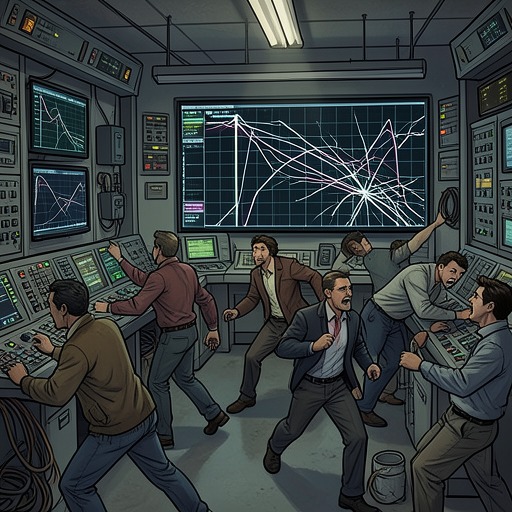
The gates are open when Andersson arrives. He reports the apparent break-in to Ågren by radio, then finds that the transformer-building door is ajar. Inside, he discovers a burned corpse among the power lines. The body has caused a short circuit that cuts power across the region. Andersson calls the main office, and Ågren instructs him to remain at the site while the company attempts to reconnect the grid around the damaged substation. The failure reaches far beyond the field. A quarter of Skåne is without power, with darkness extending from Trelleborg to Kristianstad. Hospitals switch to emergency generators, while the outage is otherwise described as total. A company executive tells the press that the problem has been located and expects power in most areas to return within half an hour, but that estimate does not mean the damaged site itself will be restored. Ystad’s power comes back shortly after 3 a.m., after Sydkraft has worked around the substation. The account emphasizes both the practical ability to reroute supply and the consequences of losing a central connection point, even temporarily.
Security Questions and the Police Inquiry
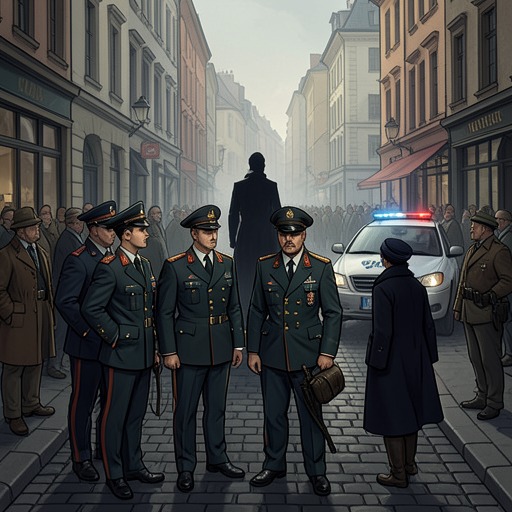
The open gates are not unprecedented. Earlier break-ins had been reported to the police, and the company had considered whether an intruder might intend to sabotage the grid. In September, one of Sydkraft company’s safety engineers proposed a new set of security measures. That prior discussion becomes significant after the blackout: the incident is not simply an unforeseeable equipment failure, but a breach at a site whose vulnerability had already been recognized. The scene presents a puzzling contrast between the two barriers. The outer gates have been clumsily forced, yet investigators see no sign that the reinforced inner door was forced. Kurt Wallander asks why the gates were broken while the inner door was apparently opened without damage. He calls for an accounting of everyone who could have had access to the keys. The company’s internal inquiry later reports that all authorized key holders can account for their keys, and that Sydkraft company has taken the matter seriously. That finding narrows the question without resolving it: possession of the listed keys does not explain how the intruder reached the transformer building. A further security weakness emerges through the investigation. One technician, Moberg, had returned from leave to find his house burgled. The station keys were not taken, but Hansson maintains that the burglars could have copied them and arranged for duplicates to be made by the American manufacturer, perhaps for a substantial payment. Jonas Landahl’s passport contains an entry visa showing that he travelled to the United States in the month after the burglary. The suspected copying route remains an investigative conclusion rather than a proven account of exactly who ordered the duplicates, but it offers a possible explanation for entry without damage to the inner door.
Blueprints, Network Vulnerability, and Aftermath
The investigation also links the substation to a stolen blueprint. According to Sydkraft company, the original blueprint was in Tynnes Falk’s office, while a copy had been left in its place in the company’s files. The company supplies a list of people who could have accessed those files, giving the police a line of inquiry. The evidence does not establish why Falk possessed the original or how it came to be there; the document’s unexplained presence remains one of the case’s loose ends. The broader threat in the novel extends beyond electricity. Falk and Carter’s plan targets the global financial network, and the investigation reveals how exposed major institutions are to coordinated attack. The substation episode therefore stands both as a concrete act of sabotage and as an early demonstration of the vulnerability that the later computer investigation identifies more widely. The book does not show Sydkraft company participating in the financial plot; rather, its damaged installation and compromised access procedures make the utility a local example of the infrastructure on which ordinary life depends. The aftermath preserves that tension between repair and uncertainty. Power is restored by routing around the damaged substation, and the company investigates its own security failures, but neither the reason Sonja Hökberg was thrown against the high-voltage wires nor Falk’s possession of the blueprint receives a satisfactory explanation. Sydkraft company can restore service and account for its authorized keys, yet the inquiry leaves unresolved how the breach was arranged and what the substation’s plans were meant to enable.