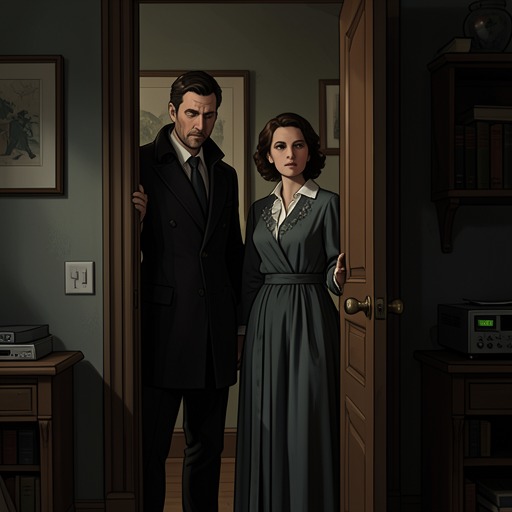
Kurt Wallander and Linda’s father–daughter relationship
FirewallKurt Wallander and Linda Wallander’s relationship is affectionate but strained by distance, his loneliness, and her growing independence. He wants to stay close to his daughter, yet knows little about the people she sees or the details of her daily life. Linda, in turn, can read his isolation clearly enough to challenge him directly: their conversations show both the care between them and the limits of what a father can know about an adult daughter.
A father attentive from a distance
Linda is 26 and lives in Stockholm, sharing a flat in Kungsholmen with two women Kurt knows only by name. She sometimes works as a waitress at a nearby restaurant to make ends meet. Kurt enjoyed the food there on his last visit, though the music struck him as oppressively loud. The details he retains are telling: he notices where she lives, how she supports herself, and what he likes or dislikes about the place, but this knowledge comes in fragments rather than from regular shared time. He misses being able to see her often, and their good relationship does not remove the ache of that separation.
Kurt tries to reach her in ordinary, practical ways. After hearing that a French book on restoring antique furniture had arrived at the bookshop, he remembered that he had ordered it for Linda. He had read about it in a magazine at his doctor’s surgery, hoping she might return to the idea of restoring furniture for a living, even though she had since experimented with other careers. He had promptly forgotten the order, but the call from the bookshop brought the gift—and his continuing interest in her plans—back to mind. He decided to call her that evening; when she was not home, he left a message saying that it was not important. The modesty of that message contrasts with how much the call mattered to him.
Care, health, and unspoken concern
Linda’s attention to her father is visible in her response to his changing health. After his diabetes diagnosis, Kurt changed his eating habits, began exercising, and lost weight. He established a walking route from Mariagatan through Sandskogen park and back, taking it about four times a week, and stopped visiting his favorite fast-food places. When Linda last saw him, she was delighted by the change in his appearance. Her reaction stands apart from the silence of his colleagues, who made no comment; her notice reassures him that she sees him even when those around him seem not to.
Their concern also runs in the other direction, though Kurt is cautious about how he expresses it. When Linda calls from the restaurant, he asks whether she might visit soon and offers to pay her fare. She says she does not have time, making clear that money is not the obstacle. Kurt recognizes that he cannot change her mind and does not press. He also knows better than to ask where she spent the previous night: he expects that such a question would make her angry and end the call. Although he does not know much about her current romantic life, he remembers that an earlier relationship with a young man from Kenya who was studying medicine in Lund had ended, and that she had since begun seeing someone new from time to time. His awareness is incomplete, but his uncertainty does not cancel his concern.
Linda confronts his loneliness
In the same phone conversation, Linda asks whether Kurt is still in contact with Baiba. He says that the relationship ended long ago. Linda tells him that it is not good for him to continue as he is, and observes that he is beginning to sound whiny—something she says was not characteristic of him before. Her bluntness exposes a change that Kurt himself has difficulty admitting. He recognizes that she sees through him, while his irritation and jealousy about her private life show how readily his loneliness can blur into a wish to know more than she is willing to share.
Linda’s suggestion that he contact a dating agency is both practical advice and a measure of her awareness of his isolation. She warns that otherwise he will become an old man who worries about where she spends her nights. Kurt rejects the idea of a personal advertisement or dating agency, though he cannot explain why beyond saying that he does not believe in them. The proposal touches a reluctance he has felt before: choosing to seek companionship seems to him like an admission of desperation. Linda does not resolve that reluctance for him, but she names the problem and urges him to consider a life that is not organized around work or anxiety about her.
Affection without control
Kurt’s gestures—calling, arranging a book he thinks might help Linda’s ambitions, asking her to visit, and offering to pay her fare—express care without giving him a claim over her time. He wants more closeness, but when she says she is busy, he accepts that answer. Linda’s frankness likewise combines affection with independence: she checks on his past relationship and emotional state, then tells him what she thinks he should do without pretending she can choose for him.
Their relationship therefore holds two truths together. Linda remains a source of delight and connection for Kurt, as her pleasure at his improved health shows, yet she cannot fill the companionship he misses or provide constant access to her adult life. She sees his loneliness more clearly than he wants to be seen, while he continues to reach toward her through small acts of attention. The distance between them is not presented as a rupture; it is the condition in which their care now has to operate.