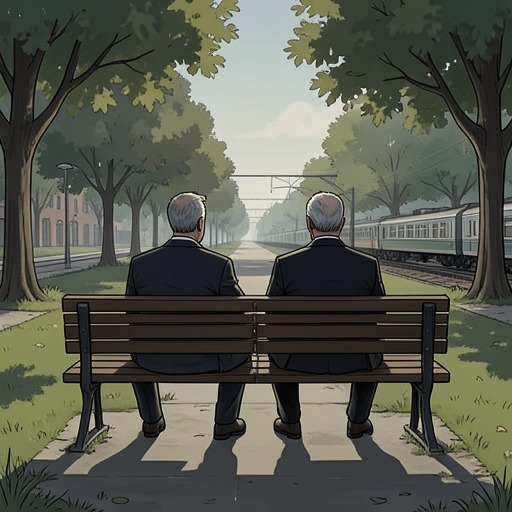
Kurt Wallander and Sten Widén’s longtime friendship
FirewallKurt Wallander and Sten Widén’s longtime friendship gives Wallander a rare point of personal connection, but its eventual rupture reveals how little shared life remains beneath their history. Widén is one of Wallander’s few close friends and probably his oldest; when Widén decides to sell his farm and leave, Wallander’s envy of that freedom gives way to the recognition that the two men have been growing apart for years.
A Rare Friendship
Widén is part of the small circle Wallander can imagine turning to outside work. While considering whom to take on a week-long holiday, Wallander thinks of Widén, who raises horses at a stud farm outside Ystad. The possibility quickly seems impractical: Widén drinks heavily, while Wallander is trying to keep his own once considerable alcohol consumption to a minimum. Wallander also wonders whether Widén would be a good travel companion. Even in this private calculation, the friendship is real but not uncomplicated; Widén is one of the few people available to ask, yet Wallander already anticipates the strain of spending a whole week together.
When Widén calls during Wallander’s illness, he says it would be good to see him, but Wallander initially puts him off because he is trying to find Sonja Hökberg, who has escaped custody. Widén then says he wanted to say goodbye. Wallander’s stomach tightens as he wonders whether Widén is seriously ill, and he asks why he needs to leave. The answer is that Widén is selling his place and taking off. The call immediately changes the emotional balance: Wallander is relieved Widén is not dying, but envies the decisiveness with which his friend is setting out toward an unknown future.
Widén’s Departure and Wallander’s Envy
For years, Widén had talked about leaving. The stud he inherited from his father had ceased to be profitable, and Wallander had grown accustomed to hearing Widén’s plans as dreams he would never act on. This time Widén sounds sober, energetic, and resolved. Wallander realizes he had been wrong to dismiss the possibility that his friend might actually go; Widén’s dreams have proved more alive than his own. Wallander, by contrast, finds the idea of leaving his police work remote and believes he could not do what Widén is doing.
A few days later, Wallander visits the farm. The stables contain many empty stalls, and after a teenage girl finishes mucking out, the two men are left alone. Widén confirms that the stud is for sale. He expects the price to be poor, but thinks that living cheaply might let him survive on the interest. He has not decided where to go; selling the farm comes first. Wallander asks what he will do without the horses. Widén does not know, and jokes that he might either drink himself to death or, in the new circumstances, finally break the habit.
Widén’s possible futures remain vivid but unresolved. In the untidy living room that also serves as his office, he imagines working backstage at La Scala in Milan, perhaps moving props and hearing the singing without paying for a ticket. He also considers going north and burying himself in a cold snowdrift. He is not presenting a settled plan so much as a range of possibilities opened by leaving. Wallander has no answer when Widén asks what he will do. He has drunk too much, and the contrast between Widén’s uncertain freedom and his own inability to step away sharpens his envy.
Work as the Widening Divide
Their visit brings the difference between their lives into direct conversation. Widén teasingly asks whether Wallander is still chasing liquor smugglers. Wallander reacts defensively, insisting that he pursues murderers, including the people who killed a taxi driver by smashing and stabbing him. Widén has not heard about the killing. He says he does not understand how Wallander can keep doing the work; Wallander replies that someone has to do it and that he probably does it as well as anyone else. Widén reassures him that he has always considered him an excellent policeman, while asking whether he will ever make time for anything else.
The case Wallander describes also touches the investigation into Sonja Hökberg. He tells Widén that one of the girls who killed the taxi driver had a stepfather, Erik Hökberg, known to the police as Eriksson, and that the girl now appears to have been murdered. Widén is surprised. Wallander says he cannot take time away from the case even if he wanted to. Their exchange makes the separation concrete: Widén is preparing to leave a life tied to horses and an unprofitable farm, while Wallander remains bound to an investigation whose developments Widén does not know.
Wallander’s defensiveness exposes the pressure beneath his commitment. He calls himself no quitter, but Widén’s question forces into view the possibility that perseverance has narrowed his life. The conversation is not simply a disagreement about police work: Widén admires Wallander’s competence, while Wallander cannot make room for the alternative life his friend’s departure represents. Neither man resolves that difference.
The Friendship’s Ending
As they talk, Wallander recognizes a distance he had not previously understood. They had once been very close; later, after growing up and going separate ways, they met again and assumed they could build on the old friendship. Only now does Wallander see that the continuation of their earlier bond would have to be something different. He suspects Widén has reached the same conclusion. The loss is not caused by one quarrel. Their shared past had concealed how long their present lives had diverged.
When Wallander asks for a taxi, Widén’s face shows disappointment, and Wallander feels the same. The narrative makes the separation mutual: Wallander understands that the friendship has ended, or more exactly that they have finally discovered it ended some time ago. Widén does not argue when Wallander refuses a ride because Widén has been drinking; instead, he calls the taxi company. They wait outside on a clear, windless autumn evening. Widén asks what they expected when they were young. Wallander says he has forgotten and that he is occupied with the present and worried about the future. They promise to write, but the farewell does not restore their closeness.
Widén’s departure therefore marks both a practical change and a belated recognition. He is selling the stud and leaving without knowing where he will go; Wallander remains at work, unable to take time away. Their friendship survives as affection, envy, disappointment, and a promise to keep in touch, but not as the continuation of the intimacy they once assumed they could recover.