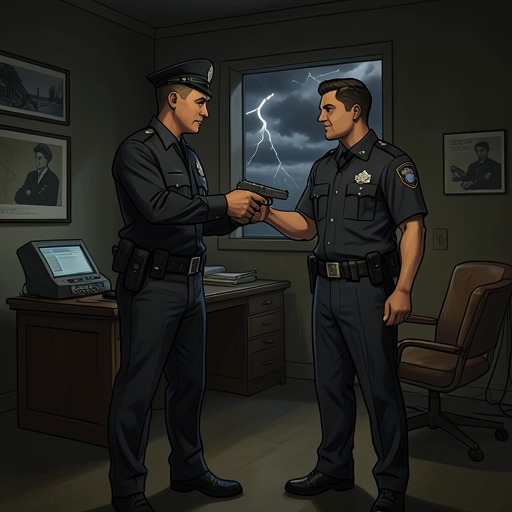
Kurt Wallander and Martinsson: colleagues and a broken friendship
FirewallKurt Wallander and Martinsson’s relationship is both a working partnership and a friendship whose collapse becomes one of the investigation’s personal costs. Wallander has understood their bond through trust, shared police work, and the example of his own mentorship by Rydberg. As he begins to believe Martinsson has been acting against him, the professional conflict reaches beyond disagreement over leadership: Wallander experiences it as betrayal, and the final conversation leaves him grieving a friendship he can no longer recover.
Mentorship and Trust
Wallander’s sense of responsibility toward Martinsson is shaped by Rydberg, who trained him. Wallander believes that he, in turn, trained Martinsson, but he distinguishes his own conduct from what he fears Martinsson may be doing: he never wanted to overthrow Rydberg’s authority. The comparison makes the dispute more than a contest over who leads an investigation. For Wallander, it touches the continuity of professional trust between generations of detectives and the question of whether he has passed on the kind of loyalty he once received.
That trust is already under strain when Wallander learns what Ann-Britt Höglund has told him about Martinsson. He has lingering doubts, partly because he wants her account to be untrue; losing Martinsson as a trusted friend, he thinks, would make the work environment impossible. He also sees the police force as a place of envy, gossip, and intrigue, and fears that he has been drawn into the very politics he believed himself to stand above. In that anxious reading, Martinsson is not simply a colleague who disagrees with him, but a possible successor impatient for his place.
Wallander nevertheless calls Martinsson after Robert Modin reports a discovery. Martinsson has not yet heard from Modin, and Wallander briefly explains the situation. Martinsson questions how Modin could have worked it out without access to the computer, then suggests that he might have copied material onto his own computer. The exchange sounds normal to Wallander. He cannot decide whether Martinsson is concealing what he knows or whether Höglund’s account is mistaken, so their ordinary work conversation offers no resolution to his private suspicion.
Dispute in the Field
The rupture becomes overt after Wallander pursues a gunman alone and is left trapped in the field. At the scene, Chief Holgersson tells him that reports say he ordered Martinsson to stay behind rather than follow as backup. She calls that decision irresponsible and invokes the principle that an officer should never act alone. Wallander recognizes Martinsson as the only possible source of this version: Elofsson and El Sayed were too far away to have heard the exchange. What had been a suspicion of covert criticism now seems to him like a specific false account of an episode in which he thought he might die.
When Martinsson and Hansson approach, Wallander asks Hansson to hold Martinsson’s flashlight. He steps toward Martinsson and hits him, but the shifting beams make the blow land as a glancing nudge rather than the intended strike. Wallander then throws himself at Martinsson, and they fall into the mud; Hansson slips while trying to intervene, and a flashlight goes out. Wallander accuses Martinsson of telling Holgersson that he had ordered him to stay behind and of spreading lies about his work. He also says Martinsson has been going behind his back to complain to Holgersson. Martinsson denies knowing what Wallander means. Wallander ends the exchange rather than prolonging it, throws a flashlight at Martinsson’s feet, and leaves in a patrol car.
The next morning, the evidence of the fight is visible: Martinsson has a black eye and a swollen lower lip. He tells Wallander he will get him for what he did, but first they must finish the case. Wallander admits that hitting him was wrong and says that is all he will take back. Their exchange is brief, and they resume the practical work of the investigation. The case still requires cooperation, but the physical confrontation has not repaired the trust between them.
The Final Conversation
After the investigation meeting and the handover of the dossier to the prosecutor’s office, Wallander asks Martinsson to speak privately. Wallander accuses him of going behind his back, spreading lies, and questioning his ability to lead. He speculates that Martinsson may be laying groundwork for a future career, though he acknowledges that only Martinsson knows why he chose to act covertly. Martinsson answers that Wallander has lost his grip and says his own fault was failing to say so earlier. He claims he tried, but that Wallander does not really listen.
Wallander returns to the report about the field incident. Martinsson says Holgersson must have misunderstood him. The account therefore remains contested: Wallander is convinced Martinsson lied, while Martinsson does not retract his explanation. Wallander still feels the urge to hit him, but lacks the energy and recognizes that he will not make Martinsson change his official position. When Martinsson asks whether there is anything else to discuss, Wallander says there is not. Martinsson leaves without reconciliation.
A Friendship Broken
Wallander experiences the end of the conversation as the end of the friendship. He wonders whether the friendship had ever truly existed or whether Martinsson had always been waiting for an opportunity to move against him. That suspicion does not erase his grief. He feels both rage and loss, and the loss is stronger. He resolves to remain in charge of Ystad’s most complicated investigations for at least the next few years, but determination cannot restore the companionship he believes has disappeared.
The relationship’s ending also sharpens Wallander’s sense of professional exhaustion. The breach is not an isolated disagreement that can be set aside once the case is over: he has to keep working alongside Martinsson while understanding their personal bond as broken. In the aftermath, Wallander leaves the station and drives away without telling Irene where he is going or when he will return. His reaction shows how deeply the conflict has unsettled him, even as the work itself continues to demand his leadership.