Modern Society’s Dependence on and Vulnerability of Electrical and Technological Infrastructure
FirewallModern Society’s Dependence on and Vulnerability of Electrical and Technological Infrastructure is a central concern of the novel: systems that seem reliable because they operate in the background can become visible, and dangerous, when one of their crucial points fails. The blackout originating at the Ystad power substation makes that dependence concrete, while the threat discovered in Tynnes Falk’s computer extends the same concern from electricity to international finance. In both cases, complex networks promise continuity but conceal weaknesses that a determined intruder can exploit.
Infrastructure in Ordinary Life
Electricity is usually encountered through its benefits rather than as a system requiring attention. When the power fails, that apparent transparency disappears. On October 8, 1997, a utility employee is called from bed after his bedside lamp fails; he turns to the flashlight he keeps nearby and learns from Sydkraft that a quarter of Skåne has lost power. The incident immediately reveals that the failure is not a minor local inconvenience but a disruption across a region.
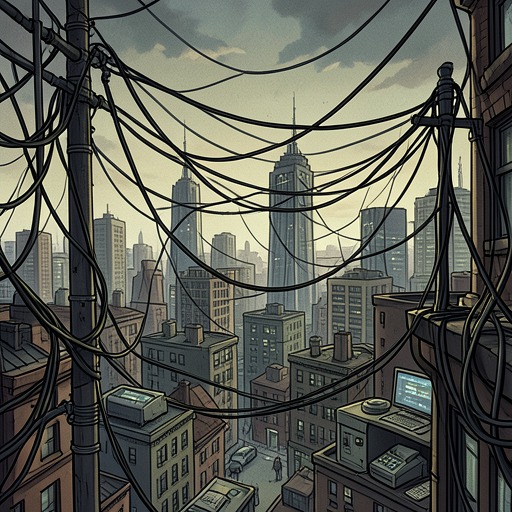
The substation’s position explains the scale of the danger. It is one of the central connection points in the network that carries electricity to towns, houses, and the countryside. Its failure can affect much of Skåne, and the employee considers the larger possibility that one fault in the grid could leave a third of the country in darkness. The novel sets this extensive dependence against the much older experience of darkness: electricity has transformed daily life so thoroughly that no one then living can remember what life was like before it. That transformation has brought convenience, but also a reliance difficult to perceive until supply stops.
The Blackout and Its Physical Cause
The interruption is made tangible through the investigation at the substation. The utility employee reaches it in nineteen minutes and finds the area dark, the outer gates broken open, and the steel door to the transformer building ajar. Inside, a burned corpse lies among the power lines. The body has short-circuited the system, and the suspected failure of the relay safety has turned one person’s death into a regional blackout.
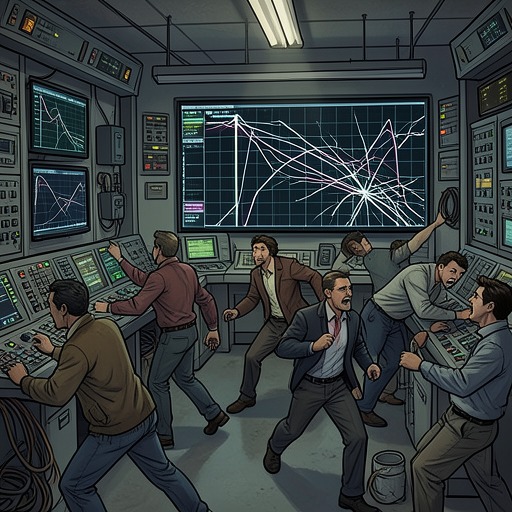
The consequences reach well beyond the site. A quarter of Skåne is without electricity, from Trelleborg to Kristianstad. Hospitals are operating on emergency generators, while the outage elsewhere is total. A Sydkraft executive expects power to be restored in most areas within half an hour, but the discovery at the substation makes that reassurance uncertain: the apparent technical problem is also a police investigation, and the cause is not yet understood. The contrast between a routine restoration estimate and a burned body at the grid’s central point exposes how little the public can know about the condition of the system on which it depends.
Security, Access, and Investigation
The blackout turns maintenance and access arrangements into questions of public safety. The outer gates have been forced, but the reinforced transformer-building door shows no visible signs of being forced; it appears to have been opened with a key. The substation is supposed to be protected by distinct keys, and the security system has been tightened. In the subsequent inquiry, police identify five people with keys and find that one technician’s home had been burgled. The keys themselves were not reported stolen, but the investigation develops the possibility that they were copied and duplicated through the American manufacturer. A later check finds that Jonas Landahl had been in the United States after the burglary.
These details make the infrastructure’s vulnerability more than an abstract warning. Its protection depends on physical barriers, controlled keys, reliable record-keeping, and the assumption that authorized access remains secure. Yet the broken outer gate and apparently unlocked inner door present a troubling contrast: the most conspicuous barrier has been damaged, while entry to the protected building may have depended on access that left no obvious mark. Kurt Wallander also concludes that the substation was not chosen by accident, since it was one of the most vulnerable points in Skåne’s power distribution system. The inquiry cannot settle every question, but it shows that a network’s resilience depends on human procedures as well as equipment.
From Electricity to the Financial Network
The novel broadens its concern from the power grid to computer systems and financial institutions. In Luanda, Carter receives a warning that someone has penetrated the first layer of security on Falk’s computer in Ystad. The system contains multiple layers of protection, but even a breach at its outer boundary signals that a threat may be moving through a network designed to conceal its most important operations.
Later, Robert Modin explains that the institutions connected through Falk’s computer form cornerstones of the global financial network. If they were compromised sufficiently, the consequences could include collapsing stock markets, panic withdrawals, and wildly fluctuating exchange rates. This is not the same incident as the blackout, but it develops the novel’s wider pattern: apparently separate services are connected, and a weakness at a point of access may propagate far beyond its immediate location. The danger lies not only in a machine being disabled, but in the cascading effects of disruption across systems that depend on one another.
Consequences and Significance
The projected financial attack gives this theme its largest scale. Experts later determine that if Kurt Wallander or Modin had inserted Carter’s Visa card into the machine at 5:31 a.m. on October 20, they would have triggered an electronic avalanche. Falk and Carter had exposed major financial institutions around the world as shockingly vulnerable, prompting security specialists to work continuously to repair the deficiencies. The plan is not set in motion; cash machines in Skåne malfunction for a day and then resume normal operation. Even so, the near miss leaves the underlying weakness unresolved as a serious public concern.
The power failure and the financial conspiracy therefore work as distinct but related demonstrations of dependence. One begins with a corpse among high-voltage lines; the other with a concealed program and a card operation timed to a precise minute. Both make invisible infrastructure legible through interruption, and both reveal that technical complexity does not guarantee security. The novel’s warning is grounded in specific dependencies—regional electricity distribution, emergency generators, controlled access, computer defenses, and interconnected financial institutions—rather than in a generalized fear of technology. The systems that sustain ordinary life can also concentrate its vulnerability at hidden points where a single breach has consequences far beyond its immediate scene.