October 20 countdown
FirewallThe October 20 countdown is a suspected deadline encoded in the changing positions of recurring markers on the network displayed through Tynnes Falk’s computer. It gives the investigation a concrete point in time, but not a clear account of the threatened action: the investigators cannot yet identify what will happen, which servers are involved, or where the system is controlled. The countdown therefore functions both as a clue and as a measure of how little they know: October 20 is drawing near while the danger remains indistinct.
The Pattern in the Network
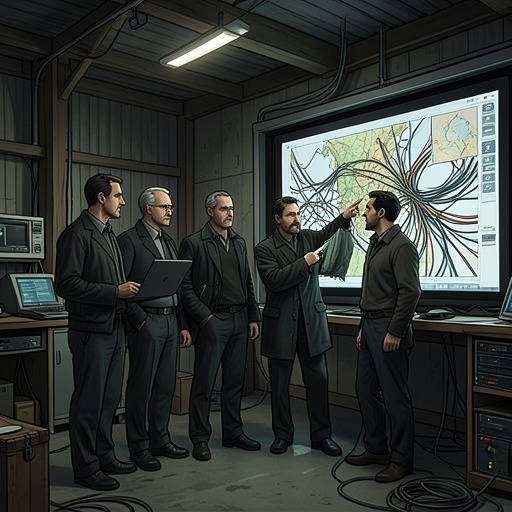
Robert Modin and Martinsson first describe initials, JM, that repeatedly appear alongside institutions on the computer’s list. Attempts to focus on the initials make them disappear, but leaving them alone reveals that their positions change. The investigators call these recurring markers the nocturnals. As they compare entries, the markers appear to move according to a strict pattern, trending toward the lower-right corner of the display. The movement suggests an ordered process rather than a static list, although the initials’ meaning remains unexplained.
Modin finds a time element in the shifting coordinates. He constructs a calculation using the upper-left corner as zero, the assumption that the network contains 74 identities, and the supposition that the recurring number 20 refers to October 20. On October 17, he identifies the Atlanta satellite company as the fourth component from the end of the sequence. Wallander takes this as a possible sign that the pattern will reach a high point on Monday, October 20. The calculation gives the investigation a date to test against the data, not proof of what that date signifies.
From the Year 2000 to a Nearer Deadline
The number 20 initially leads Modin to consider the year 2000 and the computer problems associated with Y2K. He abandons that reading when he cannot find the missing zeroes and notices that the sequence appears set to conclude much sooner than the end of the year. October 20 becomes his preferred interpretation because it better fits the apparent pace of the countdown. The shift matters operationally: a threat years away would demand preparation, but a date only days off demands immediate decisions.
By Sunday at 11 a.m., Wallander tells the team that 13 hours remain until October 20 officially begins. Earlier, the investigators had described the date as less than 34 hours away; the shrinking interval turns an uncertain interpretation into a pressing constraint. Wallander organizes the inquiry around three questions: whether October 20 is truly the date, what will happen if it is, and how the event can be prevented. He tells the team that nothing else can take priority over answering them. The clock narrows the investigation even though it does not make the underlying evidence clearer.
A Deadline Without a Location or Mechanism
Wallander asks whether the team should simply pull the plug, but Martinsson explains that the computer is only a monitor. It does not expose the network clearly, and the investigators do not know whether one server or several are involved. Disconnecting the visible equipment would therefore not necessarily interrupt the process. Even the bomb analogy remains a hypothesis: Wallander asks the team to imagine a bomb-like countdown, but they cannot determine where it would be controlled or what form the threatened action would take.
The computer also leaves the initials JM unresolved. When Wallander asks what they mean if 20 is a date, no one has an answer. This gap is significant because the pattern supplies a possible timetable without supplying the key that would turn it into an actionable warning. The countdown is legible enough to create urgency, yet incomplete enough to frustrate intervention. Its apparent precision should not be confused with certainty about either the threat or its target.
The Suspected Financial Threat
Modin searches the Web for information about institutions already identified in the network, including the National Bank of Indonesia, the World Bank, and a stockbroker in Seoul. He looks for a point of weakness: a place where someone might enter a system without being noticed. The institutions appear to share a broader function as cornerstones of the global financial network. Modin argues that compromising them sufficiently could precipitate a crisis across financial systems, with stock markets crashing, people rushing to withdraw money, and exchange rates fluctuating so wildly that their value becomes uncertain. This is his proposed explanation of the network’s purpose, not a confirmed outcome.
The list also includes a telecommunications company and Telsat Communications, a satellite company in Atlanta whose business includes renting broadcasting space on communications satellites. Wallander sees a possible connection between the satellite and telecommunications entries and the financial institutions: all participate in electronic transfers or communications. Their presence broadens the suspected vulnerability beyond banks alone, but the investigators have not established exactly how the entries relate or how an attack would proceed. The countdown points toward a possible systemic crisis while the mechanism remains hidden.
Investigation Under Pressure
The date changes how Wallander allocates responsibility. He wants a National Police specialist brought in because the team cannot risk facing a countdown without the necessary expertise. Later, he leaves the analysis of the computer pattern to Modin, Alfredsson, and Martinsson while trying to maintain the larger investigative picture. Alfredsson is applying probability calculations and reduction programs to isolate a pattern and is also consulting Interpol computer specialists about whether other countries have encountered anything similar. At the time of the briefing, no response from abroad has arrived.
The team’s practical caution reflects the difference between detecting a deadline and knowing how to act on it. Wallander says they cannot rule out a plan to knock out the power grid, particularly in light of the group’s apparent knowledge of power stations, but this remains one possibility among others. The October 20 date does not settle that question. Instead, it forces the investigators to pursue several lines of inquiry under the same shrinking window, with no confirmed target and no established way to stop whatever the computer may be counting toward.