The vulnerability of modern infrastructure
FirewallThe vulnerability of modern infrastructure is both a practical danger and an organizing idea in the investigation: systems that make modern life appear stable are linked through hidden points of dependence, and a failure or deliberate strike at one of them can spread far beyond its point of origin. The blackout in Skåne gives that danger immediate, physical form; the investigation of Tynnes Falk’s computer expands it into a threat to the global financial network. In both cases, the apparent reliability of the system conceals how much depends on a limited number of connections—and how difficult it is to know what an attacker intends once those connections are exposed.
Dependence Hidden in Everyday Life
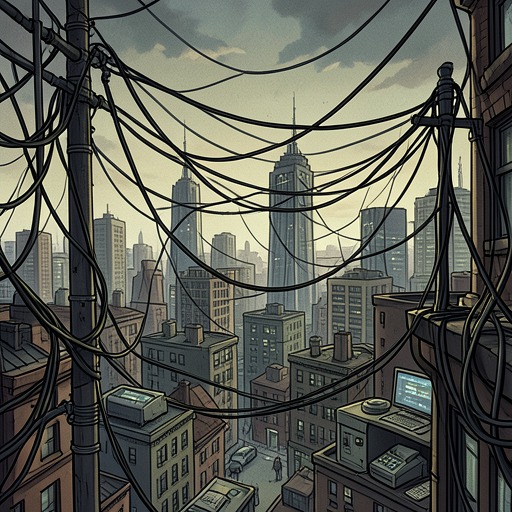
Before the outage, electricity is easy to take for granted. Its absence makes that dependence visible at once: Kurt Wallander’s power fails while he is at home, and the street lamps outside go dark. The interruption is not confined to one household. At the Ystad power substation, Sydkraft’s night operator reports that a quarter of Skåne has lost power. The substation is a central connection in the network that carries electricity to towns and homes, so damage there can affect a much wider area than the site itself.
The response also shows how much ordinary activity depends on electricity. Wallander learns that the darkness extends from Trelleborg to Kristianstad. Hospitals are operating on emergency generators, while the blackout elsewhere is total. Sydkraft expects power to be restored in most places within half an hour by routing around the affected substation, but Wallander recognizes that this reassurance does not describe the scene before him: a burned body lies among the power lines. The system can be rerouted, but the local failure has already become a regional emergency.
The outage is therefore more than a dramatic backdrop. It turns a generally invisible network into a chain of practical consequences: lighting fails, normal services are interrupted, and emergency provision becomes essential. Nyberg voices the larger implication in the phrase, “We live in a vulnerable society.” The words connect the immediate power cut to a wider condition: the same infrastructure that makes daily life possible can magnify the effects of a single disruption.
A Physical Network and Its Weak Points
The substation’s safeguards make the difference between designed security and actual security part of the mystery. It is enclosed by barbed-wire fencing and warning signs, and its transformer building has a thick steel door with two separate locks. Yet when the responding utility worker arrives, the outer gates have been broken open and the inner door is ajar. The contrast is unsettling: the perimeter has been visibly forced, while the door protecting the transformers shows no obvious sign of forced entry. The investigation cannot initially explain how access was obtained or why the breach left this particular pattern.
The blackout itself demonstrates the reach of the site’s position in the grid. At the cash machine, Wallander recalls that whoever struck the substation had chosen a point capable of affecting as many areas as possible. He connects the electrical network to other services that rely on their own critical connections: cash machines, air traffic, trains, and water supplies. His concern is not that every service has already failed, but that knowledge of the right point of attack could let a local intervention disrupt systems on a much larger scale.
Falk’s possession of a power-substation blueprint intensifies that concern, as does the electrical relay found in the morgue. Wallander begins to reconsider the blackout, the relay, and Sonja Hökberg’s death as parts of possible sabotage rather than unrelated incidents. At this stage, however, he is testing a theory, not reporting a settled explanation. He wonders whether Hökberg’s death was meant to expose a point of vulnerability and whether Lundberg’s murder belongs to a separate sequence. The distinction matters: the infrastructure threat becomes more legible to the investigators, but the precise purpose of every act remains uncertain.
From the Power Grid to the Financial Network
The computer investigation carries the same logic from physical infrastructure into digital systems. Robert Modin identifies a possible connection among institutions including the World Bank and a stockbroker in Seoul: they are cornerstones of the global financial network. If they were compromised sufficiently, he explains, the consequences could include collapsing stock markets, panic withdrawals, and wildly fluctuating exchange rates. The danger lies not simply in breaking into an individual computer, but in finding a way through which connected institutions can be made to fail together.
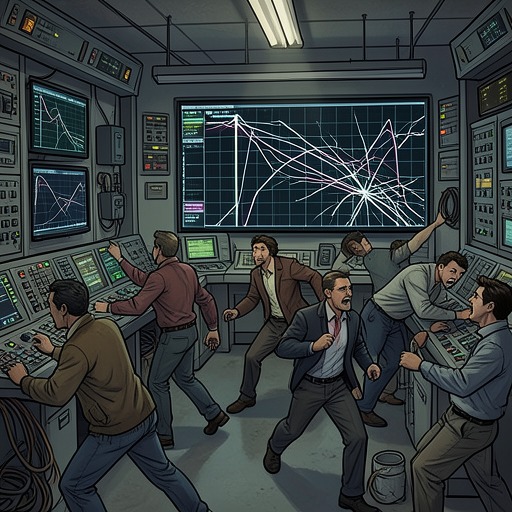
The attempted operation has an October 20 countdown, and the investigators come to understand that the date marks a danger to financial systems rather than a routine computer malfunction. The eventual assessment confirms how exposed the institutions were: specialists around the world work to repair deficiencies after Falk and Carter’s penetrations reveal weaknesses in major financial networks. The technical systems at issue are far removed from a darkened street in Skåne, yet the underlying pattern is familiar. In each case, a network’s scale and interdependence create the possibility that a carefully selected weakness will produce consequences well beyond the initial intrusion.
The novel does not treat the threat as proof that every system is helpless. Sydkraft works to reconnect the grid around the damaged station; hospitals have generators; and experts begin repairing the financial institutions’ security. But these responses come after the weakness has been exposed. Preparedness and recovery can limit damage without erasing the vulnerability that made disruption possible in the first place.
The Warning and Its Limits
The investigation’s account of the planned financial attack gives the warning its clearest measure. Had either Wallander or Modin put Carter’s Visa card into the machine at exactly 5:31 a.m. on Monday, October 20, it would have triggered an electronic avalanche. They do not do so. Instead, a selection of cash machines in Skåne malfunctions for the day, and many are shut down before resuming normal operation; no satisfactory explanation is found for their temporary disorder.
That outcome distinguishes an interrupted catastrophe from a resolved danger. The global attack is thwarted, but the specialists’ astonishment at the financial institutions’ exposure makes clear that the underlying weaknesses were real. Likewise, the investigation learns how the substation’s keys may have been copied after a technician’s house was burgled, with Hansson tracing the likely route through a duplicated set. Yet the police never establish satisfactorily why Hökberg was thrown against the high-voltage wires or why Falk possessed the blueprints. Some access questions are answered while the larger motives remain unresolved.
The concept thus links the novel’s public emergency to its unfinished questions. Electricity and finance are not merely settings for crime: they are connected systems whose ordinary usefulness depends on structures most people do not see. When those structures fail, the consequences spread outward; when an attacker understands them, the point of failure can become a lever against a much larger society. The blacked-out region and the nearly triggered financial avalanche make that risk concrete, while the unresolved details preserve the investigators’ central difficulty: recognizing a system’s vulnerability does not always reveal who exploited it, or why.