Modern Society’s Vulnerability to Electronic Sabotage
FirewallModern Society’s Vulnerability to Electronic Sabotage is the novel’s central warning that systems people take for granted can become instruments of disruption. It connects the blackout in southern Sweden to Tynnes Falk’s knowledge of electronic networks and the scheme he developed with Carter, while showing how easily everyday reliance on technology can conceal the scale of the danger.
A vulnerability made visible
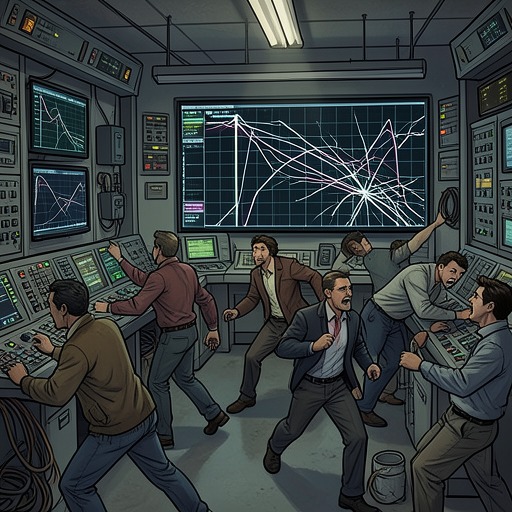
The blackout makes the abstract problem tangible to Kurt Wallander. Revisiting his notes, he considers the power substation as the centre of the case: the disruption of power across large parts of southern Sweden could be understood as sabotage. He also links the removal of Tynnes Falk’s body to the electrical relay placed on the gurney. In Wallander’s reasoning, that deliberate pairing was meant to make the connection between Sonja Hökberg’s fate and Falk unmistakable. The act thus points beyond a concealed crime toward a demonstration of how vulnerable the power system is.
The same vulnerability appears in a quieter encounter with Hansson. At a cash machine, Hansson admits he has little idea how the machines work and imagines a person inside counting out the notes. Wallander recalls Erik Hökberg’s warning about society’s vulnerability; the recent blackout has given that warning practical force. The contrast is pointed: the machine is familiar enough to feel ordinary, yet its operation remains opaque to the people who depend on it.
Falk and Carter’s electronic vision
The novel traces the larger threat to conversations between Falk and Carter during long nights in Africa. Falk explains the electronic world in which he works, and Carter comes to see control of electronic communication as a route to control more broadly. Their discussions turn warfare away from conventional weapons and toward computer viruses, electronic signals, and the networks that carry them. In their imagined future, digital attacks could disable an opponent’s weapons, stock markets, or telecommunications.
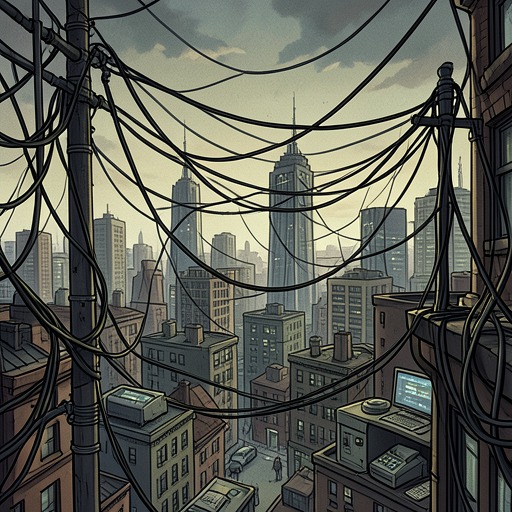
The image of fibre-optic cables entangling the world like a web gives their thinking a physical dimension: distant institutions are joined by systems that can also transmit an attack. Falk and Carter agree to wait rather than act hastily, treating patience as part of their plan. The danger lies not only in a single system’s weakness but in the reach and interconnection that make electronic disruption consequential across many systems.
The breach in Ystad
The threat becomes immediate when Carter sees a signal indicating that someone has broken through the first layer of security on Falk’s computer in Ystad. Falk had assured him that the system could not be penetrated, but the breach shows that even a carefully defended network is not invulnerable. Carter knows that the computer has further layers, with decoys and firewalls protecting its inner core, yet the attempt to enter it has already begun.
Carter’s alarm also exposes a second vulnerability: the security of the system depends on assumptions about who can reach it and how well its defenses will hold. After hearing of Falk’s death, he had sent someone to Ystad. The episode therefore joins the novel’s local investigation to its broader concern with electronic intrusion: the small town and the computer at its centre are part of the same connected world in which a breach can carry consequences far beyond its point of origin.
Significance
The concept links two scales of risk. Wallander sees how a physical power substation can be made the focus of sabotage; Carter and Falk imagine electronic attacks directed at weapons, markets, and communications. Hansson’s uncertainty about the cash machine supplies the everyday counterpoint: people rely on systems they cannot readily see or understand. The novel presents that dependence not as proof that catastrophe is inevitable, but as the condition that makes disruption possible and difficult to grasp until ordinary systems fail.