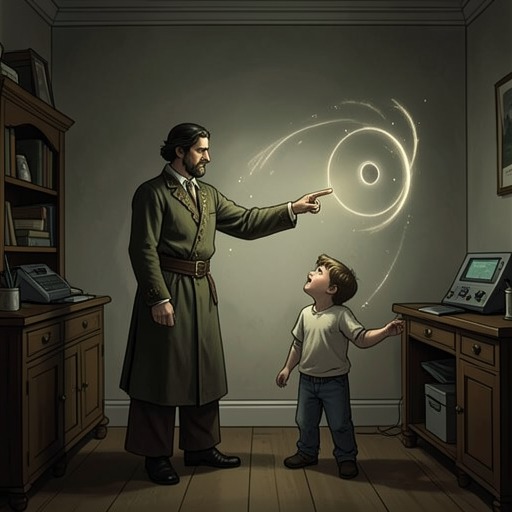
The Square’s Attempt to Teach His Grandson Three Dimensions
FlatlandThe Square’s Attempt to Teach His Grandson Three Dimensions is the first, unsuccessful test of whether the Square can transmit the Sphere’s revelation to another inhabitant of Flatland. It turns the promise of a new disciple into a scene of retreat: under a Council proclamation criminalizing revelations from another world, the Square chooses his young Grandson as a seemingly safe pupil, only to find that the crucial direction, “Upward, not Northward,” resists both explanation and demonstration. The movable Square in his hands becomes an emblem of the gap between possessing an experience and being able to make it intelligible to someone who has not shared it.
Background and the Threat of the Proclamation
The episode opens after the Square has awoken from his encounter with the Sphere and formed an ambitious plan to spread the Gospel of Three Dimensions throughout Flatland. He imagines proclaiming it even to Women and Soldiers, beginning with his Wife. Before he can act, however, a herald in the street calls for silence and recites the Council’s Resolution: anyone who perverts the people’s minds with delusions or claims to have received revelations from another world is liable to arrest, imprisonment, or execution. The lesson is therefore not simply a private experiment in geometry; it takes place under a public threat that makes the transmission of the revelation politically dangerous.
The Square decides to avoid mentioning the revelation and rely instead on demonstration. He takes “Upward, not Northward” as the key to the proof, remembering that the idea had seemed clear before sleep and as obvious as arithmetic when he first awoke. Yet, as he considers teaching it, its apparent clarity fades. The phrase remains the intended route into the concept, but the Square already senses the difficulty of converting a vision into a proof that another Flatlander can follow.
Choosing a Pupil
The Square rejects his Pentagonal Sons as unsuitable students. They are men of standing and reputable physicians, but not strong mathematicians; more importantly, he fears their reverence for the Circles might outweigh their affection for him. If they heard him seriously defend the Third Dimension, they might feel obliged to report him to the Prefect. His choice of pupil is thus shaped both by aptitude and by the danger of betrayal.
He settles on the youngest Grandson, an unusually intelligent, mathematically inclined Hexagon whose casual comments about the meaning of 3^3 had earned the Sphere’s approval. Because the boy is young and, the Square assumes, unaware of the Council’s proclamation, he seems safer than his adult sons. The decision also links the lesson to an earlier exchange: the Square recalls that the Grandson had already raised the possibility that a Square might, through motion “Upward, not Northward,” produce another kind of figure. What had been a child’s speculative remark now looks to the Grandfather like a possible opening for instruction.
Before calling for the boy, the Square attends to his Wife’s curiosity about the Sphere’s mysterious visit and how the Circle entered the house. He gives her an elaborate account that he admits is not entirely consistent with the truth, but persuades her to return to her household duties without mentioning the World of Three Dimensions. His concealment shows how the Council’s decree has already altered his conduct: even within his household, he withholds the subject he hopes to teach.
The Lesson and Its Demonstration
When the Grandson arrives, the Square carefully secures the door. Sitting beside him with their mathematical tablets—Lines, in the terminology of Spaceland—he begins with familiar steps: a Point moving in one Dimension produces a Line, and a straight Line in Two Dimensions produces a Square. He then turns the boy’s earlier suggestion back on him, laughing as he asks him to repeat the idea that a Square might move “Upward, not Northward” to produce another figure in Three Dimensions. The lesson is framed as playful teasing, but the locked door and the Square’s concealed purpose give the exchange a seriousness the boy soon detects.
The street interrupts them again. The herald’s “O yes! O yes!” announces the Council’s Resolution, and the Grandson listens until the proclamation is over. Although young, he understands the danger with an acuity that surprises his Grandfather. He bursts into tears and denies that he meant anything by his earlier suggestion: it was only a joke, he says, and he knows nothing of the new law. He also disavows having said anything about the Third Dimension or “Upward, not Northward,” insisting that such a claim would be nonsense. The boy’s response changes the lesson from an attempt at mathematical instruction into a wary act of self-protection.
The Square loses his temper and tries to answer with an object. He takes up a movable Square lying nearby and announces that he will move it not Northward but Upward. Yet the demonstration falters as soon as it begins. He can say that he will move the figure somewhere, but cannot make the motion resemble the movement he means; instead, he shakes the Square about in a purposeless manner. The Grandson laughs louder, concludes that his Grandfather is joking rather than teaching, unlocks the door, and runs out. The intended first disciple leaves unconvinced, and the Square’s first attempt to convert a pupil ends in failure.
Spatial Knowledge and the Limits of Explanation
The failed lesson replays, in miniature, the central problem of the Square’s own education. When he tried to explain a direction beyond Lineland, words proved insufficient; the Sphere had to move out of the King’s Line, disappearing from the King’s view before explaining that he was in true Space. The King interpreted the disappearance as death because his world offered no means to perceive the movement. The Square’s lesson reverses the positions: now he has encountered a higher-dimensional reality, but his pupil remains confined to the concepts and directions available in Flatland.
The Sphere’s earlier account supplies the geometric basis the Square hopes to pass on. Flatland is a plane, while a three-dimensional solid appears there only as a section; the Sphere describes himself as an infinite series of circles of varying sizes, and says that a Spacelander can see the interiors of houses and creatures by rising above the plane. In the later lesson, however, the Square has only a movable Square and his words. He cannot enact the essential motion in a way the Grandson can recognize. His failure therefore exposes a distinction between seeing a higher-dimensional truth and possessing a reproducible demonstration of it within Flatland’s spatial limits.
The episode also contrasts the Square’s elevated experience with the practical reach of political authority. His intended proof rests on a new spatial possibility, but the Council’s decree is audible in the street and immediately shapes what the Grandson dares to say. The call to silence interrupts the lesson at the precise point when mathematical speculation might become dangerous. The child’s retreat and the Square’s failed gesture show that an idea does not travel by proof alone: the available language, the limits of perception, and the risks imposed by authority all determine whether it can be communicated.