The Square’s Vision of Lineland
FlatlandThe Square’s Vision of Lineland is Square’s dream encounter with the King of Lineland, a ruler whose entire world is one Straight Line. Square can leave that line, see its inhabitants from outside, and return; the King interprets these demonstrations as tricks and rejects the possibility of a second direction. The encounter makes dimensional limits tangible through a clash over what can be seen, named, and proved—and foreshadows Square’s later difficulty accepting a reality beyond his own plane.
The Dream and Its One-Dimensional World
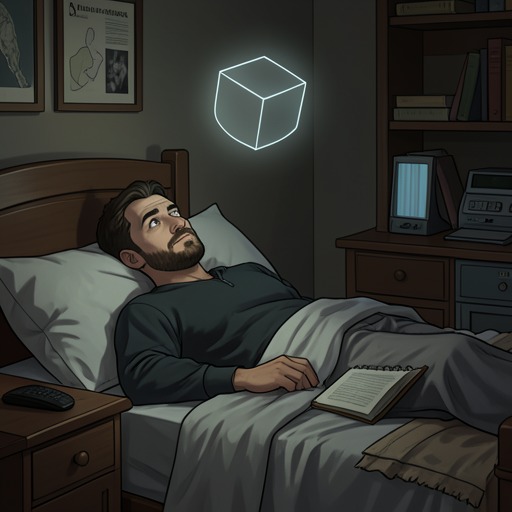
The vision comes on the night before the last day of the 1999th year, at the start of the Long Vacation. Square has spent a late hour on Geometry with an unsolved problem still in mind when he falls asleep. In the dream, he sees a multitude of small Straight Lines and still smaller, lustrous points moving along one line at what seems to be the same speed. Their movement produces intermittent chirping; when they stop, silence falls. Assuming the Lines are Women, Square approaches one of the largest and receives no answer.
His first attempt to speak fails, and impatience leads him to put his mouth directly in front of the Line’s mouth, interrupting her movement so she can hear him. He asks what the gathering, the confused chirping, and the monotonous motion along a single Straight Line mean. The figure answers that it is no Woman but the Monarch of the world, and asks how Square has entered the realm of Lineland. Square apologizes for startling or molesting the ruler and identifies himself as a stranger, but finds it difficult to obtain information: the King repeatedly assumes that anything familiar to him must also be familiar to his visitor.
The King’s world does not merely lack a second direction; to him, nothing beyond his Line exists. He cannot move or see except along it, and cannot conceive of anything outside it. Square’s first voice had reached him as an inexplicable sound, apparently from his own interior. Until Square places his mouth within the King’s world, the ruler can neither see nor hear him as an external being. Beyond the Line is not even a blank, since a blank would still imply space: it is, for the King, nonexistent.
A Dispute About What Can Be Known
Square tries to explain his own knowledge by asking how the King distinguishes the shapes and positions of his subjects. He says that, before entering the realm, sight allowed him to recognize Lines and Points and to distinguish larger Lines from smaller ones. The King dismisses this as impossible. In his account, the difference between Line and Point can be detected through hearing, and his own shape can be established in the same way. He calls himself the longest Line in Lineland, over six inches of what he insists is Space. When Square suggests the word length, the King rebukes him: space, in Lineland, is length.
The King can confirm the number and sex of the people Square claims to have observed, but rejects the account of how Square acquired that knowledge. Right and left have no meaning for him; he interprets them as Northward and Southward. Square insists that, in addition to motion north and south, he can move from right to left. Asked to demonstrate, he explains that he cannot do so without stepping out of the Line altogether. The King treats leaving his Line as leaving the world and space themselves.
Square states the dimensional difference directly: the King’s space is only a Line, whereas true space is a Plane. Yet verbal explanation cannot give the King an experience of the direction Square names. When Square asks whether the King has ever wanted to move toward what might be called his side, rather than toward one of his extremities, the ruler says never. The King cannot make sense of an inside facing in any direction, or of movement toward it. The disagreement is not simply a failure to find the right words; the King’s experience supplies no place for the distinction those words describe.
The Demonstration and Its Rejection
Conceding that words have failed, Square decides to demonstrate the other direction by moving out of Lineland. He begins to move his body away from the line. While any part of him remains within the King’s dominion and view, the King continues to insist that he sees Square and that Square is not moving. Once Square has entirely left the Line, the ruler cries that the visitor has vanished and died.
Square answers that he is alive, merely outside the Straight Line the King calls space and within the true space from which the Line can be seen. From there, Square can observe the King’s side or inside, as well as the Men and Women to his north and south. He enumerates their order, sizes, and intervals, then re-enters Lineland and resumes his former position. The physical demonstration gives the reader a clear account of the difference between the worlds: Square can see the Line and its arrangement from beyond it, while the King can perceive only what remains within his own domain.
But the King does not accept the demonstration as evidence of another Line or another motion. He argues that Square has neither moved in the direction he claims nor described a new world lucidly; instead, he has performed an act of vanishing and return and recited facts about the King’s retinue that any child in the capital would know. The King demands that Square either acknowledge his folly or leave the dominions. What appears to Square to be a decisive proof is absorbed into the King’s existing explanations, which preserve the Line as the only possible space.
The Dream’s Reversal and Ending
Frustrated, Square turns the King’s certainty against him. He calls the ruler imperfect and imbecile, saying that the King sees no more than a Point even as he prides himself on inferring a Straight Line. Square contrasts his own ability to see Lines and infer Angles, Triangles, Squares, Pentagons, Hexagons, and Circles with the King’s restricted perception. He identifies himself as a Square, a Line of Lines, and explains that even he is of little account among the nobles of Flatland. The visitor who had entered as a stranger now claims superiority through the larger world he can see.
The claim provokes a threat rather than comprehension. The King advances as if to pierce Square through the diagonal, while the voices of the subjects gather into a rising war-cry. Square is spellbound and cannot move or speak. The imagined uproar grows until it seems to rival the roar of an army of a hundred thousand Isosceles and the artillery of a thousand Pentagons. At the point when the threatened violence is imminent, the breakfast bell wakes Square and returns him to the realities of Flatland. The vision ends not with the King persuaded, but with Square’s attempted lesson collapsing into danger and awakening.
Dimensional Irony and Its Larger Echo
The dream reverses the relation between teacher and student that will shape Square’s later encounters. In Lineland, Square knows that the King’s world is only one-dimensional and tries to enlarge his understanding by moving beyond its boundary. Yet the King’s refusal is structurally familiar: he judges every claim by the senses and concepts his world has made possible. Square can show him something the King cannot perceive from within the Line, but the demonstration cannot itself supply the missing dimension of experience.
That impasse anticipates Square’s encounter with Sphere. Sphere later explains that Flatland, like Lineland, cannot represent a higher-dimensional being in full: a Sphere passing through a plane appears to its inhabitants only as a changing circular section. The dream therefore does more than introduce Lineland as a curious miniature world. It places Square on the side of the higher-dimensional visitor and exposes the limit of his confidence that a demonstration must convince anyone who sees it. When Square later struggles to understand a dimension beyond his own, the King’s certainty becomes an uncomfortable precedent for his own resistance.