Dan
FosterDan is the girl’s father, yet his place in her life is marked by a painful distance between kinship and care. He brings her to stay with the Kinsellas and eventually returns to collect her, but the girl remembers that he leaves without a goodbye and has never once held her hand. In her account, his gestures of provision and praise coexist with absences that she cannot overlook; by the end, her attachment to the people who have minded her has become part of how she understands him.
Identity and Introduction
Dan first appears through the girl’s view from the back seat as he arrives at the Kinsellas’ house. His greeting to John Kinsella is brief, and the men move into familiar topics: rain, the fields, cattle prices, and the cost of farm supplies. The girl recognizes this conversational routine as a way men avoid speaking directly, occupied instead with spitting, kicking at the grass, or slapping the car roof. Dan is present in this social exchange, but the scene offers little emotional communication between him and his daughter.
At the house, Dan’s conduct is observed closely by the girl. As John Kinsella lays out plates, cutlery, beetroot, sandwich spread, salad cream, tomatoes, onions, bread, and cheddar, Dan watches him. When the conversation turns to Mary, Dan answers that she is well. The meal is outwardly ordinary, but the girl is already caught between wanting her father to leave her there and wanting him to take her back to what she knows. She cannot yet settle into either identity: the child she has been at home or someone she might become in this household.
The girl also notices Dan’s tendency to lie about things that would be pleasant if true. At the Kinsellas’ table he speaks of a plentiful hay harvest and a loft filled to capacity, though the narration explicitly questions the truth of this account. His optimism is not presented as a reliable report of circumstances; it is a recognizable habit of making things sound better. That habit sits beside the girl’s wish to be outside working rather than sitting still, and underlines how little her inward unease is addressed during the visit.
The Summer Placement
Dan frames the placement in practical terms. He tells the Kinsellas that the girl will eat a great deal but can be put to work. John Kinsella rejects that expectation, saying she will only need to help Edna Kinsella around the house; Edna echoes the welcome and says the girl is welcome there. Dan responds by joking that she will eat them out of house and home, then adds that he expects no complaint about it a year later. The exchange makes visible a difference in how the adults imagine the child’s stay: Dan speaks of her appetite and usefulness, while the Kinsellas offer hospitality without making farm labor her condition of welcome.
When Dan leaves, he puts rhubarb on the back seat, gets behind the wheel, and starts the engine. His parting words wish the Kinsellas luck and express hope that the girl will cause no trouble; to her, he adds a warning not to fall into the fire. Then he reverses, turns into the lane, and drives away over the cattle grid. The girl hears the gears change and the motor recede along the road. What she notices most is what he does not do: he gives no goodbye and never says that he will come back for her. The sudden loss of his presence makes the yard feel cooler to her, and she is left with the unanswered question of why he departed so abruptly.
Absence and Contrast
The girl’s experience of care at the Kinsellas’ house gives her a physical comparison for what she has not received from Dan. On a walk with John Kinsella beneath a bright moon, Kinsella takes her hand. The touch immediately brings to mind that Dan has never held it. She initially wants Kinsella to let go, because feeling the difference is hard, but as they continue walking she begins to accept that her life there is not the same as her life at home. Kinsella adjusts his steps so they can walk in time. The detail makes care legible through a small act of accommodation, in contrast to the remembered absence of a comparable gesture from her father.
The girl does not describe this difference as a simple rejection of Dan. Her response to the handholding is unsettled: she wants to escape the feeling even as she recognizes what it means. The narration keeps both impulses in view, showing how attachment can involve discomfort as well as comfort. Later, when she walks hand in hand with Edna, she imagines that Edna would tip over without her and wonders how she manages when the girl is not there. The girl’s thought reverses the expected direction of dependence: she understands herself not only as someone being cared for, but as someone whose presence matters to the person caring for her.
Return and Final Encounter
When the Kinsellas bring the girl home, John praises her to Mary as a credit to her and tells the girl to keep her attention on her schoolbooks, hoping to see gold stars in her copybooks next time he visits. He kisses her; Edna hugs her. The girl watches them get into the car and senses that John is more eager to leave than he had been on arriving. Dan is not present in this exchange, but its attention to welcome, touch, and the promise of another visit continues the contrast that shapes the girl’s understanding of family.
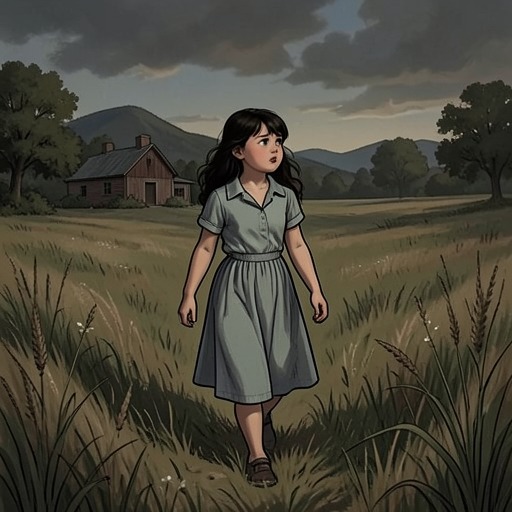
After the car has gone, Mary asks what happened. The girl says nothing and understands that she does not have to disclose what she has experienced. As she holds to that silence, the car brakes on the gravel and a door opens. Without having to think about it, she runs down the lane. Her mind flashes through particular fragments of the summer—the boy in the wallpaper, gooseberries, the bucket pulling her under, the lost heifer, the weeping mattress, and the third light—before she sees John at the gate. He has stopped to close it. She runs into his arms, and he holds her tightly; her heart and breathing settle there. These actions belong to the girl’s reunion with John, not to a return to Dan, and they reveal how strongly her emotional life has become bound to the Kinsellas’ care.
Only after the embrace does the girl see Dan coming along the lane with his walking stick. She holds on to John as if letting go would mean drowning and hears Edna sobbing and crying. She wants to get down and reassure Edna that she will never tell, but something deeper keeps her in John’s arms. Her repeated call to Dan as Daddy is therefore inseparable from the scene’s divided attachments: her father is approaching, yet the person she runs toward and clings to is John. The ending gives Dan a presence in the girl’s awareness without making him the center of her homecoming.
Narrative Role
Dan’s characterization is built from a limited set of concrete actions and remembered omissions rather than from an explanation of his motives. He transports the girl to the Kinsellas, speaks about her in terms of appetite and work, leaves without promising to return, and later participates in her homecoming. The narrative does not supply enough to resolve why he leaves as he does or what he understands about her inner life. Instead, it lets the girl’s observations—the doubtful hay story, the departing car, and the memory of an unheld hand—give emotional weight to his role.
The final scene brings that role into sharp relief through movement and touch. Dan walks toward the girl, but she has already run to John and remains held in his arms. Her call to her father coexists with her refusal, in that instant, to let go of the person who has cared for her. Dan thus embodies the limits of biological belonging in the novel’s account of the girl’s summer: he is unquestionably her father, but the meaning of family is also formed through welcome, daily attention, and the bodily gestures she remembers.