Unnamed girl
FosterThe Unnamed girl is the first-person narrator and central figure of a summer spent away from her family, in the care of John Kinsella and Edna Kinsella. The placement changes her sense of what care and belonging can feel like: she is welcomed into a household that attends to her needs, and her attachment to it becomes clearest when she must leave. Her story is shaped as much by what she withholds as by what she says, culminating in a silent reunion with John Kinsella that makes her emotional choice visible without explaining away its mystery.
Identity and Arrival
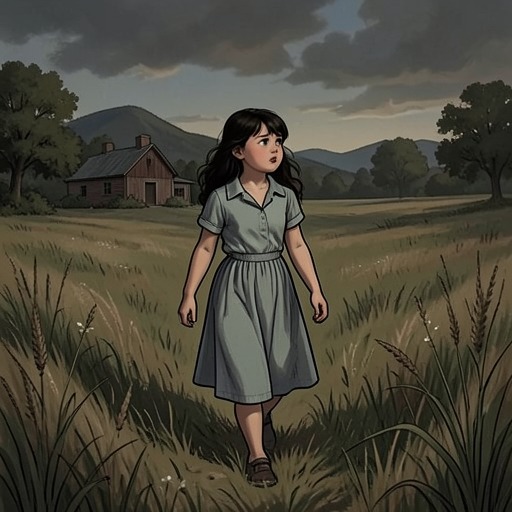
The Unnamed girl begins the journey on a Sunday after Mass in Clonegal, when Dan drives her through Wexford toward the coast, where Mary’s family came from. From the back seat, she watches the sky and trees and imagines what life with the Kinsellas might be. Her visions pull in opposite directions: Edna Kinsella might be a generous figure who offers hot milk or another pancake, while John Kinsella might take her to town for red lemonade and crisps—or set her to work cleaning sheds and clearing weeds. Even before she arrives, the girl measures the unknown household against the possibilities of comfort, labor, and being looked after.
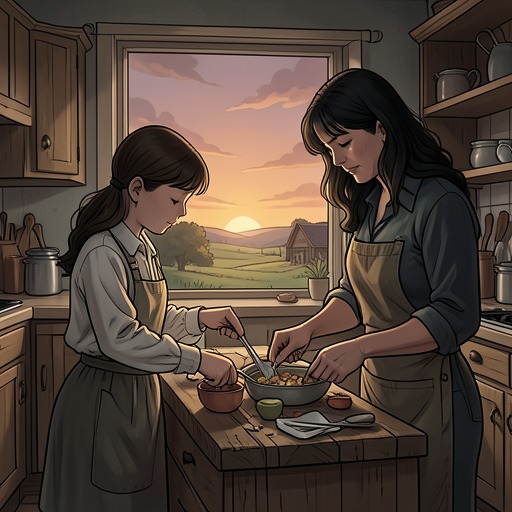
The road passes through Shillelagh and Carnew, places associated in her mind with Dan’s lost heifer, before the car enters a narrow lane and crosses a cattle grid to reach the long white house. These details give her arrival a particular geography, but her attention is also fixed on domestic uncertainties: whether the house will be old or new, whether it has an indoor bathroom, and whether she will sleep among other girls. Inside, the warm kitchen smells of baking and cleaning; Edna Kinsella brings out a rhubarb tart, and the girl notices that there is no sign of a child in the house. Her first impressions thus combine welcome with the awareness that she has entered a household organized around adults and a loss she does not yet understand.
Care and the Making of Belonging
The adults’ agreement that she may stay establishes an important contrast with Dan’s joking concern that she will eat too much or could be put to work. John Kinsella says she will have no more to do than help Edna Kinsella around the house, and Edna Kinsella confirms that the girl is welcome. The arrangement is expressed not as a bargain for her labor but as an offer of care. At the meal, the girl watches Dan serve beetroot with his own fork, staining the ham, while the family eats through a patch of silence. The domestic scene gives the farewells and assurances a material setting: food is shared, but the ease of belonging has not yet arrived.
When Dan drives away, he offers no goodbye and does not tell her when he will return. He also leaves without her belongings. His final warning is to try not to fall into the fire, a careless-sounding remark that leaves the girl confronting the departure without reassurance. Edna Kinsella recognizes that the forgotten clothes explain her distress, and John Kinsella promises that they will get her supplied. Their practical response does not undo the hurt of Dan’s leaving, but it turns immediately toward meeting the child’s needs. Edna Kinsella takes her in for a bath, and the girl’s arrival is marked by being cleaned and given different clothes rather than by any demand that she explain herself.
The well becomes another occasion on which care is joined to the girl’s changing sense of home. Warned that the water is deep, she drinks six ladlefuls, finding it cool and clean and associating its taste with Dan’s departure and the emptiness left by it. She wishes that this place, without shame or secrets, could be her home. When Edna Kinsella pulls her back to safety and descends alone, the girl then walks back through the fields holding her hand. She imagines that Edna Kinsella would tip over without her and wonders how she manages when the girl is absent. The child’s fantasy reverses the usual direction of care: having been looked after, she imagines herself necessary to the adult who cares for her.
Relationships and Emotional Attachment
The girl’s bonds with John Kinsella and Edna Kinsella develop through different gestures, but both are conveyed in everyday acts rather than declarations. At night, Edna Kinsella does not make her kneel to pray; instead, she tucks her in and leaves the choice of prayer to her. The girl is offered room to keep her own habits, just as she is allowed to remain in the bright light rather than have a blanket hung to darken the room. Such small accommodations make care feel attentive rather than imposed.
John Kinsella’s relationship with her is marked by playful encouragement and physical gentleness. When the girl says she does not know whether she will marry and recalls Mary’s warning not to accept a man as a present, John Kinsella answers with a joke about how fast a man would have to be to catch her. He turns the exchange into a promise to try again at running the next day. The teasing treats her as a person with a future, while keeping the conversation light enough not to force a decision from her.
A nighttime walk to the sea makes the difference between the girl’s two homes bodily immediate. Edna Kinsella warns John Kinsella to be careful with the girl and to take a lamp, which he accepts despite questioning whether it is needed. Under the moon, John Kinsella takes the girl’s hand. She realizes that Dan has never once held it; at first, she wants John Kinsella to let go so she will not have to feel the contrast. As they walk, his small steps keep time with hers, and she gradually settles into the difference between her life at home and her life with the Kinsellas. The affection is not presented as an abstract promise: it is a hand held, a pace adjusted, and a child given time to become comfortable with the feeling.
Silence, Departure, and Ending
The girl is described as quiet and as saying only what she has to say. That quality matters at her departure, when John Kinsella praises her to Mary and tells the girl to keep her attention on her schoolbooks. He kisses her, Edna Kinsella hugs her, and the couple drive away. When Mary asks what happened, the girl answers that nothing happened. The narration makes clear that this is not simply a failure to find words: she has learned enough to understand that she does not need to mention what happened. Silence becomes a decision, although the story does not disclose everything that decision protects.
The car’s return overturns the apparent finality of the departure. As soon as she hears it braking on the gravel, the girl runs down the lane toward John Kinsella. Her mind flashes through fragments of the summer—the boy in the wallpaper, gooseberries, the bucket pulling her under, the lost heifer, the weeping mattress, and the third light—before narrowing to the present. At the bend she sees John Kinsella closing the gate, his eyes lowered toward his hands. When he sees her, he stops; she keeps running, reaches him, and is lifted into his arms. The long embrace steadies her racing heart and breath, while the first raindrops begin to fall through the trees.
The ending holds two family relationships in the same frame without making them equivalent. Over John Kinsella’s shoulder, the girl sees Dan approaching with his walking stick. She clings to John Kinsella as if letting go would mean drowning and hears Edna Kinsella crying. Part of her wants to get down and promise Edna Kinsella that she will never tell; something deeper keeps her in John Kinsella’s arms. She calls out to Dan as Daddy, repeatedly, but does not release her hold. The reunion does not resolve the tension between her birth family and the home where she has been cared for. Instead, her body makes the attachment plain while her words remain guarded. The final scene brings together the narrative’s recurring contrasts—silence and speech, separation and contact, vulnerability and shelter—and leaves the girl’s strongest expression of belonging in the embrace she chooses not to end.