Mary
FosterMary is the narrator’s mother, seen chiefly through her daughter’s memories and the homecoming that ends the summer with John and Edna Kinsella. She is nearing childbirth, caring for a crowded household with limited resources, and separated from her daughter while the girl stays with the Kinsellas. Her significance lies partly in what the child remembers of her care, and partly in the contrast between that familiar family bond and the new sense of safety formed elsewhere. When Mary asks what happened after the girl comes home, the answer is silence: the daughter has learned that love and disclosure do not always coincide.
Identity and circumstances
Mary is referred to as the narrator’s mother, and the child’s early memories place her in the physical intimacy of ordinary care. On the morning of the girl’s departure, Mary’s hands pull a comb through her hair as she makes tight plaits. Her pregnant belly presses against the child’s back; the memory also includes clean pants packed in the suitcase. These details make the separation tangible without suggesting that Mary is indifferent to her daughter. The girl carries with her evidence of maternal attention even as she leaves the household.
Mary is close to the end of her pregnancy during the summer. When Edna Kinsella asks about her, Dan says she is coming near her time and refers to the youngest baby as hardy. The exchange places Mary within the continuing demands of pregnancy and childcare, while her daughter is being welcomed into another home. The text gives no account of Mary’s private response to the arrangement, so her feelings about the separation remain unstated rather than settled by the child’s interpretation.
The family’s finances are strained. Dan tells Edna that Mary has not enough money to pay the man who cuts the hay, and that she had only just paid him for the previous year. Mary’s circumstances are thus conveyed through another person’s explanation, not through a direct account from her. The girl also knows that the hay has not been cut, though she suspects Dan of lying about it. The gap between the practical difficulty and her father’s preferred version of events complicates the information she receives about home and sharpens her awareness of what is left unsaid within the family.
Care remembered and contrasted
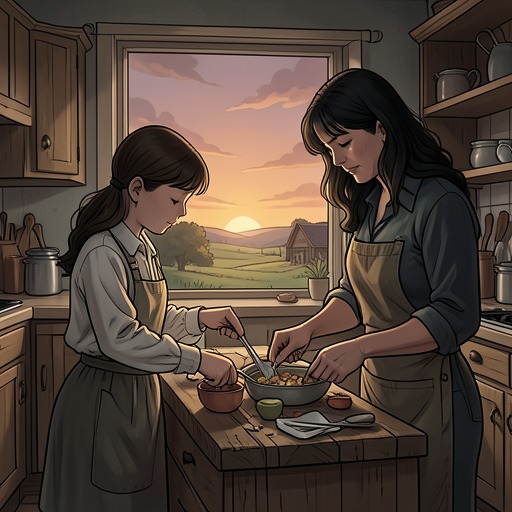
The girl remembers that Mary bathes the children with very little water and makes them share it. At the Kinsellas’ house, Edna gives her a much more thorough bath: the girl sits in deeper water while Edna scrubs her feet, removes dirt from beneath her nails with tweezers, washes her hair, and soaps her body. The child recognizes that Edna’s hands resemble Mary’s, yet she feels something new in Edna’s way of caring for her, something she cannot name. The comparison does not erase Mary’s place as her mother; it makes the difference between the two households legible through the child’s body and through the practical conditions of their care.
The girl’s attachment to Edna develops through shared routines as well as moments of tenderness. She helps with housework throughout the day: storing food in the freezer, vacuuming, digging potatoes, making coleslaw and loaves, and bringing in laundry. Edna works steadily without rushing, while John comes in to make tea before returning to his work. In a separate memory, the girl walks back from the well holding Edna’s hand and imagines that Edna would tip over without her. She cannot recall another time she felt that way. This new, reciprocal feeling of responsibility shows how belonging is being formed through companionship and everyday work, not through kinship alone.
Separation and return
The girl’s first departure from home is marked by her memory of Mary’s hands, the clean clothes in her suitcase, and the uncertainty around the letter associated with the arrangement. Later, the girl reflects that her mother bathes the children in the little water available. These recollections accompany her growing recognition that the Kinsellas’ home offers a different kind of attention. On a night walk with John, she notices that her father has never held her hand, a contrast that unsettles her before she gradually accepts the difference between her life at home and her life with the Kinsellas. This observation concerns her father directly, but it also places Mary’s household within the emotional background against which the girl experiences care elsewhere.
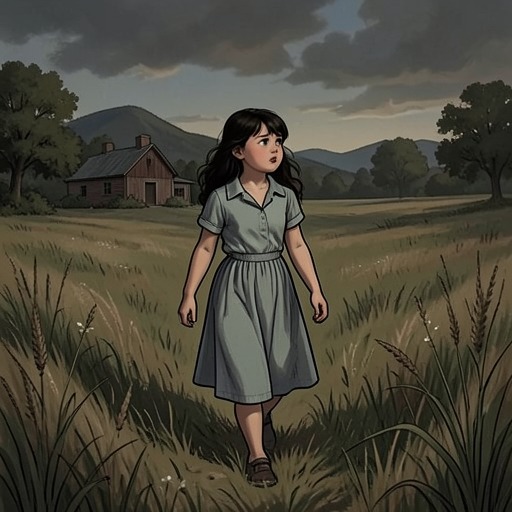
After the girl falls into the well, Edna gathers her up, remakes her bed, and keeps her upstairs the next morning with hot drinks made with lemon, cloves, and honey, along with aspirin. John calls it a chill; Edna voices her fear about what might have happened. The girl is taken home on the Sunday evening, after the recovery period at the Kinsellas’ house. Mary is there with the younger child in her arms. The family home feels damp and cold to the returning girl, and dirty footprints mark the lino. Mary looks at her and says she has grown. The child agrees, a brief exchange that registers a change Mary can see even though the summer’s meaning is not yet spoken between them.
Silence and the relationship’s unresolved end
After John and Edna have left, Mary asks what happened and presses the girl to tell her. The child answers that nothing happened, then repeats the denial. This is not presented as a failure to remember: the girl understands that she has learned enough to know she need never mention what happened. Her silence becomes a deliberate boundary around the summer, especially around the well and the experiences she associates with the Kinsellas. Mary’s questions establish her wish to know; the girl’s refusal means that the most consequential part of the separation cannot simply be carried back into conversation at home.
Before leaving, John calls the girl a credit to Mary and encourages her to keep her head in the books, asking to see gold stars in her copybooks on his next visit. Edna says the girl is welcome again at any time. These words connect the two households without making them interchangeable: the child is Mary’s daughter, yet she has also acquired a place with the Kinsellas that remains open beyond the summer. Mary is not shown responding to John’s praise, and the narrative does not say what she makes of the child’s silence. Her role at the ending is instead defined by the question she asks and the knowledge her daughter chooses to keep from her. Through that uneven exchange, Mary remains central to the story’s distinction between the family one returns to and the care one has learned to miss.