Edna Kinsella
FosterEdna Kinsella becomes the girl’s principal source of care during her summer in the Kinsella household. She receives a child arriving in thin clothes and dusty sandals, then gives her practical attention, patient companionship, and a sense of welcome that contrasts with the girl’s life at home. Her care is not abstract: it is made of baths, meals, shared work, hands held on a country path, and an open invitation that continues beyond the summer.
Identity and Arrival
Edna is introduced as a tall woman with black hair cut close around her head, wearing a printed blouse and brown flared trousers. She comes out to meet the girl, kisses her, and recalls that the last time she saw her, she was in a pram. When the girl explains that the pram is broken because her brother used it as a wheelbarrow and one wheel fell off, Edna laughs and gently wipes something from the child’s face. The girl notices the softness of her thumb and, looking at her own thin cotton dress and dusty sandals through Edna’s eyes, becomes conscious of how she has arrived.
Edna leads the girl into the house and, when the child hesitates in the dark hallway, hesitates with her rather than hurrying her along. The kitchen offers a strong first impression of warmth and order: baking and disinfectant mingle in the air, a rhubarb tart cools on the bench, and tall daisies stand in a glass of water. Yet there is no visible sign of a child in the house. The welcome is personal, but the home also carries an absence that the girl does not initially understand.
The question of whether the Kinsellas will keep the child is treated by Dan as a practical arrangement, including whether she will eat heavily or be useful. Edna answers this calculation with an unqualified welcome: the girl is gladly received and may help her around the house, but John Kinsella makes clear that she will not be expected to do more than that. Edna’s welcome therefore begins in words, while the household’s daily treatment of the girl gives those words substance.
Care in the Household
Edna’s care first becomes unmistakably physical when she bathes the girl. The water is painfully hot, and the child keeps her foot in it until her response to the scald changes and she can bear it. Edna scrubs her feet, uses tweezers to prise dirt from beneath her nails, washes and rinses her hair, and soaps her all over with a cloth. The girl recognizes something in Edna’s hands that resembles her mother’s touch but also feels new and difficult to name. The scene registers both the discomfort of unfamiliar care and the child’s discovery that care can have a different quality from what she has known.
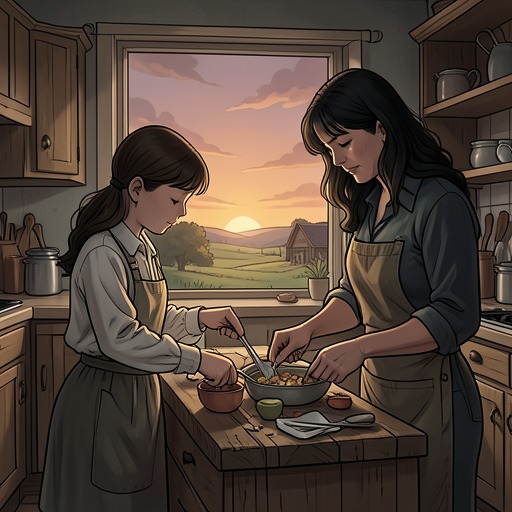
That attention extends into ordinary work. Edna shows her the freezer, where food described as perishable can be stored, and the girl helps make ice cubes, vacuum the floors, dig new potatoes, prepare coleslaw, and bake two loaves. Edna continues through the day without rushing, but without really stopping; she later takes in damp washing and begins ironing. The girl sees this steady labor alongside John’s work and tea-making, learning the household through repeated tasks rather than through explanation. Edna’s domestic world is busy and organized, and the child is included in it as a participant rather than left at its edges.
At the well, Edna warns the girl that it is deep and pulls her back to safety after she has drunk from the water. On the path home, the child holds Edna’s hand and imagines that she herself is keeping the woman balanced, so that Edna would tip over without her. The fanciful reversal reveals how strongly the child has begun to feel their mutual closeness: she experiences being cared for not as a one-way arrangement but as a bond in which her own presence matters. She cannot remember another time of feeling this way, and is both saddened and relieved by that discovery.
Shame, Loss, and Emotional Recognition
Edna’s understanding of care includes a direct challenge to shame. She tells the girl that secrets bring shame and that shame is something the household can do without. When the child takes deep breaths to keep from crying, Edna puts an arm around her and says she is too young to understand. The exchange establishes a promise of openness, although it does not erase the girl’s uncertainty or require her to disclose everything. Its importance lies partly in the contrast with the child’s earlier life, where distress and deprivation have not been met with this kind of reassurance.
A later visit to Gorey exposes another painful difference. After John rebukes the girl for not washing her hands and face before going to town, she freezes, expecting something worse. She runs upstairs, but the bathroom door is locked. Edna speaks from inside and eventually opens it; she has been crying, but is not ashamed of her tears. She apologizes for keeping the child waiting and says it will be good for her to have clothes of her own, adding that Gorey is a nice town and wondering why she had not thought of taking her there before. Her tears and her apology make the moment more than a shopping decision: she has heard the rebuke and responds by recognizing the child’s unmet needs.
The girl later tells John that Edna has explained how their little boy followed the dog into a slurry tank and died, and that the girl wore his clothes to Mass. This disclosure gives the household’s earlier absence a painful context: the kitchen had seemed to contain no sign of a child, while the clothes Edna provides belong to the dead boy. The account does not show Edna explaining her grief directly to the girl, but her care takes place within a home marked by that loss. In the final scene, as John holds the girl, she hears Edna sobbing and crying; the narration connects her grief with the possibility of losing not only the son who died but also the child who has come into their care.
Departure and Continuing Bond
When the girl falls into the well, Edna takes one look at her soaked return and turns very still before gathering her up, bringing her inside, and making up her bed again. The next morning she keeps the girl upstairs and brings her hot drinks made with lemon, cloves, and honey, as well as aspirin. This response is immediate and concrete: Edna attends to the danger and then stays with the child through the following day, even as John calls the illness no more than a chill. The girl’s accident ends her stay earlier than planned, but Edna’s actions show that her responsibility does not stop at the household’s ordinary routine.
Before the girl leaves, Edna says she was welcome and remains welcome again at any time. The invitation makes the summer more than a temporary placement: it gives the child a continuing place in the Kinsellas’ home, even after she is taken back to Mary. At the farewell, Edna hugs her while John kisses her and urges her to keep her head in her schoolbooks. The departure is difficult for the girl, and John seems more eager to leave than he had been on arrival. When he later turns back and embraces her, Edna is present, crying as the child clings to him. Her response holds together affection, grief, and the recognition that the girl’s attachment to the Kinsellas has become real.
Narrative Role
Edna’s significance is conveyed chiefly through the girl’s close attention to gestures and objects: the thumb wiping her face, the cloth and tweezers at bath time, the cooling tart, the work shared across a day, the held hand, the bed remade after the fall, and the clothes of the dead boy. These details let the child register a form of care she initially has no words for. Edna does not simply provide a safer setting; through repeated acts she makes that setting legible as a possible home.
The girl’s account also preserves the limits and tensions of that refuge. Edna’s house is loving, but it is a bereaved household; its welcome cannot prevent the child from being taken home, nor does Edna’s earlier assurance that there are no secrets resolve what the girl will later choose not to say. At the end, the girl keeps silent with Mary about what happened, then runs back to John when he returns. Edna’s place in that ending is expressed through her tears and her embrace: she has helped create a bond that survives separation, even when the child’s final words and actions are directed elsewhere.