The girl’s relationship with Edna Kinsella
FosterThe girl’s relationship with Edna Kinsella grows from a summer welcome into a bond made tangible by daily care. Edna receives a child sent away from home as a guest, but her attention gradually gives the girl a sense of safety and belonging that she has not known. Their connection is expressed less through explanations than through touch, practical work, and repeated acts of looking after one another; when the girl returns home, affection persists alongside the silence she chooses to keep.
First Meeting and Welcome
Edna first appears in the yard after the men have been talking about rain and farm prices. Taller than the girl’s mother, with short black hair, a printed blouse, and flared brown trousers, she comes out without paying heed to the men, opens the car door, and kisses the girl. Edna remembers seeing her in a pram; the girl answers with the blunt observation that the pram is broken. The awkwardness of that exchange gives way to gentler contact when Edna licks her thumb and wipes the girl’s face. The girl notices that Edna’s thumb feels softer than her mother’s, and sees her thin dress and dusty sandals as if through Edna’s eyes. Their first closeness is therefore tender but not effortless: both briefly have nothing to say.
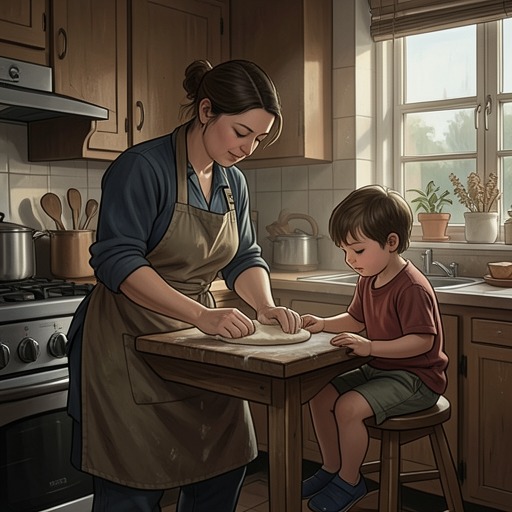
Edna leads her inside and does not hurry her through the dark hallway when she hesitates. In the kitchen she tells the girl to sit and make herself at home. Baking, bleach, and disinfectant mark a house that feels hot, still, and clean; a rhubarb tart cools on the bench, and tall daisies stand in a glass of water. Yet there is no sign of a child in the house. When the girl’s father suggests she can be put to work, John Kinsella rejects that arrangement, and Edna echoes his assurance that the child is welcome. Her welcome is not a bargain for labor: the girl is to help Edna around the house, but is not to be treated as a worker.
Care Made Physical and Everyday
Edna’s care becomes most intimate during the girl’s bath. She takes her to the bathroom, fills the tub, removes her dress, and tests the water; it is too hot, and the girl initially endures the scalding before her perception changes enough to bear it. Edna then scrubs her feet, picks dirt from beneath her nails with tweezers, washes her hair with shampoo from a plastic bottle, and soaps her with a cloth. The girl recognizes something in Edna’s hands that resembles her mother’s touch but also feels new and difficult to name. The bath is more than cleanliness: it is a bodily experience of being carefully attended to, and one that leaves the girl searching for words for this unfamiliar form of tenderness.
That attention continues in the rhythms of the house. The girl and Edna make ice cubes, vacuum the floors, dig new potatoes, prepare coleslaw and two loaves, and take in damp clothes to iron. Edna works without rushing, though neither she nor John Kinsella seems to stop for long. The girl is included in this shared work, and Edna’s household becomes a place where care is both direct and routine. The pattern is not presented as effortless sentiment: the woman has work to do, and the girl joins her in it. But the girl is also able to observe and inhabit the ordinary life of the house, rather than being kept apart from it.
The girl’s first visit to The well makes the relationship’s emotional stakes especially clear. After drinking the cool water, she walks back through the fields holding Edna’s hand. She imagines that she must be balancing Edna, who would otherwise tip over, and wonders how Edna manages when she is not there, concluding that she must usually fetch two buckets. The thought is childlike, but it reverses the direction of care: the girl pictures herself as necessary to Edna. She cannot remember another time she felt this way, and is both sad at that absence and glad not to remember. Her attachment is registered not as an abstract declaration but as a wish to be useful, needed, and present.
Trust, Vulnerability, and Mutual Dependence
Edna’s care also gives the girl a different experience of trust. At bedtime, instead of making her kneel to pray, Edna lets her say her prayers in bed if that is what she usually does. Such small choices distinguish welcome from control: Edna attends to the girl’s habits without insisting that she perform them on command. Earlier, the girl had noticed that Edna and John Kinsella sleep together in a room with a large double bed and felt glad of it. The detail belongs to the child’s effort to read the household as safe and settled, and to understand the place she has entered through what she can see.
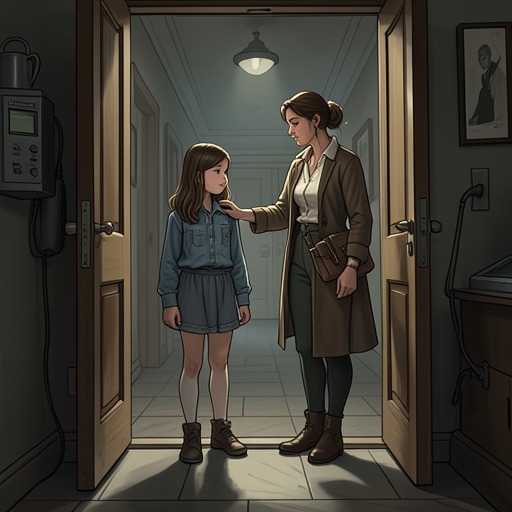
The bond is tested when John Kinsella speaks sharply to the girl about washing before going to town and whether her father taught her to do so. The girl freezes, expecting something worse, and rushes upstairs; the bathroom door is locked. Edna speaks from inside, then opens it after a while. She has been crying, but is not ashamed of it. She wipes her eyes and tells the girl that it will be good for her to have clothes of her own and that Gorey is a nice town, acknowledging that she had not thought of taking her there earlier. Edna’s tears do not erase the girl’s fear, but they reveal that the exchange has affected her too. The subsequent trip offers the girl a first sight of the town’s crowded street and its beach toys, plants, ice cream, and fish seller; John Kinsella gives her money for a Choc-ice. Edna’s recognition of what the girl needs becomes a concrete change in her experience of being cared for.
The child’s attempt to repay that care ends in danger. On the evening she is due to go home, Edna leaves for the milking parlour, and the girl considers fetching water from The well so Edna will have it for tea when she returns. Wearing the deceased boy’s jacket, she takes the zinc bucket down the familiar path, past the cows and electric fences. The water has risen: where she had stood on the fifth step before, she is now on the first, with the water reaching almost to the next. As she lowers the bucket, a hand seemingly like her own emerges from the water and pulls her in. The girl returns soaked. Edna turns very still when she sees her, then gathers her up, takes her inside, and makes her bed again. The next morning she keeps the girl upstairs and brings her hot drinks with lemon, cloves, and honey, as well as aspirin. The accident makes plain both the girl’s desire to care for Edna and the danger of that desire; Edna responds by taking responsibility for her safety and nursing her through the chill.
Parting and the Bond That Remains
The girl is taken home on the Sunday, two evenings after the fall. Before the departure, Edna says that the girl is welcome again any time. John Kinsella praises her to Mary, while Edna hugs her; the girl watches the couple get into the car and feels the departure in the doors closing and the engine starting. Their welcome is explicitly left open, but the immediate separation is real. The girl does not answer her mother’s questions about what happened. She says that nothing happened and understands this as her opportunity to say nothing. The account does not disclose what she means to keep private, and the relationship with Edna is important partly because it gives the girl a place where care need not be converted into an explanation.
After the car has moved away, it brakes on the lane. John Kinsella has turned back and is closing the gate when the girl runs to him and is lifted into his arms. She holds on, and Edna, who has minded her so well, is left beyond that embrace. The girl wants to tell Edna that she will never tell, yet something deeper keeps her clinging to John Kinsella. She sees Edna taking turns between sobbing and crying, as though grieving for two. The final scene does not resolve the girl’s silence or remove the pain of leaving; instead, it sets the physical force of her attachment beside Edna’s visible grief. Edna’s relationship with the girl has made the summer a lived experience of being minded, and its significance continues to register in the girl’s refusal to speak and in the intensity of the farewell.