Fukushima Paradise
GunsoulFukushima Paradise is a nuclear Authority first seen as an overwhelming strike on Battletown and later revealed as Manhattan’s own power. Its significance lies in the contrast between annihilation on a vast scale and the precise, costly resistance mounted against it: the Authority can erase a city and overwhelm Arc’s failing reality, but Arc’s final counterattack breaks its wielder’s core, while Orient’s intervention limits the pollution left behind.
Nature and Revelation
Fukushima Paradise is identified as Czar Zoa’s Authority, a unique power that cannot be copied. When Arc names it after the strike on Battletown, Yuan understands that the revelation also changes who he has been facing: Manhattan is not Czar Zoa’s student but Czar Zoa himself. The Authority is therefore more than a devastating technique. Its singularity exposes Manhattan’s identity and makes the conflict personal in a new way: the power used to devastate Battletown belongs to the same adversary who later confronts Arc.
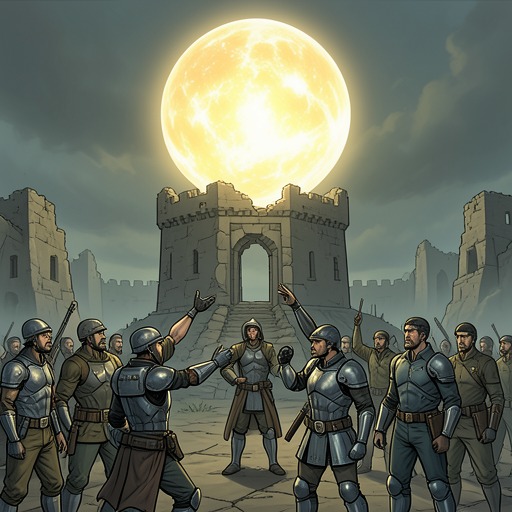
The name is first attached to an attack whose appearance conceals its scale. During the History Road race, a green light silently swallows Battletown; only when a skull-shaped cloud of radioactive dust spreads across the artificial leyline do the racers grasp what has happened. The racing rings go dark and the contestants stop. Where the race had begun amid the conspicuous shock of a nuclear explosion, this strike has no comparable shockwave: its terror comes from its eerie precision and the city-sized crater it leaves behind. Yuan recognizes the destruction as a nuclear cultivator’s Authority, not a loss of control. Coyote runs toward the ruins, but Yuan expects that he will find only death.
Battletown and the Reach of the Strike
The destruction of Battletown establishes Fukushima Paradise as an attack on a place and its inhabitants, not merely a display staged at a safe distance. The strike interrupts the race and replaces its artificial leyline spectacle with a radioactive cloud and the crater where the city stood. Its quiet arrival makes the devastation more disturbing: there is no warning blast to match the damage, only a sudden change in the landscape and the racers’ abrupt realization that the city is gone.
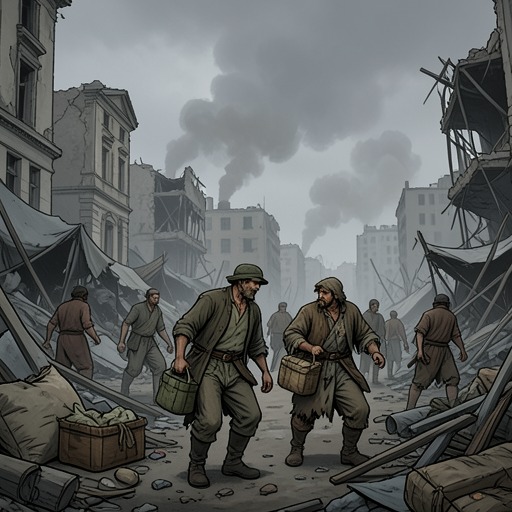
The book places this event in a world where environmental damage already has visible, uneven consequences. Beyond Gatesville, Yuan encounters an old city ruin whose poisonous dust makes him sick and resists assimilation by his bullet-core. In the Thunderlands, radiation has also transformed the region’s caretaker spirit: Holster’s purification restores the spirit’s untainted energies, but its corrupted body sheds centidead maggots and finally disintegrates. These episodes are not presented as effects of Fukushima Paradise itself; they make legible, however, the difference between lingering contamination and the Authority’s sudden nuclear violence. Fukushima Paradise turns radioactive harm into an immediate act of destruction, while other damaged landscapes show how corruption can persist in land and living forms.
Clash with Headshot Forge
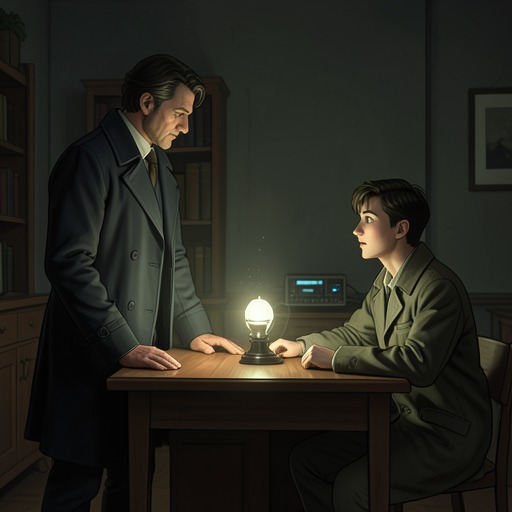
Fukushima Paradise reaches its fullest expression in Manhattan’s confrontation with Arc. As they invoke their competing powers, Manhattan releases radioactive dust and green energy across Yuan’s horizon. Yuan finds the radiance strangely beautiful and comforting, even as he understands that it is consuming the world before him. The Authority’s beauty does not soften its function: its flood swallows the Khan’s corpse, Slash’s sword, and the handgun, leaving none of them behind.
Arc’s Headshot Forge encloses Yuan and shields him from the radiation, but the contest is sharply unequal. Arc’s core is broken and her Authority crippled, while Manhattan’s remains intact; Fukushima Paradise steadily pushes back Headshot Forge’s wavering reality, and cracks spread through both the Authority and Arc’s body. Facing imminent defeat, Arc asks Yuan to end the conflict. She then detonates her own bullet-core. The pulse carries all her life and strength into one final counterattack, pushing back the radioactive light and breaking Manhattan’s manifested core. The opposing Authorities collapse, and Yuan is thrown back into the ruins of Battletown as the old universe reasserts itself.
Aftermath and Significance
The destruction of Manhattan does not make the aftermath harmless. Orient confirms that she felt his core shatter against her locomotive and says that the blast would have destroyed her too without the qi of a leyline infusing her steel. Changes to the History Road circuit barely suffice to purify the resulting radiation before it can pollute the entire region. The cube, by contrast, remains intact. This aftermath distinguishes the defeat of the wielder from the cleanup of the power’s consequences: victory requires both breaking Manhattan’s core and preventing the irradiated landscape from becoming a wider disaster.
Fukushima Paradise thus shapes the conflict at two scales. It is the revelation that Manhattan is Czar Zoa, and it is the force that destroys Battletown, overwhelms Arc, and threatens to contaminate the region. Arc’s sacrifice answers that power not by matching its scale indefinitely, but by turning her remaining life and strength into a decisive counterstrike. Orient’s preservation of the locomotive and the circuit’s purification work then extend the victory beyond combat, toward containing the damage the Authority has already done.