The Liberation of the Sacri-Farm Human Pillars
GunsoulThe Liberation of the Sacri-Farm Human Pillars is Holster’s deliberate return to the kind of place that once held her captive. Rather than let Yuan Guang’s fearsome reputation do the work for her, she insists on facing the slavers herself. The assault frees fellow Human Pillars and shows how her experience of being treated as property shapes not only whom she chooses to save, but how she chooses to treat them afterward.
Background and Stakes
Holster’s connection to the rescue begins with her own captivity. She had been bound and gagged in a car trunk, wearing an explosive slave collar, when Yuan Guang encountered her. The sellers intended to deliver her as a Human Pillar, a person prepared for sacrifice and valued by those who would use such victims in rituals or other supernatural transactions. Her rescue did not erase the danger: even later, Holster still had nightmares about what might have happened if Yuan Guang had not intervened.
At Sacri-Farm, the threat was no longer confined to Holster’s memories. Other Human Pillars were still imprisoned there. The rescuers faced a system that turned people into captives and potential ritual resources, while the prisoners had reason to fear even those arriving to help. Holster therefore approached the assault as more than a chance to defeat slavers. The cages themselves mattered: opening them would reach people who had endured the same kind of captivity she had.
Holster Chooses to Lead
Yuan Guang could have dealt with the slavers himself, and the fear surrounding the Gunman might have persuaded them to surrender without a fight. Holster nevertheless insisted on taking the lead without his supervision. She wanted to prove to herself that she could fight back against the people who had created her predicament, and to show her parents that they no longer needed to fear for her safety. It took considerable persuasion to win their agreement. Mom consented on the condition that Uncle Revolver accompany Holster and keep watch over her.
That condition places Holster’s new independence beside the continuing care of her family. She is trusted to act, but not simply abandoned to the danger; Revolver’s presence provides the safeguard her mother requires. The choice is still Holster’s in an important sense: she does not accept a rescue conducted in her place, but takes responsibility for confronting the slavers and reaching their captives herself.
The Rescue and Its Methods
During the operation, Holster kills a slaver with a rifle shot. The man dies before hearing the gunshot, and she lowers the weapon only after he has stopped moving and loosened his hold on his victim. The result fills her with pride, but the moment also reveals the care she takes over the mechanics of violence. She had spent months refining bullets that could pass through skin and bones as well as inorganic matter. They work as intended, but she dislikes the possibility that the people she saves will be frightened by their captors’ blood spraying over them.
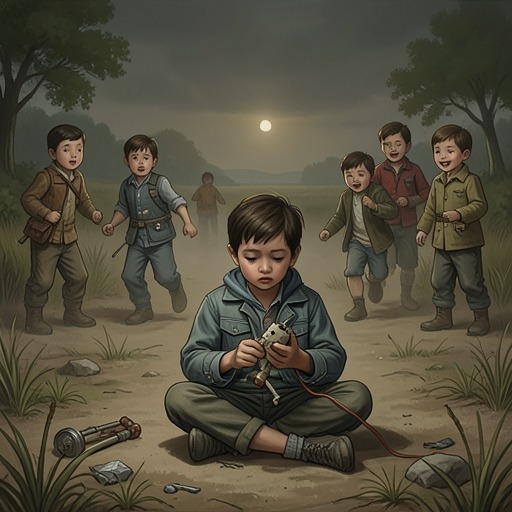
The rescue therefore does not end with defeating an enemy. When a freed boy is still crying, Holster recognizes that his safety has not made him immediately all right. She asks after him, realizes that the question is inadequate, and reassures him that he is safe. Gotama tears open the car door and gently lifts the terrified child in her mouth. The boy stops crying; Holster pets Gotama’s head, acknowledging the creature’s ability to calm those held in her tender jaws.
Holster then whistles for six cheruguns, which gather around her carrying an assortment of weapons, from cannons to Kalash Angels. She asks them to carry the boy to Jared LaChaire, her doctor, who has become skilled at treating Human Pillars and has successfully operated on and cured some of them. The destination matters: rescue includes getting the child to someone capable of medical care, not merely removing him from the captors.
Care, Agency, and Aftermath
The cheruguns are not truly independent sentient beings. They are extensions of Holster’s qi and the first Gun Path technique she invented. Yet she has given them part of her soul and a measure of autonomy, and she makes requests rather than issuing commands. Her reason is personal: Holster herself was once a slave, and she knows nobody likes being bossed around. The distinction carries her history into the smallest decisions of the rescue. Even beings made to serve her are not treated as objects to be ordered about.
The cheruguns respond with a clinking sound, dematerialize their weapons back into raw qi, and gently carry the boy away by his arms. Holster and Gotama watch them fly over the dunes. Revolver questions whether it is wise to entrust the child to creatures who sometimes wander off, but Holster trusts them despite their tendency to get themselves into trouble. Their conduct in this moment supports that trust: they handle the boy gently and take him toward help.
Holster judges that she acquitted herself well, though the satisfaction of putting down slavers is smaller than the joy of opening the cages and freeing her fellow Human Pillars. That contrast defines the rescue’s central achievement. Her victory is not simply that she can use force against those who once controlled her; it is that she reaches people still confined and brings them within the possibility of safety and treatment. A former captive leads the assault, but the event’s measure is the opened cages and the lives no longer held there.