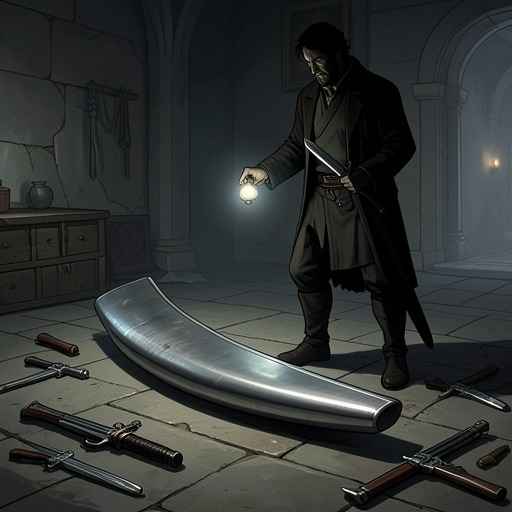
Gunsoul cycle
GunsoulThe Gunsoul cycle is the rule binding each Gunsoul’s return from death to an eventual confrontation with The Gun. A Gunsoul rises to pursue a defining quest, but completing it brings The Gun to challenge its host: the cycle ends, for that Gunsoul, either in killing The Gun or being killed by it. The rule turns resurrection into a reprieve with a condition attached, and makes Yuan Guang’s revenge, his commitment to the Gun Path, and his hope of freeing Revolver part of a much larger contest over whether the succession can be broken.
Trigger and Terms of the Cycle
Kaguya explains the trigger through the timing of The Gun’s attack on Yuan Guang and Revolver: The Gun engaged them immediately after its own murderer had perished in the bombardment. A Gunsoul’s return is tied to a particular quest, and once that quest is fulfilled, The Gun comes to demand the final contest. Yuan Guang recognizes that killing Slash has brought him to this point. He had, in effect, been given time and power to settle that score in exchange for a promised duel; The Gun had kept its side of the bargain, and the reckoning was now due.
Revolver had earlier described the same fate to Yuan Guang as a choice between killing The Gun and being killed by it. His warning makes the rule more than a prediction about an isolated encounter: it is the fate shared by Gunsouls. The cycle’s apparent reward—returning to life with the strength to pursue unfinished business—therefore carries a built-in expiration. Completing the purpose that brought a Gunsoul back does not restore an ordinary life; it summons the next trial.
A Bargain That Becomes a Trap
The Gun’s pursuit is especially perilous because its challenge follows a period in which the Gunsoul can act. In Yuan Guang’s case, that interval lets him take revenge on Slash, but the same sequence reveals its cost: his victory does not release him from danger. The promise of a duel gives his return direction while making that direction a route toward The Gun. The cycle thus folds revenge into its mechanism, converting the quest that sustains a Gunsoul into the event that exposes it to its final opponent.
Yuan Guang cannot simply choose a different way forward once he understands the terms. Crossing the Fourth Coil committed him to the Gun Path, and Kaguya tells him he cannot change that Path. Fighting The Gun was therefore not only the consequence of having killed Slash; it was also the destination built into his cultivation choice. Yuan Guang has to face the consequence of that commitment without a safe alternative supplied by the rule.
Arc as a Partial Exception
Arc appears at first to contradict the cycle. She killed her own tormentor years earlier and nevertheless survived The Gun’s pursuit, even managing to fend it off. Kaguya’s account makes the distinction: Arc was not free of the challenge. The Gun hounded her across the wasteland, while Arc could do no more than destroy it temporarily and buy time. That time came at the cost of her friend.
Kaguya suspects that Arc’s cracked core eventually made her an unsuitable vessel for The Gun, which may have caused it to lose interest. The qualification matters: Arc’s survival does not demonstrate that an ordinary Gunsoul can evade the cycle after fulfilling a quest. She existed on borrowed time, and sustaining herself in her condition required a leyline’s worth of qi as a Fifth Coil cultivator. Yuan Guang considers cracking his own bullet-core but knows it could kill him; he has not reached the power that let Arc linger. Her case offers no reliable escape for him, only an exceptional and costly delay.
Escalation and the Gun’s Aim
The cycle also serves The Gun’s progress. Kaguya explains that each Gunsoul host is technically stronger than the last, so each reincarnation carries The Gun closer to the heavens and, ultimately, to the Dao. The challenge is therefore not merely a repeated personal duel. Every succession contributes to a larger ascent, even when an individual Gunsoul resists the role assigned to it.
The Gun seeks to join with the Dao and become an underlying principle of reality. Its desired universe would make death by firearm not simply possible but inevitable, a condition Kaguya connects to its unending appetite for murder. This purpose gives the cycle a brutal asymmetry: the Gunsoul’s quest may be personal, but its return also advances a power working toward a universal order founded on firearm death. The danger grows across generations, while the succession itself supplies the means of that growth.
Resistance and the Uncertain Perfect Shot
Yuan Guang refuses to accept that he and Revolver must die as links in an endless chain. His determination is shaped by Revolver’s kindness and by the memory of Revolver struggling against the bloodlust associated with The Gun’s curse. After Revolver has saved Yuan Guang twice, Yuan Guang will not treat his friend’s fate as an unavoidable debt owed to the cycle; he resolves to find a way to free him, even if that delays revenge.
The Perfect Shot offers a possible means of resistance, but not a guaranteed answer. Its conditions demand the right shot, bullet, gun, place, time, and reason. Kaguya says only a Gunsoul can destroy The Gun and that the prophecy may one day be fulfilled, while admitting that it is unknown whether Yuan Guang or someone else will accomplish it. When Yuan Guang asks whether Arc’s bullet could free Revolver from the curse if he lands that shot, the uncertainty remains. The cycle establishes the stakes and the narrow class of person capable of ending it; it does not promise that the attempt will succeed, or that Yuan Guang will be the one to make it.