Unspeakable Vow
GunsoulThe Unspeakable Vow turns a spoken promise into a binding obligation anchored to a cultivator’s core. Its force is not merely social: breaking an oath can permanently cost the oathbreaker the right to cultivate, and a vow’s terms can threaten the life sustained by the core itself. In Yuan Guang’s pact with Arc, the Dao responds to their words, and the resulting obligation persists as an invisible pressure until Arc releases him. The vow therefore makes speech an instrument of power—and a means of placing a future self under judgment.
Definition and operation
An Unspeakable Vow is sworn on a cultivator’s core. Gayak describes its basic cost to Yuan Guang during a negotiation over the care of a child: the Metallists cannot repair her core, but Gayak says his side can, and offers to swear an Unspeakable Vow if that is what it takes. Yuan recognizes that such an oath is made on the core. Gayak adds that oathbreakers permanently surrender their right to cultivate, making clear why a cultivator would not swear lightly and why an offer to do so signals the seriousness of the proposed bargain.
The pact Arc later makes with Yuan demonstrates a still more personal danger. She warns him that if he abandons his assigned goal or passes up a reasonable opportunity to act against Manhattan, the oath will destroy his core. Yuan understands the consequence in bodily terms: his bullet-core keeps him alive, so its destruction means his death. The vow’s penalty is thus shaped by its specific terms; in this case, failure is not simply a loss of standing or trust but a lethal breach.
The pact between Arc and Yuan Guang
Arc offers to train Yuan on condition that he swear to destroy Manhattan, oppose his plans, and act against those who follow him. Yuan initially refuses. He judges himself far too weak to meet the demand, and Arc makes clear that she will not soften the oath’s consequences. She does, however, specify that it has no time limit: Yuan may need years or decades to reach Manhattan’s level, provided that he keeps working toward the goal. Her eventual oath also allows the task to take centuries.
Yuan accepts after choosing the Path of the Gun despite Arc’s warning to abandon it. Their exchange makes the bargain reciprocal. Arc vows on her core to teach him everything she knows, while Yuan swears not to be a friend to Nuclear Path cultivators, to defeat Manhattan and his followers once he has the power, to oppose their plans whenever possible or reasonable, and to destroy Manhattan in time. Yuan’s wording is not identical to Arc’s proposed terms: he qualifies when he can defeat Manhattan and when he must oppose the plans. Those qualifications become part of the words on which the pact is made.
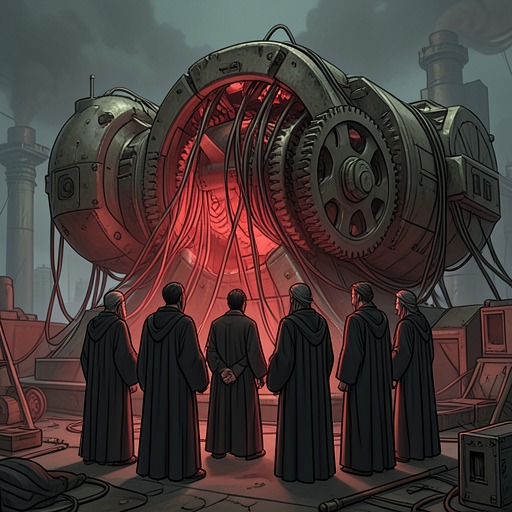
Once Yuan finishes his oath, he feels an invisible grip close around his bullet-core. A force from the Dao takes heed of what he has said and fashions a chain from his words. The pressure on his soul is faint, but it remains after the spoken exchange ends, ensuring that he will not forget the promise. The vow is therefore both an agreement between teacher and student and an enduring constraint that follows Yuan beyond the scene. Arc accepts the oath and agrees to teach him; Yuan, in turn, can no longer simply withdraw from the obligation.
A bond recalled—and released
The vow later makes Manhattan’s intervention more than a political threat. When an Authority halts the activity around Yuan and the racers, he recognizes the familiar nuclear qi and feels his bullet-core pounding in his skull. The dread is joined to the memory of his oath: Manhattan has acted, and the long-term obligation Arc laid upon him has become immediate pressure. The scene shows how the vow carries an earlier bargain forward into a later crisis, making the core a physical reminder of words spoken in the past.
Arc ultimately releases Yuan from the Unspeakable Vow herself. As an atomic cloud gathers, she tells him he is free to do as he wishes and no longer has to confront Manhattan on her behalf. Yuan immediately feels the invisible weight on his bullet-core lift. Arc has severed his side of the pact from her own; the release is registered not just as permission but as a change in the binding itself. This reversal establishes that the obligation can be ended by the party who imposed its condition, even though Yuan could not safely abandon it on his own.
Other uses and limits
The vow also appears as a proposed instrument of negotiation rather than an accomplished bond. Gayak offers one as part of his attempt to secure Yuan’s help: his people can cure the child and repair her core, and the offer of an oath is meant to make that promise credible. Arc’s pact with Yuan likewise begins as a condition for training, but becomes binding only when they swear. The distinction matters: a proposed vow can signal the stakes of an agreement without proving that anyone has entered into it.
Later, Kaguya asks whether Yuan wants the Moonlight Sect to form an Unspeakable Vow. The proposed exchange would have the Sect promise not to seek the Cube of Natho, while Yuan would promise to do everything in his power to keep the Nuke contained. Yuan wants the Sect’s neutrality secured because he expects other enemies to come for the cube. The scene presents the vow as a possible tool for limiting future conflict, but the offer itself does not establish that the parties swear it.
Yuan’s parting assurance to Revolver offers a revealing contrast. Revolver warns that if he loses control again, the Gun will come for Yuan and try to kill his hope. Yuan promises to be ready when Revolver comes for him, but the narration expressly notes that this is not an Unspeakable Vow. His commitment is sincere, yet it does not carry the core-binding mechanism that defines the formal oath. The distinction separates personal resolve from supernatural enforcement: not every promise becomes a chain, even in a world where words can fasten themselves to the soul.
Narrative significance
The Unspeakable Vow binds cultivation, life, and obligation together. Its terms can support cooperation, as in Arc’s offer of training, or make a promise credible in a negotiation, as Gayak proposes. But its distinctive force lies in the cost of default: the core that enables a cultivator’s life and power can also become the point at which the vow punishes betrayal. In Yuan’s story, a subtle pressure outlasts the spoken oath, returns as dread when Manhattan acts, and disappears only when Arc releases him. The rule gives promises a material consequence while leaving room for distinctions between proposal, formal oath, release, and an ordinary promise kept by choice.