Last Rites Sutra
GunsoulThe Last Rites Sutra is a conditional funerary rite that prevents the dead from rising as hungry ghosts when their corpses are buried within an hour of death and their graves are blessed with final prayers. Its defining scene is starkly practical: after killing Yuan Guang and his team, their murderer gives them graves and the final rites, not as an act of reconciliation but to prevent the dead from returning to haunt him. The rite makes burial a safeguard against the supernatural—and exposes how ordinary that safeguard has become in a violent world.
Definition and Operation
The Last Rites Sutra belongs to the Sutras, one of the Three Pure Disciplines of spiritual practice. Where cultivation refines human qi and Feng Shui manipulates earthly qi, Sutras call upon heavenly qi through scripts and formulas. Their power is inherent in the ritual rather than dependent on the practitioner’s own strength. This distinction makes the Last Rites Sutra available even to Scraps, who may lack the means to use cultivation techniques but can still perform a properly structured rite.
Its protection is governed by two explicit conditions. The corpse must be buried within an hour of death, and the grave must receive final prayers. The rule therefore binds spiritual effect to both timing and treatment of the body: neither burial alone nor prayers alone are stated to suffice. The account does not describe the words or gestures used in this particular rite, but it makes clear that the Sutra is not an automatic property of a corpse or grave. Its effect depends on carrying out the prescribed steps in time.
Ritual Knowledge and Access
Sutras can draw power from constellations and cosmic phenomena when their required steps are followed. That independence from the user gives them broad potential reach, but it does not make their knowledge freely available. Rituals commonly demand precise conditions, while sects guard their scripts and mantras jealously. The Last Rites Sutra is thus an unusually consequential piece of practical knowledge in a culture where spiritual techniques are protected as institutional possessions.
Its wider circulation is linked to necessity rather than generosity. Yuan Guang doubts that sects would have released the Last Rites Sutra to the wasteland without the undead epidemic that followed Deathsong’s Ascension. He learned only a few Sutras during his years of wandering, a detail that places even a rite with a plainly communal purpose within a landscape of scarcity and restricted teaching. The rule can be used by people outside formal cultivation, but access to the knowledge needed to use it remains uneven.
Use in Yuan Guang’s Burial
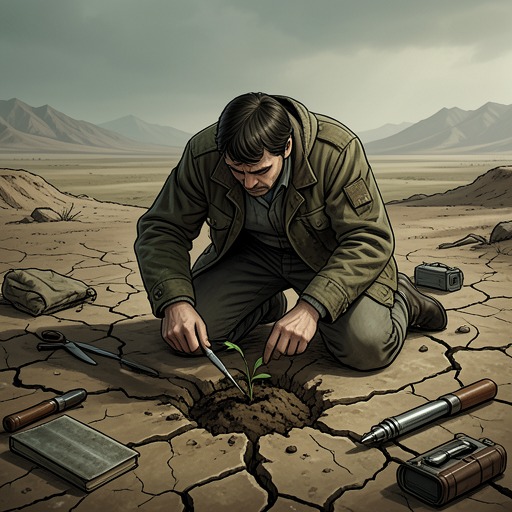
The rite’s clearest demonstration comes after Yuan Guang’s murder. Fifty years after the Spiral Dancer’s ascension and forty-five after the Sky-Biter unmade the world, Yuan Guang has lived only twenty years before being left dead in a ditch with his fallen companions. His murderer digs a tomb and gives the group the final rites. The grave and prayers enact the rule’s protection at the same time that the scene confirms the violence that made such protection necessary.
Yuan Guang understands the gesture without mistaking its purpose. In this world, killers give their victims funerals so that they will not return as hungry ghosts. The rite therefore does not repair the relationship between murderer and victim, absolve the killer, or undo the deaths. It addresses the danger the dead may pose to the living. The same act that honors the basic requirements of burial is also an extension of self-preservation: the murderer wants to prevent those he killed from haunting him.
As Yuan Guang faces the darkness between life and death, the rite’s intended consequence becomes personal. He considers whether sufficient willpower could let his ghost endure despite the Sutras, driven by the wish to avenge his friends and fulfill his final curse against their murderer. Yet he dismisses the hope that persistence alone could change his condition, thinking that dead or undead he would remain a Scrap. The scene presents the Sutra as a real barrier, but does not establish that it can never be resisted; Yuan Guang’s speculation leaves a narrow uncertainty between the rule’s intended protection and a dead person’s will.
Limits and Significance
The Last Rites Sutra addresses one defined danger: a dead person rising as a hungry ghost. The evidence does not make it a general defense against death, a guarantee of peace for the living, or a remedy for the violence that produces corpses. Its strict timing and burial conditions also make its protection dependent on action taken immediately after death. In practice, a safeguard available even to Scraps still requires someone to know the ritual and perform it before its window has passed.
That combination gives the rule its grim force. The Sutra’s power is not reserved for the strong, yet the world around it has made a victim’s final protection something a murderer may administer for his own safety. Burial becomes both care for the dead and containment of them. In a landscape where the fear of hungry ghosts shapes what follows a killing, the Last Rites Sutra marks the thin, procedural boundary between a corpse properly laid to rest and a dead person feared to return.