Agnes’s husband’s melancholy
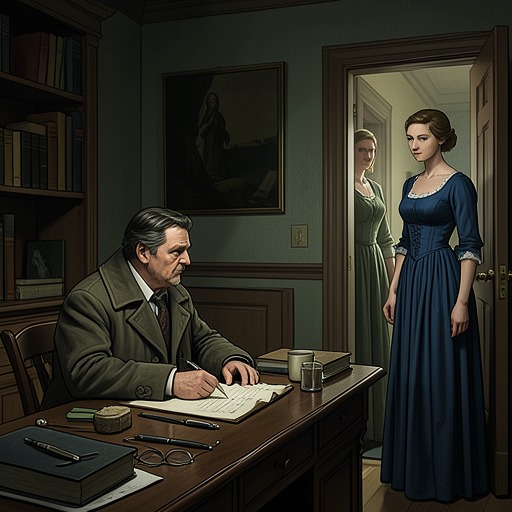
HamnetAgnes’s husband’s melancholy is a gradual but alarming collapse in William Shakespeare’s ordinary life, first registered by Agnes as a sour, damp odor and then confirmed by his pallor, sleeplessness, withdrawal, and loss of direction. The novel presents no clinical explanation: it follows what Agnes can observe, what William can scarcely articulate, and the strain this change places on a household already carrying her care of Susanna and her pregnancy.
Signs and Recognition
At the table, Agnes keeps Susanna close on her lap, feeding her bread spread with honey and talking to distract and protect her. While mother and daughter sing about birds in a nest and buzzing bees, William comes downstairs, drinks several cups of water, circles the room, and sits opposite them. Agnes senses a bitter, damp smell growing stronger around him. She imagines it gathering above his head like a greenish-gray cloud and clinging to his skin. The image is her perception, but it gives bodily form to a change she has not yet understood.
His appearance sharpens her alarm. Beneath his beard, his face seems gaunt and parchment-pale; his eyelids are swollen, his shadows dark, and his hand lies on the table as if emptied of presence. He looks toward the window without seeming to see it. Agnes tries to reconstruct how this happened without her noticing. He has been sleeping more, spending more nights away at taverns with friends, and no longer reads to her by candlelight in bed. Their conversations by the fire have grown less frequent, though the work of the house, the garden, Susanna, and callers has made the change easy to overlook. William still teaches in the afternoons and runs errands for his father in the mornings; to Agnes, their lives had seemed to move forward together until the altered state suddenly became unmistakable.
Agnes also thinks of the child she is carrying and of Susanna warm in her lap. She fears that the constricted home or their shared life might be draining William, though she does not know the cause. She has not told him she is pregnant. His condition makes the news difficult to broach: she worries it could deepen his melancholy and cannot bear the thought that her happy announcement might meet anything but joy. When she calls him by name, he does not answer at first. Asked whether he is ill, he seems slow to hear and formulate a reply, then denies it and asks why she would think so.
Naming What He Cannot Explain
At night, Agnes whispers questions about what is troubling him and whether she can help. She places a hand on his chest and feels his heartbeat in her palm, but the repeated physical rhythm brings no answer. William says there is nothing; Agnes persists that there must be something he can tell her. When she asks again what is wrong, he describes himself as weighed down by dejection and melancholy, then minimizes it as nothing. As Agnes begins to fall asleep, he says, or seems to say, that he is lost and has lost his way. He draws her close around the waist, as if she might drift beyond his reach.
The gap between that confession and his daytime denials becomes part of the condition. Agnes observes that he cannot sleep at night but also struggles to rise in the morning. He gets up around midday, unsteady, pale, and gray in mood; the bitter, stale smell seems stronger in his clothes and hair. His father calls at the door, shouting for him to get moving and work. Agnes understands that she must keep the household steady, enlarge her own presence, remain patient, protect Susanna, and prevent the darkness she senses from overwhelming them all.
Withdrawal and Disruption
The change appears across ordinary family scenes. William drags his feet and sighs on the way to teach, stares through the window when his brother Richard returns from school, and sits frowning at his parents’ table, playing with the food on his plate. When his father praises an employee at the tannery, William reaches for the beer jug. Edmond comes to his side and rests his head against William’s sleeve, but has to tap him repeatedly with his forehead before his older brother notices him. William lifts Edmond onto his lap with tired, absent attention; Edmond studies his face and touches his unshaven cheek. Agnes notices that Edmond is the only one who seems to recognize that something is wrong.
William also startles at small noises: a cat jumping onto the table, a door slamming in a draft, or a dish being set down abruptly. John snaps his fingers at him and mocks him, drawing Gilbert into the ridicule. When William spills beer on the tablecloth, John calls him useless and laughs at his inability to serve himself. The scenes show his vulnerability becoming visible within the family, where it meets not care from his father but humiliation. Agnes, meanwhile, watches and tries to understand what may happen if he keeps everything inside.
One night the strain breaks into anger. William drinks late, not at a tavern with friends but at the bedroom table, where he is trying to write. He cuts quill after quill, rejecting each as too long, too short, or too thin for his fingers; they break or scrape the paper and leave smudges. Agnes wakes to his shouting, and he hurls the writing things against the wall, including the inkpot. Susanna begins to cry. Holding the child on her hip, Agnes scarcely recognizes the pale, disheveled man or the black splash of ink on the wall. The episode makes his distress a force felt by the whole household, not merely a private silence.
Agnes Seeks Help
The next morning, while William sleeps, Agnes ties Susanna onto her back and goes to Hewlands. On the way she gathers quills, poppy heads, and nettle branches. She finds Bartholomew working in the first sheep pen, hammering a fence stake into the ground to mark off the enclosures for newborn lambs. Agnes tells him that William stays awake through the night and then cannot rise, that he is sad and resentful, and that he speaks only to argue with his father. She admits that she does not know what to do.
Bartholomew listens in silence, finishing his bread and cheese before taking up the hammer again. He answers through the work in front of him: a man needs work, he says, and needs work with substance. In his view, William has too much intellect and too little sense, and his scattered duties as his father’s errand-runner and a teacher moving from place to place give him neither a firm purpose nor an occupation capable of setting him straight. Bartholomew’s assessment does not resolve the cause of William’s melancholy, but it offers Agnes a practical interpretation and a possible direction. The state remains defined by uncertainty: William can name his lostness only briefly, Agnes can register its signs but cannot cure it, and the first proposed answer is not an explanation but meaningful work.