John Shakespeare’s loss of standing and debt
HamnetJohn Shakespeare’s loss of standing and debt is both a civic decline and a private humiliation: the former town official still has a business and the instincts of a negotiator, but no longer commands the respect or companionship he once expected. Shut out of local authority and burdened by liabilities, he tries to recover influence through the marriage negotiations involving his son William Shakespeare and Agnes. The episode reveals how readily he turns family circumstances into leverage—and how that strategy deepens the estrangement between father and son.
Former Standing and Present Exclusion
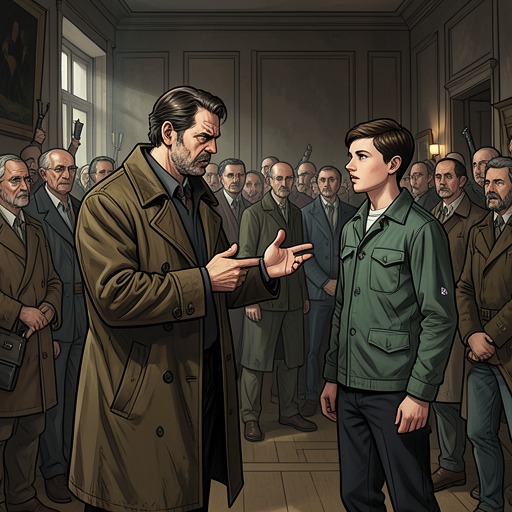
John remembers himself as a man who mattered in Stratford. He had served as bailiff and later held an important council position; he occupied the front pew at church and wore scarlet robes. At the town hall, he turns up uninvited after hearing that a meeting is to take place, hoping to catch men he has known for years before they disperse. He believes their familiarity with his past work and loyalty to the town might restore his position, or at least persuade the council and town authorities to forgive him or overlook his offenses.
The gathering offers no such recognition. The men avoid his eyes and carry on talking rather than listen to the speech he has prepared about the glove market, his successes, and his achievements. His invitations to drink at the tavern or eat at his house go unanswered. They assent coldly, turn away, and one offers a noncommittal reassurance while touching his arm. The rebuff shows that John’s loss is not only official: what he cannot endure is that these men will not share a drink, bread, or warmth in his home. He can bear reprimands and exclusion from council meetings more readily than the refusal of ordinary fellowship.
Debt, Business, and Reputation
John’s financial position is compromised, but not reduced to the failure of his trade. The glove business continues to prosper to some extent because people will always need gloves. At the same time, his dealings include secret wool trading, and he faces notices for failing to attend church and fines for throwing rubbish into the street. He tells himself he can accept reprimands, penalties, demands, and sarcastic talk about his family’s ruin. He is also prepared to live with exclusion from civic meetings. The distinction matters: his business retains a market, while his social and political standing has deteriorated.
He now depends on money sent from London by his eldest son, a reversal that rankles. John remembers that son as a young man who lingered around the market and wasted time; he had not expected him to become useful. The dependence brings together the two sides of John’s decline: his diminished resources and the unexpected success of a son whose independence he resents. At the town hall, his prepared claims of commercial solidity cannot make the men listen, even though glove-making still gives him a practical foothold in the town’s economy.
The Negotiator’s Instinct
John’s response to the marriage question is shaped by the same calculating habits he brings to business. When his son tells him that he had opposed the relationship before but is uncertain now that Agnes is pregnant, John falls silent. The son recognizes that silence as the expression his father wears while evaluating a profitable transaction: the look he uses when he finds cheap skins, considers concealing extra wool in the attic, or bargains with an inexperienced trader. The familiar expression makes the son understand that his father is weighing advantage, not simply considering the wishes of the young couple.
The son realizes that John intends to profit from a marriage agreement with the widow of the sheep farmer. In John’s reckoning, Agnes’s bloody face when she arrived, the kestrel, and the child she carries can all become useful terms in a bargain. The son is appalled that what happened between him and Agnes at Hewlands, in the woods, might be turned into a means of binding him more tightly to his father’s house, business, and locality. John’s commercial habits have crossed into family life: a private relationship and an impending birth become instruments in a negotiation the son never meant to enter.
Marriage as Leverage
John moves quickly because he believes the circumstances give him control. He leaves for Hewlands without stopping at his market stall to harass Eliza, criticize her work, or check the stock, and without pausing to speak to a council colleague he meets on Rother Street. He takes the road to Shottery at a brisk pace, excited by the prospect of a good deal and anxious not to lose his advantage. On the way, he calculates that his son is a minor and will need written parental consent and a special licence to marry. He also counts on the old debt between the families and on the need to marry Agnes because of her pregnancy.
John regards his position as nearly perfect: Agnes is in his house, his son is under age, and John’s consent is necessary. He whistles an old tune as he approaches Agnes’s brother, who waits in a field leaning on his staff. The surrounding sheep, which John imagines could become gloves for the wealthy before the year is out, bring his business ambition into the scene even as he seeks a marriage agreement. His confidence is not merely a private feeling; it rests on practical constraints that he believes he can convert into bargaining power.
Earlier, Joan had rejected the tutor as a husband for Agnes on precisely the grounds that John’s conduct had damaged the family’s standing and left debts across the town. She cites the dishonor caused by his business dealings, the debts owed to her household, and the fact that the tutor has no independent livelihood. Her refusal establishes the wider cost of John’s reputation: his financial history obstructs his son’s marriage prospects as well as his own social rehabilitation. When John approaches Hewlands, he intends to turn that liability into a settlement, presenting the marriage as beneficial to everyone and arguing that the child should be born within wedlock.
The Cost of Trying to Recover Power
John’s efforts at the town hall and at Hewlands expose opposite outcomes of the same desire. In one setting, he cannot make the men acknowledge him; in the other, he believes that his son’s minority, Agnes’s pregnancy, and the families’ debt give him the upper hand. His imagined authority survives more strongly in negotiation than in public life, where the council’s distance and the men’s refusal to share a meal make his loss unmistakable.
The novel also places that ambition beside moments in which John is not in control. While Hamnet rushes to seek help for Judith, John stands with the men at the town hall, his back turned to his grandson as the boy runs past toward the physician’s house. Later, after the men have refused his invitations, John goes alone to the tavern. He sits in the dimness with a small candle and watches flies circle its flame. The image narrows his former public presence to solitary company and a light that attracts no human gathering. His debts and lost status are therefore not just background troubles: they shape his relationships, sharpen his hunger for influence, and leave him trying to make a family bargain where he can no longer command a civic one.