Pestilence (plague)
HamnetPestilence (plague) is presented as a force that overwhelms both a child’s body and the efforts made to save him. In the illness that takes hold of Hamnet, Agnes can ease his discomfort and remain beside him, but she cannot stop the fever or prevent his death; afterward, the plague also governs how quickly the household must prepare his body for burial. Its later return in London reaches the family through visits and silence, as the playhouses close once more.
The Illness and Its Force
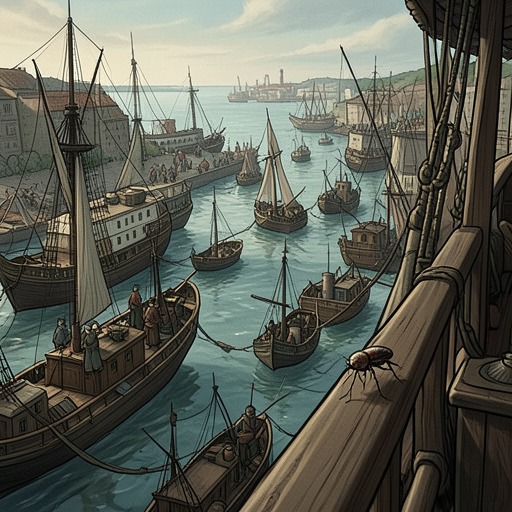
As Hamnet’s condition worsens, Agnes recognizes that the disease is beyond her ability to overcome. She can stay beside him and try to make him comfortable, but the illness grips him with a power the narrative figures as tendrils that tighten and will not release him. Agnes imagines it arriving at her home from a distant place of rot, damp, and confinement, then moving swiftly among humans, animals, and insects. The image makes the plague seem at once intimate, because it has entered her home, and vast, because its path crosses the boundaries between kinds of life.
The disease’s advance is registered in Hamnet’s body. His fever continues to rise, and the pustules grow increasingly taut and swollen; one hand turns an ugly grey-blue along one side. His body sweats as its humors come out through the skin, as though it were being emptied. These changes give Agnes visible evidence of what she cannot reverse: the household’s remedies and her attentive presence do not halt the illness.
Agnes’s Care and Helplessness
Agnes does not leave Hamnet. She wipes his forehead, legs, and arms with a damp cloth, places bags of salt in his bed, and lays valerian and swan feathers on his chest in an effort to comfort and relieve him. When she lifts his discolored hand to her cheek, care becomes a physical act of closeness in the face of the disease’s separation of her from any power to save him. She would give her blood, heart, and organs if doing so could ease him even a little.
Her earlier attention to Judith’s danger sharpens the shock of Hamnet’s decline: Agnes realizes that she had concentrated on protecting the daughter who was not in danger while her son was the one she would lose. The remedies she had trusted have not brought him back. Her garden and its shelves of powders, potions, leaves, and liquids, built up through years of tending and harvesting, now seem powerless against an enemy she cannot treat away. The plague thus overturns both her expectation that she could protect her children and the confidence invested in her healing practice.
Death and the Household’s Response
After Hamnet’s death, the women of the household prepare for the danger the plague leaves behind as well as for the burial itself. They burn the blankets, mattress, straw, and sheets; air and clean the room; and spray it with lavender water. Because Judith is still weak and has not fully recovered, though she is improving, they put her in the room above. The practical measures continue alongside the preparation of a white sheet, strong thread, and sharp needles for Hamnet’s shroud.
The town’s order requires anyone who dies of plague to be buried quickly, on the same day. The women explain the mandate to Agnes in case grief has erased it from her memory, set basins of warm water and cloths beside her, and offer to help wash and shroud Hamnet. Yet she does not answer or raise her head. The water will cool, and the neatly folded sheet remains by the door: the order imposes urgency, but it cannot make Agnes ready to begin.
The Plague’s Return
The plague reappears in the family’s later life at a distance from the house in Stratford. During visits, William Shakespeare tells them that plague has returned to London and that the playhouses have closed. Judith notices that the word is not spoken during these visits. The outbreak therefore enters the home as both news and silence: its consequences reach the family through the closure of the theaters, while the family’s refusal to name it leaves the danger present without making it a subject of open conversation.