Judith’s fragile health
HamnetJudith’s fragile health is a sustained condition rather than a single crisis: her uncertain survival as a newborn develops into a childhood marked by recurrent, severe illness. The narrative gives no diagnosis, but renders the effects concretely—in troubled breathing, fever, convulsions, and the vigilance required of Agnes—and shows how Judith’s needs reshape the family’s plans.
Uncertain Survival at Birth
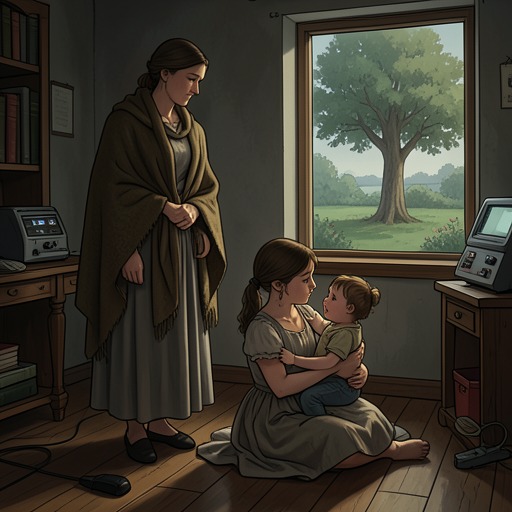
In the first days after the twins’ birth, no one knows whether Judith will live. Mary watches the newborns and sometimes touches their chests; worried, she urges John to take them to be christened. He and Mary wrap them in several blankets and hurry them to the priest. When Mary returns, she gives Judith back to Agnes with the relief of someone who has finished a race and overcome an enemy. The christening and the family’s urgent attention make plain how precarious the baby’s life seems.
The twins’ different needs are immediately apparent. Hamnet is strong and nurses with concentration, but Judith must be prompted to feed. Agnes touches her cheeks, taps her chin, and strokes her jaw to remind her to suck and eat. This early contrast does not make Judith’s frailty abstract: it is present in the intimate work of keeping her fed, while Agnes’s attention is divided between two newborns who need to be held and nursed.
Illness and Care
Judith survives infancy, but her health remains tenuous as she grows. She suffers convulsions that make her arms and legs tremble and move involuntarily, along with fevers, chest congestion, irritated skin, and labored breathing. Illness that amounts to a cold for her siblings can bring her a high fever and chills; a little coughing can become an attack of suffocation. The account emphasizes the disproportion between an ordinary illness and its danger to Judith, without naming a cause or promising a cure.
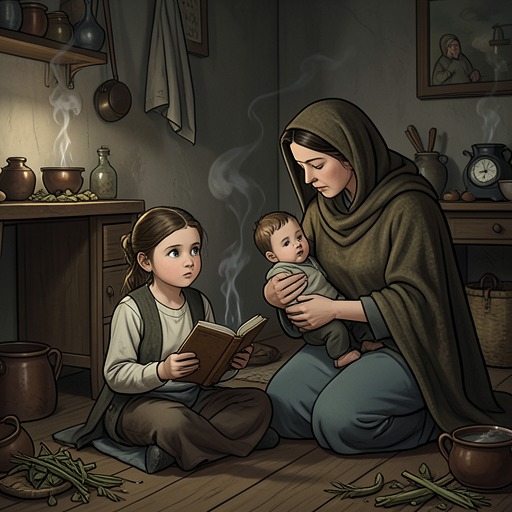
When Judith is two, Agnes stays awake through the nights to care for her. She places bowls of hot water with pine and clove among the bed curtains, trying to ease Judith’s breathing and bring back color to her blue lips so that the child can sleep. The repeated watchfulness turns Judith’s frailty into a daily bodily reality for both mother and daughter: breathing, warmth, sleep, and the next bout of illness require continual attention.
Consequences for the Family
William Shakespeare imagines a future in which Agnes and the children join him in London and he can live with his family rather than sustain a divided life between the city and home. Judith’s condition repeatedly postpones that move. Agnes waits for the child to improve, first for a few months, then until spring, after the summer heat, after the autumn winds, and after the snow melts. Each hoped-for point of departure recedes as Judith remains vulnerable.
By the time Judith is two, it is evident that the move will never happen: Agnes believes her daughter would not survive in the city. Judith’s fragile health therefore determines more than the timing of a journey. It closes off the family’s imagined arrangement of living together in London and keeps the question of relocation subordinate to the child’s capacity to endure it.
Narrative Significance
Judith’s condition is conveyed through practical acts and bodily signs rather than a medical label: the prompting at the breast, the night vigils, the bowls of pine and clove, and the blue of her lips. This attention preserves the particular demands of her care while showing how readily the family’s hopes must bend around her health. Her survival is real, but it does not erase the uncertainty established at birth; it becomes an ongoing condition that shapes Agnes’s labor and the family’s future.