Grief and bereavement
HamnetGrief and bereavement in the novel begin with a devastating reversal: Agnes spends the night tending Judith, convinced that her daughter is the child in danger, and then must face the death of Hamnet. Mourning becomes more than sorrow at a loss. It alters the family’s shape, interrupts Agnes’s ways of knowing, and persists as a search for the child she cannot find, even with the perceptive touch that once seemed to reveal what others concealed.
From Vigil to Loss
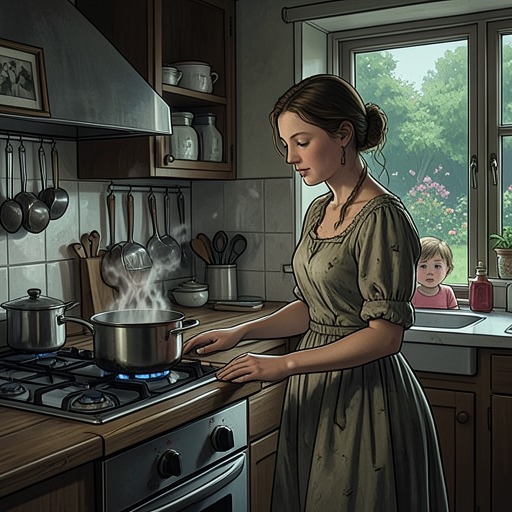
Agnes’s grief first takes the form of vigilance. She sits on the floor beside Judith’s pallet through the night, neither eating nor sleeping, with a cloth in her hand. The fire leaves red spots on her cheeks, and damp strands of hair escape her coif and cling to her neck. Under Mary’s watch, Agnes wipes Judith’s forehead, arms, and throat, murmuring words meant to reassure her. Judith’s fever does not break; the tense pustule on her neck appears close to bursting. Mary understands that the girl may die that night or in the days ahead. The scene establishes the pressure under which Agnes is acting: her attention is fixed on one child’s imminent danger.
After Hamnet dies, that vigilance turns inward and becomes accusation. Agnes’s thoughts swell and contract around the same questions: how the family will go on, what she should have done, and why she did not see that Hamnet was the one in danger. The questions collapse into the fact of his death, which her mind cannot absorb. She had expected the stronger, healthier child to survive; the speed of his illness and death makes the outcome feel impossible even after it has happened. Her habit of mentally checking where each child is—Judith upstairs, Susanna nearby—continues to summon Hamnet into ordinary possibilities: school, play, the river. The repeated search for his whereabouts exposes the distance between the mind’s routine of care and the reality it cannot yet accept.
The Body, the Grave, and the Family
At Hamnet’s body, grief narrows to touch. Agnes holds his hand and presses the muscle between thumb and forefinger in small circles, concentrating as if she might receive a sign. She remembers the softness of his hair and its split ends, made by his habit of pulling at them while studying. Her touch had once seemed able to disclose what was hidden in other people; Susanna even hides her hands behind her back because Agnes can learn what she wants by holding them. But Hamnet’s hand gives her nothing. Its silence is not simply an absence of information: it is the failure of the very means by which Agnes has understood other lives. The old kestrel’s attentiveness to the air offers her an image for listening, but no signal comes.
The burial makes separation physically and painfully visible. Agnes sees William Shakespeare lower their son into the grave, helped by Bartholomew and Edmond. She misses the moment Hamnet disappears into the clay-dark earth of the river because she looks toward Judith; the child is there, then gone from sight. Leaving the churchyard proves harder than entering it. Agnes imagines the dead reaching for her skirts and hands, and the fact that she entered with three children and leaves with two becomes unbearable. At the gate, she grips the wooden post with both hands and cannot cross away from Hamnet. Her husband, her brother, and her two daughters have to gather their strength to pull her from it.
The loss also breaks the family’s sense of itself. Agnes feels fragmented, and sees the household’s daughters as vulnerable to the same collapse: Susanna is stern, her brow furrowed, while Judith cries silently and continuously. Hamnet had been, in Agnes’s image, the pin holding them together; without him, the family seems liable to break apart. That image registers not only the absence of one child but the altered structure of the home around the remaining children.
Different Forms of Mourning
The family does not grieve in a single voice. During the first two nights, William Shakespeare walks back and forth in the room below Agnes. From the bedchamber above, she hears only his relentless footsteps; no sobbing, groaning, or sighing interrupts them. Their separate rooms and the sound traveling between them make mourning a shared experience that does not become shared speech. When Agnes says that she did not see what was happening, he tries to reassure her that she did everything she could and that the illness was too severe. She rejects the comfort: he was not there while Judith was so ill, and Agnes had been so occupied with her daughter that she failed to notice Hamnet’s danger. Her grief binds itself to the counterfactual belief that closer attention might have saved him.
Other responses remain visible in small gestures. Judith’s eyes fill with tears, and Susanna wipes them with the tip of her apron before returning to the work at hand. Agnes discovers that crying can continue through day and night and take many forms: sudden tears, deep sobs, or a silent, unending flow. She treats the irritated skin around her eyes with tincture of eyebright and chamomile. She also comforts her daughters with the promise that the family will be reunited after death, although she does not believe what she is saying. The gap between the consolation she offers and her own disbelief shows how mourning requires her to care for the living even when inherited religious language cannot console her.
Kindness arrives from beyond the intimate family, though not always from those Agnes considers close. People appear without warning, leave bread and cakes on the windowsill, offer a timely word after church, and show affection to Judith by ruffling her hair or pinching her pale cheek. These acts do not undo the loss; they make grief part of the surrounding community’s practical life. At the same time, Agnes finds it difficult even to decide what to do with Hamnet’s clothes, a domestic task that turns the child’s absence into an object she must handle.
Searching for Hamnet
Agnes’s mourning continues as a repeated search. For weeks and months after Hamnet’s death, she stays awake at night under a blanket with a lit lantern, waiting where his bed once stood. She sits in her father’s chair, in the exact place where Hamnet died, and goes into the frost-covered yard to stand beneath the leafless plum tree. There she calls for him and asks whether he is present. Each setting is tied to a previous place in the child’s life or death, but none yields a response.
The failure cuts against Agnes’s established powers. She believes she can hear the dead and the unsaid, read people through touch, and sense illness advancing through the veins or pressing inside the body. Yet she cannot find her own son’s spirit. The more capable she has been of detecting hidden conditions in others, the more absolute this silence becomes. Her search repeats not because she lacks a method, but because none of her methods can bridge the separation created by death.
Absence and the Work of Time
Bereavement persists alongside ordinary necessity. Agnes recognizes that there is no turning back: Hamnet is gone, her husband is leaving, and the pigs still have to be fed while time moves in only one direction. When William Shakespeare departs, she tells him to go if he must and to return when he can. Her consent does not make the separation easy; it places his departure beside the death she is already trying to comprehend.
In London, William Shakespeare remains caught in the pace of work—writing, rehearsing, performing, and writing again—and fears that stepping away might cost him his place. Agnes’s grief exerts a pull he describes as a dangerous current: he believes that returning to it would drag him under and that, if he sank, he would take the others with him. Distance thus becomes his way of surviving, but it also leaves Agnes and the children to live with the loss in his absence. He almost persuades himself that returning would reveal the family unchanged, with three children asleep in their beds. That imagined intact household is the inverse of Agnes’s daily knowledge that they have lost one.
When they are together again, Agnes expects an explanation or an admission that William Shakespeare has given his heart to someone else. Instead, he asks how much she thinks about Hamnet. The question reveals a grief that had remained largely unspoken between them; its force lies in the fact that she had prepared herself for a different kind of rupture. Bereavement in the novel does not resolve into a single moment of acceptance. It returns through habitual counting, touch, domestic objects, the grave, the night vigil, and the distance between the two parents. Agnes continues to seek Hamnet, while the family must continue living in a world whose daily time does not stop for the dead.