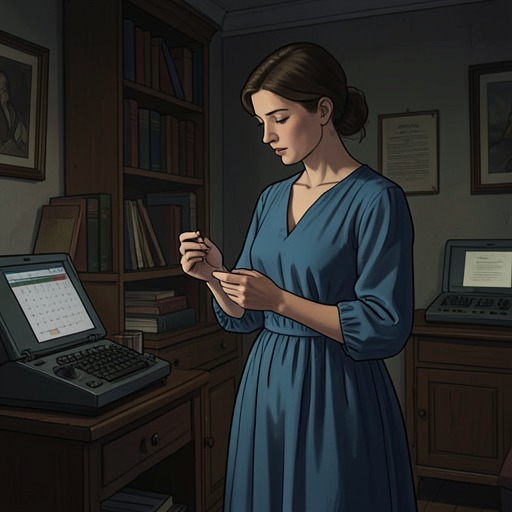
Annie Duchesne’s diary
HappeningAnnie Duchesne’s diary is both a contemporary record of her pregnancy and a crucial instrument in reconstructing it years later. Its dated entries preserve the changing course of events—from waiting for a period in Rouen to seeking help and recording the first signs of an outcome—while its silences and limitations show why the diary cannot simply stand in for memory. In the narrative, it is evidence of what happened and an object through which the past becomes available for writing.
The first entries and the discovery of pregnancy
In October 1963, while waiting for her period in Rouen, Annie Duchesne began writing in the diary every evening. She repeatedly recorded that nothing had happened, underlining the word in large capitals. The routine followed her from the girls’ dormitory in Rue d’Herbouville into the night: she woke and knew that her period had still not come. The entries register time not as a neutral calendar but as a daily expectation that remained unfulfilled. At the same time, they mark a change in attention. The previous year she had begun work on a novel; now that project seemed remote and impossible to pursue.
The diary’s record converges with scenes that remained vivid in later recollection. At a screening of the Italian film Il Posto, the narrator watched a young office clerk endure a humiliating existence and sensed that her bleeding would not return. Later, at a crowded performance of Jean-Paul Sartre’s Huis Clos, she could attend only to the reality of her own condition. The diary preserves that collision between public life and private knowledge: after the play, its entry registered how difficult it was to set aside what was happening to her.
On November 8, after Doctor N told her she was pregnant, she walked back to her accommodation and entered her conclusion and alarm in the diary. The diagnosis gave a name to the uncertainty that had structured the October entries. The diary also records the next stages: injections intended to bring back her period, a brief discharge while she was staying with her parents over the Armistice Day weekend, and the attempt to use the soiled laundry as a distraction from her mother’s attention. When Doctor N confirmed the pregnancy and sent a certificate, its predicted delivery date was July 8, 1964. She tore it up. These events made the diary more than a record of symptoms: it accompanied a decision not to continue the pregnancy and the effort to keep that decision private.
Symptoms, dates, and the experience of time
The diary gives bodily distress a sequence and a recurrence. Entries describe continuing dizziness, nausea at the library, and feeling sick, details that sit alongside episodes of nausea and difficulty eating in the narrator’s later account. Their short, repeated form registers an experience that was not confined to one dramatic moment. Symptoms returned during ordinary activities, including attending college, and interrupted the assumptions of everyday life.
By mid-December, the entries record a different disjunction. Although the narrator knew she was two months pregnant and could touch her abdomen, she experienced the pregnancy as abstract and could not imagine the future implied by the passing months. The diary thus preserves a gap between physical awareness and mental comprehension. In retrospect, that gap helps explain how the pregnancy could seem both undeniable and strangely unreal, and why the passage of time itself became a source of danger rather than a neutral backdrop.
The record is not continuous. It remained blank after January 1 until January 17, when the narrator wrote that nothing had happened and noted that she would return to the abortionist the following morning because the first visit had not succeeded. That date gives the later account a firm point of reference: on Friday evening she called Madame P-R from a post office near the station, and on Saturday she travelled to Paris. The diary’s blank interval does not explain what the narrator thought each day. Instead, the contrast between silence and the terse January entry makes the record’s limits visible while fixing a consequential turn in the chronology.
The January entries and the material record
The January 19 entry places small sensations alongside the sounds of life around the narrator: slight twinges, a bugle playing La Marseillaise, and laughter from upstairs. The combination makes the diary a record not only of the abortion attempt’s progress but also of the world continuing beyond the private crisis. By Monday, she had been walking around with the probe inside her for five days. Later that day, during a visit to her parents, she found that her clothes were wet with blood and water and that the probe was slipping out. The diary entry and the remembered circumstances together give the episode a date and duration, while the entry’s attention to nearby sounds preserves an everyday setting rather than reducing the experience to a medical sequence.
The diary was one of the materials the narrator later relied on, alongside her engagement book, to establish what had happened. She describes those records as necessary for recovering dates and evidence, particularly because thoughts and feelings from the past are abstract and evanescent. The diary cannot provide a complete transcript of an earlier self: its entries are brief, unevenly spaced, and written in the circumstances they describe. Its value lies partly in that specificity. A date, a repeated symptom, or an abrupt return to the page can anchor later recollection without resolving every uncertainty about the past.
This evidentiary role differs from that of other physical traces. In her address book, the narrator had copied references to medical publications in blue ballpoint; she later found the marks compelling because their physical persistence seemed to convey reality more directly than memory or writing. The diary is itself a material record, but it does not abolish the distinction between a surviving mark and a fully recoverable experience. The narrator explicitly recognizes that, apart from the diary and engagement book, she has no sure indication of what she thought and felt at the time.
From record to narrative
When the narrator returns to the events in writing, the diary becomes a framework for inquiry rather than a final explanation. She intends to revisit images and use the dates and evidence in her records to reconstruct the sequence. The method holds together two different kinds of knowledge: dated notes provide chronological footholds, while remembered sensations and encounters supply details that the diary alone cannot establish. Neither source is presented as complete, and the account depends on their relation rather than treating one as a substitute for the other.
The diary’s importance also reaches beyond documentation. Years after the experience, reading about abortion in a novel or hearing La Javanaise and J’ai la mémoire qui flanche could still provoke intense distress. Such returns show that the past remained active, but they do not make the diary a simple container for emotion. It records selected moments as they were lived; later writing places them in a new sequence and asks what those moments mean. The resulting narrative makes the difference between contemporary entry and retrospective account part of its subject.
A later return to Passage Cardinet, after the narrator has checked the route on a map, underscores that distinction between record and recovery. She searches for the café and church associated with her earlier visit, encounters a new street plaque above an older, blackened one, and stops at Madame P-R’s locked building. The diary helps orient the reconstruction, but the street’s altered signs and inaccessible door cannot restore the past intact. As an object, it therefore carries a double significance: it makes the experience more verifiable through dates and material traces, while its gaps remind the reader that writing can approach an event without making memory complete.