Black Death
InfernoThe Black Death, the bubonic plague pandemic that swept across Europe in the 1300s, is the historical and symbolic engine of Dan Brown's Inferno. Far more than a backdrop, the medieval catastrophe provides the conceptual template for the novel's central conflict: a brilliant but deranged geneticist's plan to save humanity from overpopulation by releasing a sterilizing virus. The plague's imagery—the long-beaked doctor's mask, the writhing bodies, the mass graves—permeates the narrative, surfacing in Robert Langdon's hallucinations, in the modified Botticelli map of hell, and in the ethical debates that drive the plot. The novel repeatedly asks whether a modern-day "Black Death" could ever be justified as a necessary evil, a question that gives the historical pandemic a terrifying contemporary relevance.
Historical Role and Symbolic Weight
The Black Death, which killed roughly one-third of Europe's population in the fourteenth century, is presented in the novel as a transformative event. Langdon explains to Sienna Brooks that the plague's name derives not from the darkening of victims' flesh but from the "profound emotional dread" it spread through the population. The beaked mask worn by medieval plague doctors—designed to keep pestilence from the nostrils—becomes a recurring visual motif, appearing in Langdon's visions as a fearsome mask with "a long, beaklike nose and two fiery green eyes" that declares "I am death." The mask also appears in the digitally altered Botticelli map that Langdon carries, and later as a tourist souvenir on the Rialto Bridge, a chilling reminder that the plague's iconography has been commodified even as its horror lingers. The novel emphasizes that the Black Death was not merely a demographic catastrophe but a catalyst: "What followed the Black Death?" Zobrist's video asks, answering, "The Renaissance. Rebirth." This historical logic—that mass death cleared the way for cultural flourishing—becomes the twisted rationale for Zobrist's own plan.
Zobrist's Plague as a Modern Black Death
Bertrand Zobrist, the novel's antagonist, explicitly models his "Inferno" virus on the Black Death. He is quoted as saying that "the best thing that ever happened to Europe was the Black Death," a statement that horrifies Langdon but reflects Zobrist's Malthusian worldview. Zobrist's virus is designed to render one-third of the human population sterile—a precise echo of the Black Death's mortality rate. Sienna Brooks explains that Zobrist "created Inferno as a kind of modern-day catalyst for global renewal—a Transhumanist Black Death—the difference being that those manifesting the disease, rather than perishing, would simply become infertile." The novel draws a direct parallel between the medieval plague's indiscriminate culling and Zobrist's targeted genetic intervention, with the crucial difference that Zobrist's method is intended to be permanent and humane, a "long-term solution" to overpopulation rather than a temporary dip in the population curve. The plague's historical role as a "natural" check on human numbers is thus repurposed into a deliberate, engineered act of bioterrorism.
The Plague's Imagery and Psychological Impact
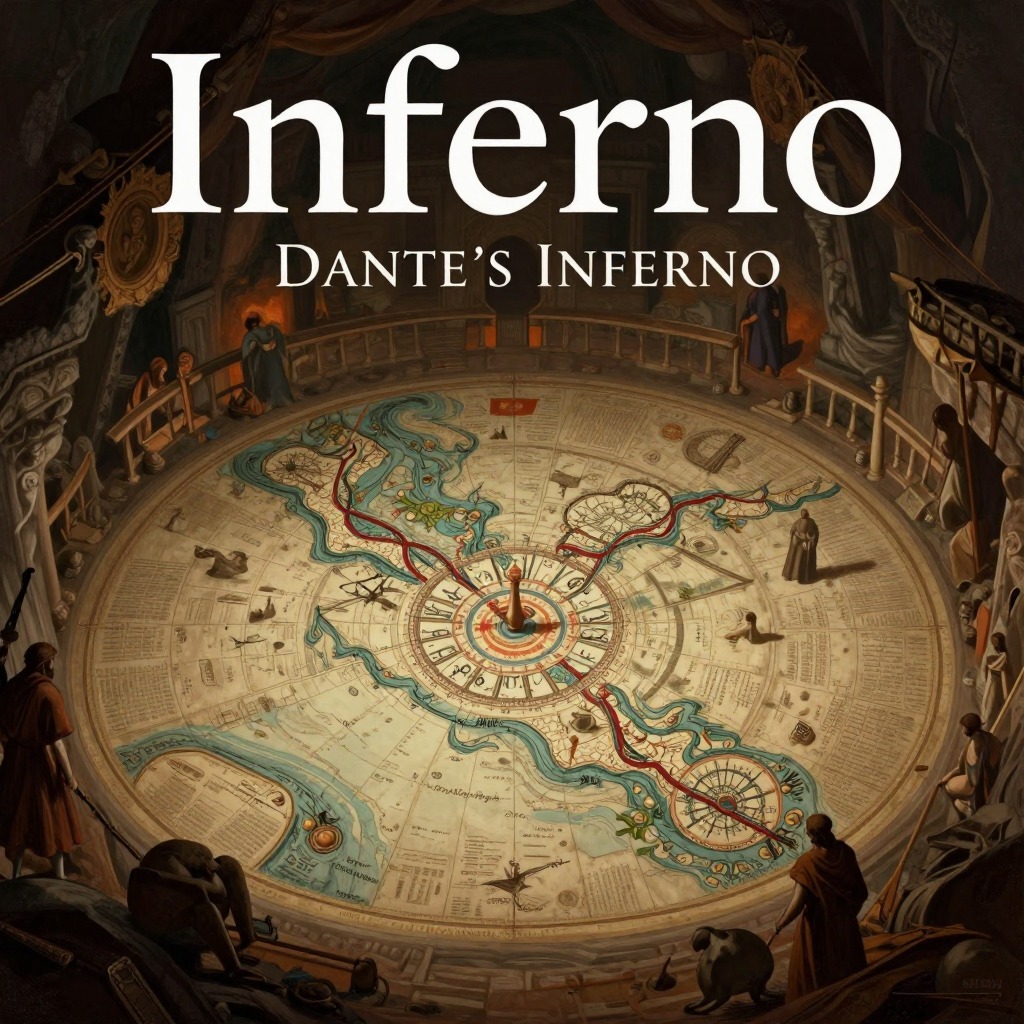
The Black Death's iconography saturates Langdon's experience from the moment he wakes up in Florence. His hallucinations feature "the lustful bodies writhing in fiery rain, the gluttonous souls floating in excrement, the treacherous villains frozen in Satan's icy grasp"—images drawn directly from Dante's Inferno, which itself was shaped by the plague's shadow. The plague mask appears in his visions as a "colossal image" that materializes in the sky, its "long, beaklike nose" and "fiery green eyes" staring blankly. Langdon identifies it as a "plague mask" from the Middle Ages, noting that it is "nearly synonymous with the Black Death." The mask also appears in the modified Botticelli map, where a "cloaked man in a mask with a long, birdlike beak and dead eyes" has been added among the sinners. This recurring imagery reinforces the novel's central theme: that the threat of pandemic is never truly past, and that the symbols of medieval death remain potent in the modern imagination.
The Plague as a Philosophical and Ethical Touchstone
The Black Death serves as a recurring reference point in the novel's debates about population control and the ethics of mass death. Zobrist's essay "Who Needs Agathusia?" argues that a catastrophic event is necessary to prevent the collapse of civilization, and he uses the plague's historical precedent to justify his plan. The novel's characters grapple with the same question: "If you could throw a switch and randomly kill half the population on earth, would you do it?" Sienna asks Langdon, pushing him to confront the logic that the Black Death, however horrific, may have been a net positive for human progress. The plague also appears in the novel's setting: Venice, where Langdon and Sienna travel, was devastated by the Black Death, and the word "quarantine" derives from the Venetian practice of requiring ships to anchor offshore for forty days. The novel's climax takes place in Istanbul's Yerebatan Sarayi, the "sunken palace," where Zobrist's virus has been incubating in a water-soluble bag—a modern plague waiting to be released. The historical plague thus becomes a lens through which the novel examines the terrifying power of exponential growth, whether of disease or of human population, and the moral compromises that arise when survival seems to demand sacrifice.