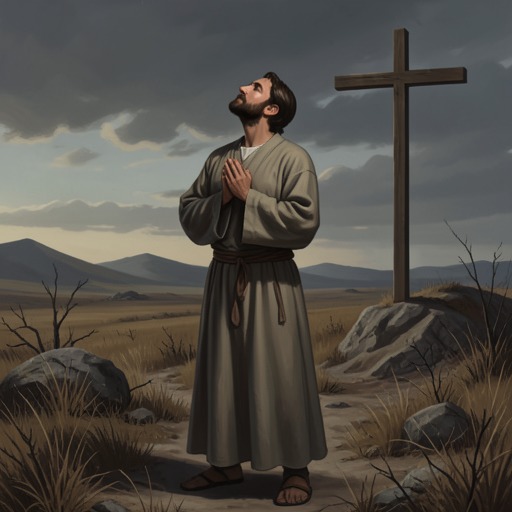
the Twelve Apostles
JudasThe Twelve Apostles are the circle of followers around Jesus whose collective identity becomes central to Shmuel Ash’s unconventional account of Judas Iscariot. Shmuel imagines Judas not as the faithless exception among the apostles but as their most committed member: the outsider who joins the group as a spy, comes to believe in Jesus, and remains with him when the others scatter. The group’s story therefore becomes a way to question how religious memory assigns loyalty, betrayal, and Jewish identity.
Identity and place in the tradition
The apostles are described as Jews descended from Jews, yet Christian popular memory singles out Judas as the one who represents the Jewish people. Shmuel finds a sharp contradiction in this inheritance: Judas is made the embodiment of both Judaism and betrayal, although his account emphasizes that the other apostles abandoned Jesus in the crisis while Judas did not. The group’s shared Jewish identity and its members’ divergent actions expose the distance between a collective history and the later symbolism attached to one person.
The historical and polemical materials surrounding Shmuel’s research also place the apostles within disputes over who Jesus was and what his followers believed. Medieval Jewish writers could present Jesus as a Pharisaic Jew who upheld the Mosaic Law rather than as a founder of a new religion; other Jewish polemics challenged Christian claims about Jesus, sometimes in language shaped by religious conflict and fear. Shmuel’s argument about the apostles belongs to this wider history of interpretation, but turns attention from arguments about Jesus alone to the disciple whom both Christian and Jewish accounts have made difficult to discuss.
Judas joins the group
In the account Shmuel writes in his notebook, Judas is a wealthy and educated man from Judea, unlike the other apostles, whom he describes as poor fishermen and peasants from Galilean villages. Jerusalem’s priestly authorities, concerned by reports that a Galilean wonder-worker was attracting followers, select Judas to join the group, observe Jesus, and report whether he poses a danger. Judas travels to Galilee in disguise and attaches himself to Jesus and his followers.
His position changes quickly. He wins the affection of the group and of Jesus, becoming a trusted confidant and eventually the treasurer of the Twelve Apostles. Shmuel’s Judas is set apart by education, means, and familiarity with the Written and Oral Law, but these differences do not leave him permanently outside the community. The spy becomes one of its intimate members, and his appointed role as observer gives way to personal allegiance.
From observer to believer
Shmuel attributes Judas’s transformation to Jesus’s character and teaching: his humility, humor, warmth toward individuals, moral seriousness, and memorable sayings turn the skeptical emissary into a devoted disciple. The notebook leaves open whether this change happens suddenly or over time, treating the precise pace as less important than the decisive reversal. Judas, sent to expose Jesus, becomes the follower who believes in him without reservation.
In Shmuel’s reconstruction, Judas is also the first person to believe with certainty that Jesus is divine. He expects that people everywhere will recognize the truth and that redemption will come to the world. Because he believes Jesus must make his power known publicly, Judas concludes that he must leave Galilee for Jerusalem, where authority is concentrated. His plan is not to betray a teacher he rejects but to bring the teacher he loves to the place where, in his belief, the decisive revelation can occur.
The apostles in the crisis
Shmuel’s account contrasts Judas’s constancy with the other apostles’ fear. When the Temple guards and emissaries come to arrest Jesus, the others disperse in terror. Judas stays. Shmuel considers it possible that Judas kisses Jesus to strengthen him or follows the captors to the place where Jesus is taken; these possibilities are presented as uncertain rather than settled details. Peter also reaches the scene, but denies Jesus three times before dawn. Judas, by contrast, does not deny him.
For Shmuel, this reversal changes the moral meaning of the group’s familiar story. Judas is the only apostle who never abandons Jesus, who believes in his divinity through the final moments, and who expects him to descend from the cross before Jerusalem and the world. Shmuel portrays Judas as dying with Jesus rather than surviving him, and as the disciple whose grief is most complete. The figure conventionally treated as the group’s traitor thus becomes, in this reinterpretation, its most faithful witness.
Memory, silence, and significance
Shmuel notes that Jewish writers who argued against Christianity often discussed Jesus while saying almost nothing about Judas. Even writers who described Jesus as born and dying a Jew, or who rejected Christian accounts of his nature, avoided the disciple’s story. Shmuel interprets this silence as shame or fear in the face of the accumulated hatred directed at Judas across generations. The apostles’ story is consequently shaped not only by what accounts say about their actions but also by what communities have found too charged to recount.
The Twelve Apostles matter to Shmuel’s larger argument because their division between those who flee and the one who stays unsettles a durable religious stereotype. His account does not establish a historical verdict about the Gospel narratives; it is a fictional and polemical reinterpretation made through Shmuel’s research and notebook. Its force lies in redirecting attention from Judas’s supposed betrayal to the possibility that he acted from belief and devotion, while the rest of the group failed him at the moment of danger.