Communist Party of the Soviet Union
JudasThe Communist Party of the Soviet Union enters the novel chiefly as the political institution whose record under Stalin unsettles Shmuel Ash’s socialist commitments. Its significance lies less in scenes of Party activity than in the arguments it provokes: members of Shmuel’s circle debate whether the exposure of Stalin’s terror condemns a corrupted regime alone or demands a re-examination of the dictatorship of the proletariat and the revolutionary tradition itself.
The crisis in Shmuel’s socialist circle
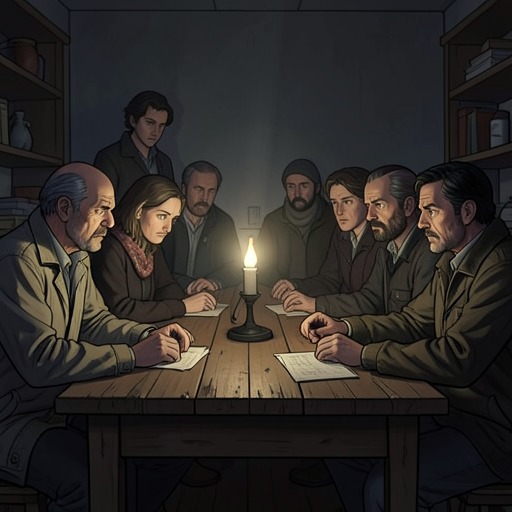
The circle for socialist renewal meets weekly in a dark, low-ceilinged café in the Yegia Kapaim neighborhood. The setting gives the group a self-conscious connection to working life: artisans, plumbers, electricians, painters, and printers gather there to play backgammon, while the political members meet nearby. The connection is real but limited; the workers do not ordinarily join the group’s table, though occasional remarks and small exchanges cross the distance between them.
After the revelations about Stalin’s terror, persistent objections give way to broad agreement among the circle’s members with the criticism expressed at the Soviet Communist Party’s Twentieth Congress. But agreement about Stalin does not resolve the larger ideological dispute. A determined faction insists that the members examine not only their allegiance to Stalin but also the foundations of the proletarian dictatorship as Lenin conceived it. Two members go further, invoking the young Marx to challenge the doctrine associated with the mature Marx.
Shmuel tries to prevent the dispute from destroying the group. His attempt fails: four of the six members announce a split and the formation of an independent cell. The two women in the circle are among the four seceders, a detail that makes the fracture personal as well as political for Shmuel. The separation deprives him of the friendships and shared purpose that had helped sustain his activism.
Ideals, inheritance, and political violence
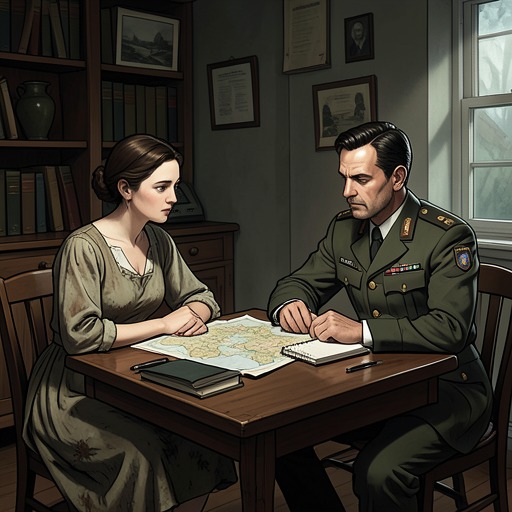
The Party’s crisis becomes part of Shmuel’s wider question about whether a political ideal can survive the corruption of the institution that claims to realize it. When Gershom Wald asks about his estrangement from his friends, Shmuel redirects the conversation toward the circle’s dissolution and the legacy left by Lenin to Stalin and Stalin’s successors. He asks whether the Soviet Party’s corruption requires abandoning the hope of social justice, comparing that question with whether the Inquisition’s actions should invalidate the figure of Jesus. The analogy reveals Shmuel’s effort to distinguish an ideal from the historical conduct of those acting in its name.
Wald refuses that separation as an easy route to redemption. He argues that Judaism, Christianity, Islam, and revolutionary movements alike may preach kindness and mercy while wielding power through prisons, torture, and execution. In his view, projects that arrive promising to save the world can become entangled in bloodshed; he rejects confidence in any worldly redemption. The Party thus belongs to a broader argument in which religious and political movements are measured not only by their ideals but by the coercive power exercised in their name.
A political vocabulary in a divided household
The Soviet example also sharpens the disagreement between Shmuel and Wald over Israel’s political future. Wald praises David Ben-Gurion as a leader of unusual breadth and argues that Jewish political separation from the nations is a curse rather than a blessing. Shmuel, by contrast, criticizes Ben-Gurion’s nationalist state and what he sees as empty biblical language used to present political choices as the fulfillment of prophecy. He warns that without peace the Arabs may eventually defeat Israel, and insists that the memory of the 1948 defeat and later political intrigues will not simply disappear.
Wald’s account of Shaltiel Abravanel supplies a further contrast. Abravanel argued for an agreement with the Arabs and a Jewish-Arab condominium rather than a Jewish state; his dissent led to his expulsion from the Zionist Executive Committee and the Jewish Agency leadership. Wald admits that he sided with Ben-Gurion’s political realism rather than Abravanel’s proposal. The contrast does not make the Soviet Party and Zionist institutions equivalent, but it places their disputes within the novel’s recurring concern with how collective ideals are altered by institutions, political authority, and the pressure of impending conflict.
Narrative significance
The Party is therefore present as both a historical referent and a measure of political disillusionment. Stalin’s terror triggers the circle’s split, while Shmuel’s questions preserve the possibility that an ideal of justice might outlast a regime that has betrayed it. Wald’s skepticism presses in the opposite direction, treating repeated revolutionary and religious promises of salvation as warnings about the violence that can follow when movements claim power. Through their disagreement, the novel gives the Soviet Party a role in Shmuel’s personal estrangement and in its broader examination of the gap between emancipatory belief and political practice.