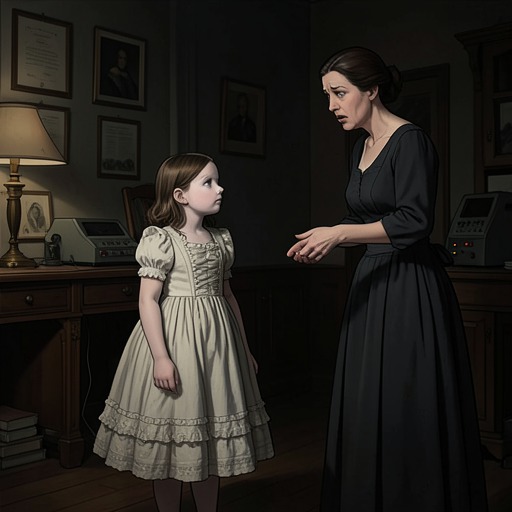
Confinement and sexual enslavement of girls at Saint Mary’s convent
JustineConfinement and sexual enslavement of girls at Saint Mary’s convent is a system of captivity concealed within a religious institution and maintained through architecture, routine, violence, and secrecy. When Therese arrives, the monks make clear that resistance will be punished and that no outsider can reach the girls in their hidden retreat. Omphale then explains how the convent’s organization turns that threat into an everyday regime: its residents are classified, inspected, assigned, and disciplined, while a well-funded network supplies new captives and removes others from sight.
Introduction and Conditions of Captivity
Therese encounters the system after being brought to an isolated building associated with the monastery. The girls’ living space is not an ordinary dormitory: its windows are high and barred on both sides, its doors are reinforced with iron, and the locks and bolts are controlled from outside. Eight girls share a large chamber furnished with separate beds and dressing spaces; another group of eight occupies a similar room elsewhere. The girls do not communicate freely between the two chambers, meeting only when the monks choose to assemble them.
The physical surroundings are coupled with an explicit threat. On Therese’s arrival, Dom Severino rejects the possibility that resistance might be respected and shows her the instruments used to punish girls who disobey. He describes the retreat as beyond the reach of family, judges, and other outsiders, and tells her that pleas or protest will not secure mercy. The institution’s power is thus presented at once as bodily coercion and as a condition of enforced isolation.
Hidden Architecture and Institutional Secrecy
Omphale describes an elaborate route between the monastery’s church and the pavilion where the girls are held. Behind the altar, a concealed door in the sacristy opens into a long, dark passage. The passage descends beneath a moat roughly thirty feet deep, rises again, and continues underground for about a quarter of a league before reaching the pavilion’s cellars. Its concealed entrance makes the girls’ quarters difficult to find even for someone familiar with the religious buildings.
The pavilion is also disguised from outside observation. It stands low to the ground, while stone walls and dense living barriers rise at least fifty feet around it. A thick roof supports earth and evergreen shrubs, blending the building into its forest surroundings. Even reaching the pavilion would not mean reaching freedom: the route back includes the underground passage, the layered enclosures, a moat, and the monastery’s own secured courtyard.
The arrangement inside reinforces the same separation. The cellars contain a central hall, eight smaller rooms, two dungeons, and storage spaces. Other floors contain kitchens, dining areas, rooms used by the monks, and quarters for four serving friars. Those attendants are deaf and mute, are forbidden to communicate with the girls, and cannot be approached as a source of help. The building is therefore organized not simply to house the captives but to keep them inaccessible and to limit their possible allies.
Classification, Surveillance, and Punishment
The convent maintains sixteen girls at all times, divided between two chambers. Residents wear clothing assigned according to age class; during the day it is light clothing in the class color, while evening dress is more formal. Omphale explains that the monks may assemble girls by class or mix them according to their preferences. The classification system makes age and appearance part of an administrative order, while the fixed number of residents allows the institution to treat individuals as replaceable occupants.
Daily oversight is explicit and repetitive. The girls rise at nine, after which the Officer of the Day visits, examines them, receives the superintendent’s report, selects participants for the evening, and imposes discipline. The superintendent is responsible for enforcing orders and inspecting the girls before they are taken to the monks. A monk may also summon a girl at other times through the jailer, and she must leave and return according to his command. Meals and hours of rest are likewise organized around the institution’s schedule rather than the girls’ own choices.
Punishment is specified in written rules displayed in each chamber. The penalties vary according to the alleged offense: failing to rise at the appointed hour brings thirty strokes; unsuitable clothing or hair brings twenty; errors in carrying out an order can bring fifty; and failing to report incapacity brings sixty. Pregnancy, refusal, or conduct judged unsatisfactory can incur still heavier penalties. Expressions of sorrow or religious feeling are also punishable, as are resistance and attempts to escape. A planned escape may lead to nine days in a dungeon and three hundred lashes each day. This graduated code presents coercion as routine administration: punishments are not exceptional, but a system for making every aspect of a captive’s conduct subject to inspection.
Recruitment and Replacement
Omphale says the four monks belong to distinguished families and possess substantial wealth. The order supplies additional funds, and the combined resources amount to more than a hundred thousand crowns annually for recruitment and the house’s expenses. A dozen trusted women are employed to bring a new girl each month. Recruitment is selective: the girls are supposed to be between twelve and thirty, free of perceived defects, and valued especially for their birth and family standing.
Abduction is integral to the system rather than an accidental consequence of it. Omphale says the girls are taken far from the convent and that the monks require proof that force was used; a girl who came voluntarily would be rejected. Their coercion is itself made part of the captors’ design. Therese, Omphale explains, is kept because her resistance signals the quality of virtue that the monks seek to violate, not because her opposition offers protection.
The captives’ backgrounds expose the reach of this practice. Omphale identifies herself as the only daughter of a count, taken from Paris at twelve while travelling with her governess; the governess disappeared, and Omphale suspects she had been bought. Other girls are described as daughters or relatives of barons, counts, dukes, and margraves. Yet high birth offers no effective safeguard once the girls are sealed away from the world. When a new girl arrives, another is removed, maintaining the number at sixteen; those who leave do not, as far as the isolated girls can tell, return to public view. The women are left unable to establish whether the dismissed captives have been killed or otherwise disposed of.
Consequences and Narrative Significance
The convent’s treatment of illness and pregnancy shows how completely its priorities override the girls’ welfare. The residents receive medical attention only from the surgeon friar; if a girl dies, her body is placed between the outer enclosures without religious rites. If illness becomes severe or contagion is feared, the monks may remove a girl before she has died. Omphale reports that during her eighteen years there she witnessed more than ten such cases. The institution’s claim that losing one girl is preferable to endangering sixteen reduces the captives to a managed population whose members can be discarded.
The episode is presented through Therese’s first-person testimony to Madame de Lorsange and Monsieur de Corville. Omphale’s account gives Therese and the reader a detailed explanation of the institution after Dom Severino has established the immediate threat. This shift from a captive’s initial shock to a systematic description makes the convent’s brutality legible as policy: hidden routes and walls secure isolation, schedules and inspections regulate daily life, and recruitment and replacement preserve the organization.
The ending points toward exposure rather than an immediate liberation. The narrator states that the suppression of religious orders will reveal the crimes committed by the monks of Saint Mary-in-the-Wood. Until that change, the structure Omphale describes remains protected from outside scrutiny. Its religious setting and concealed architecture sharpen the contrast between public institutional respectability and the private violence that the institution is designed to hide.