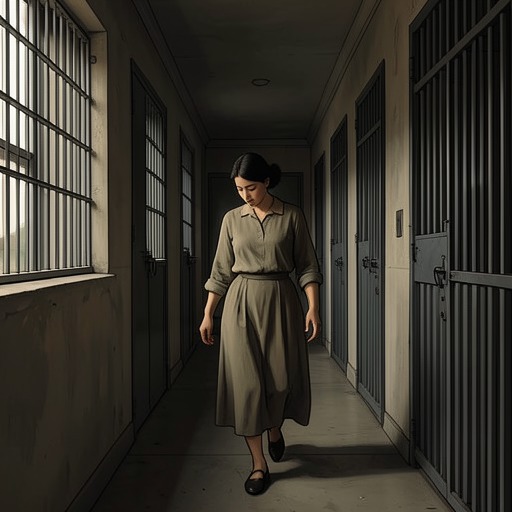
Therese’s repeated captivity and forced servitude
JustineTherese’s repeated captivity and forced servitude are not a single imprisonment but a recurring condition shaped by poverty, deception, and the power of those who control her movements. Again and again, a promised place or apparent escape becomes another form of confinement: she is taken against her will, made dependent on her captors, and compelled to serve. Her efforts to resist do not end the pattern, but her eventual testimony to Juliette and Monsieur de Corville gives its accumulated injustices an audience able to intervene.
Poverty and Exposure to Exploitation
Therese’s vulnerability begins with the loss of family and resources. After her parents die, distant relatives leave her and Juliette only a small legacy, and the sisters are turned out of the convent. Therese later recounts that, still young and without dependable support, she spent her limited inheritance in Paris while searching for work. Her account connects destitution not simply to hardship but to constrained choices: appeals for help expose her to men who treat need as an opportunity to demand services she refuses to provide.
The contrast between her intentions and her circumstances recurs. Therese seeks respectable work and accepts positions in the hope of securing food and shelter; other people decide what those positions will require, withhold information, or use their authority against her. Even when she escapes one threat, the need to recover belongings or find another place to live can draw her back into contact with those who have harmed her. The result is a cycle in which employment offers little reliable protection and apparent consent is compromised by dependence.
Captivity Behind the Monastery Walls
After escaping the monastery, Therese’s freedom lasts only briefly. Her escape had taken two months of preparation: she sawed through her window bars with dull scissors, made a rope from sheets and linen, and descended from the building. On the grounds she discovered that the enclosure concealed more than she had known. Looking through a basement window, she saw four girls who were not among her companions; in a further enclosed area, she encountered the remains of the dead. These discoveries revealed a system of confinement and violence extending beyond the people she had personally known.
Therese reached the forest’s edge before daybreak and continued toward Dijon. At a small hill from which she had seen the monastery six months earlier, she paused to pray and reflect on her escape. The reprieve did not last. Two men seized her while she was on the road, covered her head, and led her away. They eventually told her that she was being taken to serve the Comte de Gernande’s wife, whom they described as insane and kept under strict watch. They admitted that they had abducted Therese because, if told the truth, she would not have accepted the position. A service presented as an opportunity was therefore captivity by design.
From Abduction to Forced Labor
The Comte’s isolated château makes the coercion behind the supposed employment unmistakable. During the journey, Therese learns that she will be confined with his wife and will not be free to leave. The men promise that she will otherwise be well provided for and may someday make her fortune, but those assurances cannot undo the fact that she has been taken without consent. Her previous experience of seeking work has become the means by which her captors make abduction sound like a job.
A later episode repeats the reversal of rescue into imprisonment. Therese had helped Roland, but when he brings her to his mountain stronghold, he identifies himself as the chief of a counterfeiters’ gang and makes her join the women forced to turn a wheel for ten hours each day. He says that she will receive a small daily ration and will never regain her freedom. The work is imposed immediately after an exhausting journey; Roland’s men shackle her beside the other women, and she is also threatened with punishment if she fails to keep pace. The arrangement turns dependence and gratitude into weapons: Therese’s earlier help to Roland offers no protection from his decision to enslave her.
The repeated structure matters as much as any one confinement. At the monastery, the château, and Roland’s stronghold, those with control present coercion as a settled arrangement and expect Therese to adapt to it. Each new captivity narrows her practical choices, while her attempts to preserve her independence repeatedly expose her to further reprisals.
Escape, Recapture, and Release
Therese’s escapes are acts of planning as well as endurance, but getting beyond one enclosure does not guarantee safety. Her departure from the monastery depends on concealment, improvised tools, and the momentary distraction caused by another prisoner’s sentence. Even after she gets outside its barriers and reaches the forest, she is abducted again. The sequence makes freedom precarious: it can be regained physically and then taken away by people who exploit her isolation.
At Roland’s stronghold, the situation changes when Roland departs and his successor takes charge. The new leader releases the women from the forced wheel-work and gives them better lodging and food. This is a concrete end to that particular labor regime, not proof that the wider pattern of danger has ended. When authorities later raid the counterfeiters’ château, Therese is again at risk of being treated as a criminal because she has been found among the gang. Her freedom depends on whether anyone will distinguish an unwilling captive from a willing participant.
The distinction is eventually made in her favor. A magistrate listens to her account and testimony from the counterfeiters supports the conclusion that she took part unwillingly. Therese is acquitted and released. That judgment gives formal recognition to the difference between forced service and freely chosen crime, though it comes only after repeated confinement and depends on a sympathetic protector and a more attentive hearing than she had received in earlier proceedings.
Testimony and the Meaning of Repeated Captivity
The pattern reaches the people who can help when Therese tells the story of her life in Montargis. She is being transported after a Lyon conviction, and Monsieur de Corville takes responsibility for her while Madame de Lorsange asks her to recount her troubles. Therese’s account turns her repeated captivity into testimony: private episodes of coercion become a connected history presented to listeners who can assess her character and intervene.
The listeners’ response is part of the state’s significance. Madame de Lorsange is profoundly moved, then recognizes Therese as her lost sister, Justine. Monsieur de Corville writes to the Lord Chancellor, guarantees Therese’s innocence, and arranges for her to be entrusted to his care while her case is clarified. The story’s frame thus contrasts institutions and employers who fail to protect a vulnerable woman with witnesses who believe her and use their standing to secure protection.
Across the episodes, captivity is sustained by the same imbalance: Therese needs shelter and work, while her captors control access, information, and movement. Yet the distinction between coerced labor and willing criminality remains crucial. Her repeated efforts to escape, her refusal to accept exploitative demands, and the testimony that eventually secures her release make the state both a record of material vulnerability and a measure of the moral and legal failures surrounding her.