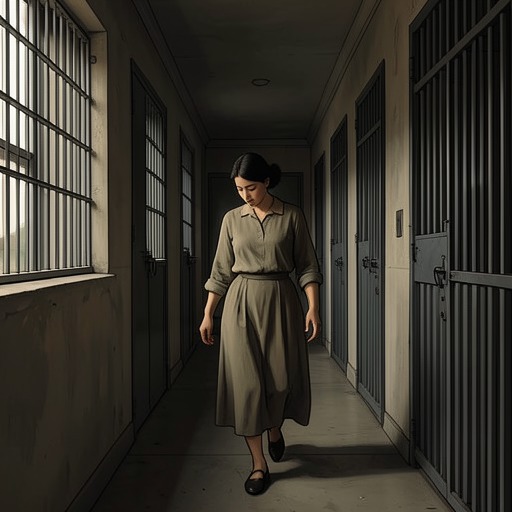
Convent isolation and impunity
JustineConvent isolation and impunity is the system that allows the monks of Saint Mary-in-the-Wood to conceal their treatment of captive girls and to act without effective oversight. A hidden, fortified pavilion, relentless internal control, and a public image of religious austerity work together: the girls are isolated from the outside world, while the outside world is given reasons not to look closely. The narrative sets this protected institution against the vulnerability of Justine, whose appeals fail in courts dominated by status and influence, and against her later rescue, which depends on powerful advocates rather than equal access to justice.
Concealment and Architecture
The pavilion is connected to the monastery church by a concealed door behind the altar, hidden in the sacristy’s woodwork and opened by a spring. Beyond it, a long, winding passage descends beneath a thirty-foot moat before rising toward the pavilion’s cellars. The route runs for a quarter of a league, but its very length and turns make it difficult to remember or navigate without the monks’ guidance.
The building is designed to disappear into its surroundings. It stands less than twenty-five feet high, while six surrounding enclosures—stone walls and closely planted living palisades—rise at least fifty feet. From the church tower, the pavilion appears to be only a dense clump of trees. Its roof is covered with earth and evergreen shrubs, blending its outline with the screens around it and reinforcing the appearance that no hidden residence exists there.
The interior arrangement further separates the captives from the outside. The pavilion has cellars, a ground floor, an entresol, and a first floor. Its basements include a central hall, eight smaller rooms, two used as dungeons and six reserved for provisions. The living and sleeping areas are organized around the monks’ use of the building; deaf-and-dumb serving friars fill key roles as jailer, valet, doctor, and cook, and the girls are forbidden to approach or communicate with them. The institution’s physical design is thus also a design for restricted knowledge: its occupants cannot readily reach its exits, and those assigned to serve it cannot become ordinary intermediaries with the outside.
Barriers to Escape
The two upper seraglios each contain a large chamber edged with eight cubicles. Even a girl who broke through a barred window would still face five palisades, a substantial wall, a moat, and the monastery courtyard’s own locked boundaries. The apparent possibility of escape by a window only leads to further barriers.
The underground route offers no reliable alternative. The girls are kept from exploring the locked cellars; the tunnel entrance is hidden in an unknown corner and barred, with the keys held by the monks. Even someone who reached the passage would encounter traps whose locations were known only to the captors. Omphale’s explanation therefore describes more than a difficult escape: the institution monopolizes the knowledge necessary to move through its space safely.
That physical control supports the monks’ sense of impunity. Omphale says that the captives do not leave except upon death and that their keepers’ certainty that no independent witnesses will see their conduct encourages ever greater cruelty. The enclosure makes the victims the only witnesses to what happens inside; the same barriers that prevent flight also prevent testimony from reaching an audience able to act on it.
Internal Control and Routine
The building’s isolation is reinforced by a regulated household. The pavilion maintains sixteen girls, divided between two chambers, and assigns them to age classes marked by different-colored clothing. Omphale explains that their dress changes between day and evening, while the superintendent is responsible for inspecting them before the monks’ gatherings. Rules and penalties are posted in each chamber, and the Officer of the Day hears complaints, gives orders, assigns girls, and imposes punishment.
Inspection is built into the daily schedule. At nine each morning the Officer of the Day makes his rounds, examines each girl, selects those assigned for the evening, receives the superintendent’s report, and orders penalties. Other requests may arrive through the jailer, who brings a card naming the girl wanted. At set hours, those selected are escorted to the monks; some return afterward, while others are kept overnight. The timetable turns access to the girls into a procedure administered by the institution, rather than an event they can refuse or control.
The rules also make ordinary conditions of life subject to punishment. Omphale lists penalties for failing to rise on time, dress properly, or notify the authorities of incapacity; refusal or perceived failure in the monks’ demands brings harsher sanctions. Even signs of distress, remorse, or renewed religious feeling are punishable. Food is likewise administered under supervision, and persistent refusal to eat brings punishment. The rules make the girls’ conduct legible to their overseers while leaving the monks’ actions beyond comparable scrutiny.
Illness and death reveal the system’s most absolute disregard for the captives’ welfare. Girls who become ill are entrusted only to the surgeon friar. The dead receive no religious rites, and their bodies are left in spaces between the surrounding enclosures. If a girl’s condition is considered dangerous or contagious, she may be removed before death. Omphale recalls seeing more than ten such cases during her eighteen years there; the monks justify the practice by arguing that one girl can be replaced and that the rest must be protected. Replacement, not care, is the governing logic.
Public Reputation and Institutional Continuity
The monks’ secrecy is protected not only by walls but by a public performance of religious respectability. Omphale says the superior is closely connected to the Pope and that the supposed miracles of the Virgin have helped establish the monastery’s reputation and deflect scrutiny. Visitors are rare—she estimates that fewer than ten arrive in a year—and the bishop of Auxerre never visits the house. When strangers do appear, the superior receives them with an outward show of hospitality, religion, and austerity. They leave satisfied, and the monastery is praised.
The false public image turns the institution’s isolation into social protection. The monks are not merely hidden from observers: the few observers who reach them are encouraged to certify the very reputation that makes closer examination unlikely. Omphale reports that the system has persisted for more than a century, with successive superiors perpetuating it. Severino, who has lived there for twenty-five years, intends to preserve its privileges; Antonin, Clement, and Jerome have likewise served there for ten, eighteen, and thirty years respectively. The routine and the concealment are therefore presented as established practice, not as the temporary excesses of one occupant.
The narrative’s framing sharpens the contrast between this institutional impunity and the legal exposure of the poor. When Justine is accused of stealing a diamond, the object is found in her mattress after her employer plants it there. Her account of his earlier attempt to involve her in wrongdoing is dismissed as recrimination, while his long-standing reputation for integrity carries weight. Because she lacks influence and protection, the discovery is treated as decisive and she is sent to prison. Elsewhere, her protest against a powerful accuser is converted into apparent evidence of guilt, and a judge accepts Saint-Florent’s fabricated account against her. Institutions that claim to adjudicate truth repeatedly fail her; the hidden monastery represents an extreme version of the same imbalance, with its victims denied both an audience and a fair hearing.
Exposure, Rescue, and Significance
The contrast does not resolve into a simple triumph of justice. Monsieur de Corville intervenes after hearing Justine’s story and learning that she is being transferred from Lyon to Paris for confirmation of her sentence. After her sister Juliette recognizes her, he writes to the Lord Chancellor, vouches for her innocence, and assumes responsibility for her custody at his château while the case is reconsidered. The protection he can offer gives her a chance to escape the ordinary machinery that has repeatedly failed her.
Royal letters eventually nullify the proceedings against Justine, restore her reputation, silence the tribunals that had defamed her, and grant her an annual income of one thousand crowns. Yet the contrast between official vindication and practical accountability remains stark. Cardoville and Saint-Florent have reached powerful posts before their crimes become public, and their influential families quiet the resulting scandal. The narrative thus distinguishes recognition of innocence from the punishment of those who caused harm: the first is secured, but the second is blunted by status and connections.
The monks of Saint Mary-in-the-Wood are likewise threatened with exposure only through a coming institutional change: the suppression of religious orders is said to reveal their crimes. Until then, the monastery’s hidden passage, layered boundaries, closed routines, and cultivated reputation form a single apparatus of impunity. Its significance lies in how thoroughly it reverses the expected roles of visibility and authority: the confined girls are observable, classified, and disciplined, while their captors remain shielded from witnesses and law. The wider story echoes that structure whenever Justine’s poverty weakens her testimony and a powerful person’s reputation or office protects an accusation from scrutiny.