Ahti and Kyllikki's Marriage Oaths
KalevalaAhti and Kyllikki's Marriage Oaths are a reciprocal marital compact whose terms restrain Lemminkainen’s pursuit of battle and Kyllikki’s attendance at village dances. Sworn before Ukko, the promises give the marriage a shared rule of conduct; their later breach marks the point at which that domestic agreement gives way to Lemminkainen’s renewed movement toward conflict.
Terms and Conditions
Kyllikki raises the matter while addressing Lemminkainen as a husband from whom she expects fidelity. Her concern is not expressed as an abstract rule for all spouses: she asks him to bind himself against going to battle when he longs for gold and silver. The condition links his military ambition to the desire for wealth, making the vow a limit on the particular impulse that could draw him away from married life.
Lemminkainen accepts the demand by promising not to go to battle. The compact also sets a different condition for Kyllikki. She promises not to visit village dances when the desire to dance moves her. The obligations are therefore reciprocal but not identical: his concerns the battlefield and the lure of riches, while hers concerns public festivity and dancing. The poem presents each promise as a restraint undertaken by one spouse in response to the other’s request, rather than as a single undifferentiated rule imposed on both.
Witness and Binding Force
The couple make their oaths together, and the narrative emphasizes their formal confirmation: the vows are registered in heaven and sworn before the all-knowing Ukko. The divine witness raises the promises above a private exchange between spouses. Their spoken commitment is treated as consequential because it has been made in a sacred presence, not merely because one spouse expects the other to remember it.
The scene gives the oath a clear structure: a request, an undertaking by each partner, and a witness who hears the pledges. It identifies no human judge or later procedure for enforcing them. Instead, the compact’s force rests on the spouses’ own words and on the heavenly witness invoked by the poem. This makes the vows both intimate and public in their significance: they concern the conduct of a married pair, but their registration in heaven places that conduct under divine notice.
Breach and Consequence
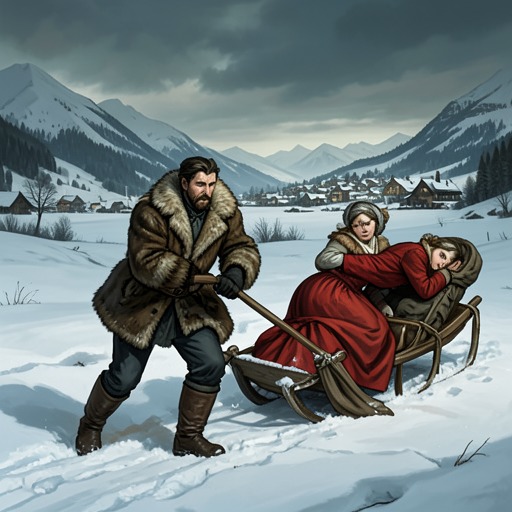
The narrative later reports that Kyllikki is not home as evening comes on; she has gone to the village dance. This is the specific action her vow prohibited. The episode does not need to restate the entire agreement: the remembered promise gives the dance its force as a breach, turning an ordinary visit into a failure of the terms the pair had sworn together.
Afterward, Lemminkainen declares that he must hasten to combat, toward the campfires of Northland and the battlefields of Lapland. His announced departure directly recalls the other half of the compact. The sequence places Kyllikki’s visit and his renewed readiness for war in sharp proximity: the two restraints that had defined their agreement are both put under pressure. The narrative thus presents the oath not as a guarantee that desire will disappear, but as a measure of whether each spouse will hold to a promise when the activity it forbids again becomes attractive.
The terms do not make the spouses’ desires interchangeable. Kyllikki’s breach is a journey to a dance; Lemminkainen’s is a turn toward armed conflict and the Northland. Yet the parallel structure matters: each had agreed to forgo a pursuit, and the pair’s shared oath now makes each departure legible as more than a private choice. The compact’s breakdown coincides with Lemminkainen’s return to the outward, dangerous world of combat.
Marriage, Choice, and the Poem’s Oath Pattern
The mutual character of these vows stands in contrast to the circumstances surrounding Aino. Youkahainen offers Aino as a bride in exchange for release from torment, while Aino’s response to her mother is marked by sorrow. In that episode, a marriage promise is made by a relative as part of a bargain, and the woman who is promised grieves. Kyllikki’s scene instead gives her a speaking role in defining terms for her own marriage: she directly asks Lemminkainen for a promise, and he answers with one of his own. The contrast does not erase the limits or later failure of their compact, but it distinguishes mutual pledging from a marriage arrangement made over a woman’s head.
Elsewhere, the poem also depicts spoken promises as consequential beyond courtship and marriage. Iron makes a promise and swears it by the furnace and the anvil, an oath framed through the objects associated with its making. The comparison underscores that sworn speech is a recurring way the poem binds a speaker to future conduct, while the marriage vows have their own distinct witness in Ukko. Here, the vows’ significance lies in joining domestic fidelity to limits on the pursuits that could draw the spouses apart—and in the narrative’s subsequent demonstration that a solemnly witnessed agreement can still be broken.