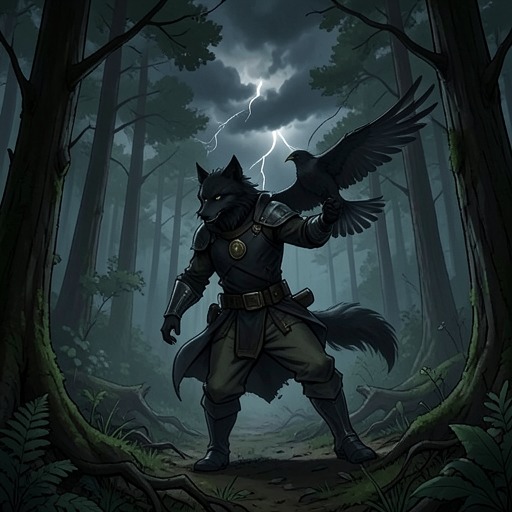
Kullervo’s cattle–bear pact
KalevalaKullervo’s cattle–bear pact is a proposed agreement between Kullervo and Otso that regulates their coexistence in the woods. Addressing Otso in Metsola’s milk-yards, Kullervo presents the compact as both protection for his cattle and a way to share the woodland without eliminating the possibility of conflict. Its terms are unusually concrete: they distinguish shared territory from separate food, and reserve any contest for winter, when the snowfields make fighting permissible. The passage gives the pact’s conditions, but not its eventual fulfillment or breach.
Setting and Participants
The exchange takes place in Metsola’s broad milk-yards as evening approaches. Kullervo addresses Otso directly, using respectful, affectionate names for the bear rather than treating it only as an animal to be driven away. That manner of address gives the negotiation its distinctive shape: the bear is approached as a participant capable of receiving a promise and entering a lasting agreement.
The scene concerns practical interests. Kullervo has cattle to protect, while Otso belongs to the woodland world in which those cattle graze. The agreement does not erase this difference or claim that the two must have identical needs. Instead, it identifies a way for them to occupy the same landscape while keeping their respective lives and food distinct. The pact’s terms make coexistence, rather than the bear’s removal, the immediate objective.
Terms of the Agreement
Kullervo proposes that he and Otso make a lasting treaty, framed as a vow intended to endure into the future. One explicit obligation is that Otso will not kill the cattle or eat the animals that provide milk. The promise therefore protects more than a single herd from immediate danger: it names the cattle’s continuing usefulness to Kullervo’s household as the interest the treaty is meant to preserve.
The agreement also speaks of honor and of a future in which food and drink will not fail. These assurances give the compact a broader horizon than an exchange limited to one encounter. Yet the passage presents them as the terms and hopes of the proposed agreement, not as proof that abundance follows or that Otso accepts every condition. Its language moves from the immediate prohibition against harming the cattle to a vision of enduring, honorable relations.
Shared Woods and Seasonal Conflict
Kullervo’s proposal allows the two to enjoy the woods in common while keeping their food separate. This distinction is central to the pact: shared territory does not mean that every resource is shared, and peaceful coexistence depends on respecting boundaries within that common space. The arrangement recognizes both proximity and difference instead of pretending that the bear and the herdsman have no competing interests.
The pact does not promise that conflict will never occur. If Otso still desires to fight Kullervo, their contests are to take place in winter, on snow-covered ground. The seasonal rule contrasts that permitted time with summer, when the swamps thaw and river waters grow warm. In the agreement’s logic, the changing conditions of the landscape help mark when a contest may be allowed; the woodland is not a neutral backdrop but part of the rule’s practical terms.
The passage also identifies a condition that would constitute a breach: Otso must not come where the golden cattle roam if he breaks the treaty. That warning gives the compact a sharper edge than its language of honor and shared enjoyment. The promise has a boundary, and the cattle’s grazing grounds make that boundary visible. The excerpt sets out the consequence as a condition of the agreement, but does not narrate a later test of it.
Oath, Form, and Significance
The pact is built from repeated acts of promising: Kullervo proposes a lasting treaty, invokes a vow for future ages, and calls for agreement in honor. This reiteration presents speech as the means by which a relationship is defined and conduct is constrained. The compact is not described as a written law or a judgment handed down by an authority; its force in the passage rests on the pledged terms between Kullervo and Otso.
That emphasis belongs to a poem whose preface describes the Kalevala as transmitted by singers and characterized by an eight-syllable trochaic metre, alliteration, and paired rhythmic movement. The pact’s successive balances—common woods and distinct food, peace and possible contest, summer and winter—fit that broader account of a poetry organized through parallel expressions. The preface also presents the epic as containing several nearly independent episodes within a continuous whole, a form that helps explain how a compact exchange can stand out as a self-contained rule within a larger narrative.
Elsewhere in the epic, promises may be expressly associated with divine witness: Lemminkainen and Kyllikki register their vows before Ukko, while Iron makes a promise by the furnace and anvil. Kullervo’s proposal, as preserved here, instead stresses honor, duration, and the practical terms of living beside Otso. The available passage does not say whether a deity witnesses this pact, whether Otso formally answers, or how either party behaves afterward. Its significance rests securely in the rule it attempts to establish: shared woodland life is possible, but it requires limits, reciprocal restraint, and an agreed place for conflict when restraint fails.