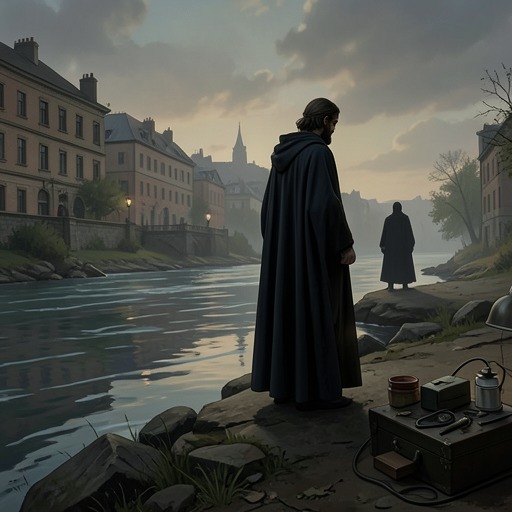
The Prohibition on the Living Crossing the River of Tuoni
KalevalaThe Prohibition on the Living Crossing the River of Tuoni is Wainamoinen’s explicit warning that living heroes and singers must not cross into the realm of the dead. Spoken after he has escaped from Tuonela, it treats the crossing not as an ordinary journey but as a transgression of nature’s laws, one from which few return to tell what happened.
Formulation and Scope
After his escape, Wainamoinen speaks in supplication. His appeal is framed as a prohibition: even the wisest among the heroes must not transgress the laws of nature, and no singer still living in a body should cross the River of Tuoni. The injunction therefore identifies both a group particularly associated with the poem’s heroic and singing world and a condition that defines its boundary: the singer is still embodied and alive.
The warning does not describe a general ban on travel or give practical instructions for a crossing. It names the destination through a sequence of related expressions: the River of Tuoni, the fatal stream of Mana, Tuonela, and Manala’s courts and castles. The changing images move from a river channel to the domain beyond it. In the appeal’s terms, crossing is a passage into a place from which return is rare, not a routine crossing between neighboring territories.
Grounds for the Warning
Wainamoinen’s request is anchored in the consequences of crossing. Many heroes, he says, pass over the channel and the fatal stream, but few come back to tell their story; few return from Tuonela. The repeated contrast between many who enter and few who return gives the prohibition its force. It does not claim that return is impossible: the warning is grave precisely because the text allows for rare survivors, while making clear that most cannot report their fate.
The language of law and the language of danger work together. Crossing is called a transgression of nature’s laws, while the stream itself is marked as fatal. The appeal thus presents the boundary as both a perilous fact of the world and a limit that ought to be respected. It does not specify a punishment imposed on those who disobey, or explain how the law is enforced; its stated reason is the lethal risk and the scarcity of return.
Wainamoinen’s Experience and the Appeal
The order of the episode gives the injunction particular weight. Wainamoinen has just escaped from Tuonela when he warns against other heroes making the same passage. His own survival stands beside the assertion that few return, making him an exceptional survivor rather than evidence that the crossing is safe. The warning turns his escape into a basis for counsel: the experience of coming back sharpens his appeal to prevent others from attempting the journey.
He invokes the addressee’s care for its creations, asking that other heroes and singers be kept from crossing. This appeal places the prohibition in a protective frame, rather than presenting it only as an impersonal rule. The text does not name the addressee in these lines, so the request is best understood through its stated concern: preserving living figures from a passage that most do not survive.
Narrative Function and Limits
The warning establishes a sharp distinction between the living, still embodied, and the destination beyond the fatal water. Its emphasis on singers makes the danger relevant not only to warriors but also to figures whose identity is bound to song. The rule therefore puts a limit around the heroic world’s movement: even exceptional figures should not treat the realm beyond the river as safely accessible.
After making his appeal, Wainamoinen calls his people on the plains of Kalevala. The movement back toward his community follows the account of the dangerous passage, though the lines do not say that the call itself enforces the prohibition. What they do establish is the warning’s place in the narrative: it is spoken in the aftermath of an escape and turns attention from the perilous otherworld toward the living community. The passage offers no detailed account of a formal code or its later enforcement; its force rests on the natural boundary it names, the rarity of return, and Wainamoinen’s immediate experience of having escaped.