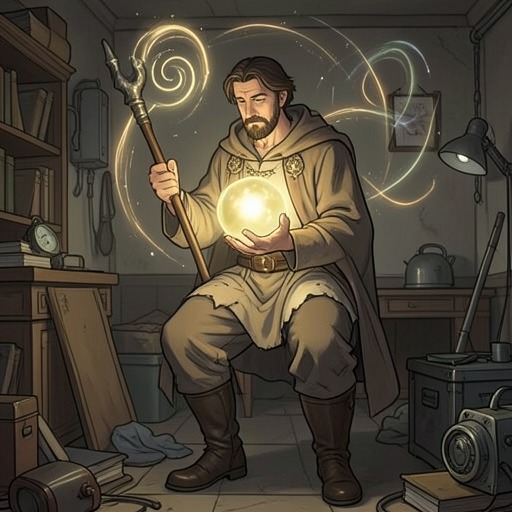
Origin-singing principle
KalevalaThe Origin-singing principle is the Kalevala’s rule that a harmful force can be overcome by chanting its origin. In the poem, knowledge of how something came to be is not merely explanation: it gives the singer a means to act upon it. The principle links practical magic to the epic’s account of nature, where wounds, diseases, beasts, and serpents may be met through a song that names their beginnings.
The Rule and Its Scope
The preface describes the principle in direct terms: when a hero seeks to overcome an aggressive force—whether a wound, a disease, a ferocious beast, or a venomous serpent—he chants the origin of the thing threatening him. The underlying thought, as the preface presents it, is that knowledge of where and how evil came into being would allow it to be obviated. Origin-singing therefore makes the past operational. A singer does not simply describe a danger; by telling its beginning, the singer gains a way to oppose it.
The range of examples matters. The rule is not confined to one kind of adversary or one kind of remedy: bodily injury, illness, and dangerous living creatures all belong to its field. This breadth reflects the poem’s account of a living, responsive nature. Harm is not presented as an inexplicable abstraction but as a force with a history that can be brought into speech. The principle makes that history a source of leverage, without suggesting that the same verse or procedure must apply to every danger.
Wainamoinen’s Wound and the Origin of Iron
The episode involving Wainamoinen gives the rule a sharply practical setting. An axe has torn open his knee, and the injury continues to bleed. Rather than beginning with an account of iron in the abstract, the scene begins with the wound’s immediate consequence: blood is flowing, and the injured singer needs help. He tells the gray-beard of his trouble and asks him to sing the cause of it, the source of metals, and how iron was first created.
The gray-beard’s reply establishes the reach attributed to mastery in song. He says that greater and more wondrous things have been accomplished through only three words of the master: cataracts have been lessened, bays made from promontories, and islands raised from the deep sea-bottoms. These examples move from changing waters to reshaping land, making the claim larger than a single act of healing. Within the episode, the response encourages Wainamoinen to begin his own incantation; it does not replace the specific work he undertakes.
Wainamoinen sings the origin of iron with the wound still at issue. The narrative connects that account to his effort to fashion a bolt as protection against the injuries inflicted by the axe. His song is purposeful: he seeks the knowledge needed to respond to the harm, and the origin of the metal that made the weapon becomes central to that response. The scene thus brings material cause and bodily consequence together. Iron is at once the substance associated with the axe and the subject whose beginning must be sung.
Knowledge, Speech, and Power
The episode distinguishes possessing information from exercising it. The gray-beard speaks of the wonders accomplished by three words of the master; Wainamoinen then begins his own ordered incantation and sings iron’s origin. In the preface’s account, the effectiveness of this practice rests on knowledge of origin, while the episode dramatizes that knowledge through speech directed toward an actual danger. Singing becomes a mode of intervention rather than ornamental commentary.
The principle also helps explain why the epic repeatedly gives its heroes magical means of action. The preface describes song as a way to confront forces that might otherwise overpower them, and identifies origin-chanting as a philosophical feature of the poem: the dangerous thing can be met when its beginning is known. This framing does not make every song interchangeable or guarantee that every conflict has the same solution. Instead, it shows how the poem makes the act of discovering and voicing a cause part of the struggle itself.
Poetic Form and Inherited Tradition
Origin-singing belongs to a poem presented as the accumulated wisdom and experience of a people, not simply as a sequence of marvels. The preface characterizes the Kalevala as rich in lore about nature and the origins of things, and describes its songs as having been preserved orally by minstrels from generation to generation. It also identifies the epic’s characteristic eight-syllabled trochaic metre and use of alliteration. In that setting, a sung account of an origin connects the principle’s content—knowledge of beginnings—with the poem’s own identity as inherited song.
The epic’s form is described as a continuous whole containing substantial, nearly independent parts, among them the contest of Youkahainen, the Kullervo episode, and the legend of Mariatta. This structure places the rule within a work that can hold distinct episodes while sustaining shared ideas about magic, nature, and human experience. Origin-singing is therefore both a particular method used in a wound episode and a compact expression of the larger world the poem describes: causes can be remembered, rendered in song, and brought to bear against harm.