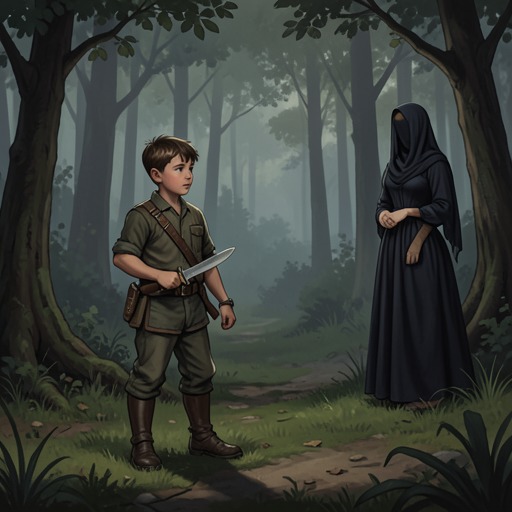
Ilmarinen and the Maiden of the Rainbow
KalevalaIlmarinen and the Maiden of the Rainbow are joined first by her change of identity into his wife and hostess, then by the violence that ends her life and the grief that follows. The surviving episodes place their marriage within the labor of a household: she is responsible for receiving and waiting for the herd with Kullervo, while Ilmarinen’s response to her death is expressed through mourning and the cessation of his work at the forge.
Identity and Household
The narrative identifies Ilmarinen’s wife as the woman who was once the Maiden of the Rainbow. That repeated identification connects her earlier identity as a sought-after maiden with her later position in Ilmarinen’s household; she is no longer described only through courtship, but as a wife and hostess with domestic responsibilities.
One brief passage gives her a moment of deliberation. After a reference to evening occupation and labor worthy of a servant, she is shown thinking for a long time and debating. The passage establishes that she pauses to consider what is before her, though it does not specify the full subject of her deliberation. Her role is thus presented through both household work and a moment of considered judgment, rather than through a detailed account of her thoughts.
The Household and Kullervo
The relationship becomes sharply practical in the episode of the herd. Ilmarinen’s wife and hostess waits for its return with Kullervo, looking toward the home-land hill-tops three times and near the coming gateways six times. The repeated watching gives her waiting a measured, expectant rhythm and places Kullervo within the household’s daily work as the person associated with the herd.
That arrangement ends in retaliation. Kullervo is named a cruel wizard, and the narration says that he repays the hostess for her wicked treatment and evil conduct. He calls on bears and wolves to tear and mutilate her with their teeth and sharpened fingers. The episode presents the violence as vengeance for mistreatment, but the surviving lines do not detail the specific acts behind that charge. The account therefore establishes the stated cause of Kullervo’s revenge without supplying grounds to enlarge or reinterpret it.
Death and Consequence
The hostess falls and perishes in the hurdles. Her death is sudden in the narration: the sequence moves from Kullervo’s demand for further mischief to the wife’s fall and death. The domestic setting, previously defined by waiting for the herd, becomes the place of a fatal reversal. The poem’s two designations for her—the wife and hostess, and the former Maiden of the Rainbow—keep her household position and earlier identity in view even as the episode reduces her final action to the violence done to her.
Her death changes Ilmarinen’s story at once. A later episode names her as his companion and again recalls that she was once the Maiden of the Rainbow. Ilmarinen weeps on the first day, the second, and from morning until evening on the third. During that mourning he does not swing his heavy hammer. The poem thus makes bereavement visible through both repeated lament and suspended labor: the smith’s defining work stops while he grieves his wife.
The Relationship’s Arc
The relationship is recorded through a compact succession of statuses and consequences: the Maiden of the Rainbow becomes Ilmarinen’s wife; as hostess, she waits for the herd with Kullervo; she dies in the revenge he directs against her; and Ilmarinen mourns her for three days, laying aside his hammer. The surviving passages do not describe the couple’s shared life in detail, so their bond is most clearly legible at its two edges—her place in the household and his grief after her death.
That structure also gives her changing titles particular weight. The narrative recalls the Maiden of the Rainbow when naming Ilmarinen’s dead companion, making the loss belong to both the marriage and the earlier identity that preceded it. Her death is not only an episode in Kullervo’s revenge: it leaves Ilmarinen bereaved and interrupts the work through which he is otherwise represented.