Iron and Fire as brothers
KalevalaIron and Fire as brothers is a mythic relationship in which kinship brings Iron into contact with the very force that threatens to destroy him. Iron is the younger brother and Fire the elder; Iron approaches him out of affection and a wish to know him better, but the visit turns into an attempted consumption. Iron’s escape, followed by his fear at the mention of the furnace and the account’s movement from iron to steel, makes their bond both a family story and an explanation of metalworking’s perilous power.
Origins and the hidden metal
The account first gives iron a material origin: red and brittle iron grows where red milk has been sprinkled. It then locates iron in swamp lands, extending beside watercourses and remaining hidden there for many ages. The surrounding landscape is not an abstract storehouse of ore: the passage places the marsh among the nesting grounds of swans and the hatching places of wild geese. Iron belongs to this wet, living terrain before it becomes a material exposed to fire and human use.
This beginning gives the later encounter a longer horizon. Iron has existed concealed for ages, but concealment does not make it safe once Fire enters its story. The episode moves from a substance embedded in the swamp to a personified younger brother who can visit, recognize danger, and run. Its account of origin therefore makes the metal’s vulnerability part of its identity: iron is red and brittle before the narrative presents its flight from Fire and its eventual formation into steel.
A visit becomes an attack
After time has passed, Iron hastens to visit Fire, described as his beloved elder brother. The stated purpose is to know his brother better. The language makes the visit an act of attachment rather than an expedition undertaken to fight or master Fire. Yet the kinship terms do not guarantee care. Fire begins to roar and labors to consume Iron, calling him his beloved younger brother even as the danger becomes immediate.
That contrast gives the encounter its force. The brothers are named through affection, but their elemental relation is unequal: Fire can threaten to consume, while Iron must save himself by fleeing from the flames. The narrative does not make Iron’s escape a reconciliation, nor does it say that the brothers reach a lasting understanding. Instead, the visit ends with the younger brother’s survival depending on distance from the elder. The desire for greater knowledge brings Iron close to Fire, but closeness reveals danger rather than security.
Fear of the furnace and the making of steel
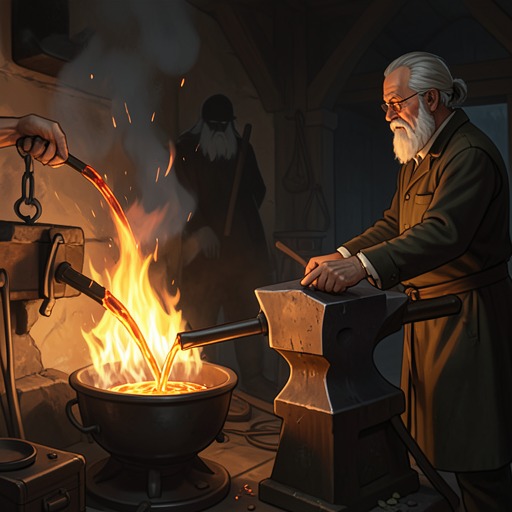
The threat returns in a later, more practical form when the possibility of placing Iron in a furnace is raised so that he might be made free and useful. Iron is then described as frightened, distressed, and horrified at the mention of Fire. That response recalls the earlier encounter: the furnace is not presented merely as equipment but as Fire’s domain, and the earlier attempt to consume Iron gives the prospect of entering it a narrative history.
The wording also introduces a tension between danger and usefulness. Furnace treatment is proposed as the means of making Iron useful, but the proposal comes to a substance already marked by fear of Fire. The narrative thus places transformation on the far side of threatened destruction: what enables a new form also recalls the force that once drove Iron to flee. It does not erase Iron’s vulnerability; it makes that vulnerability part of the story of what the metal can become.
The account then says that steel was formed from iron. In the adjacent passage, water is mixed with many poisons and mistaken for wild-bee honey before the transformation is stated. The brief sequence binds steel-making to the poem’s language of hazardous substances and mistaken recognition, without explaining every step or identifying the actor in the excerpt. Its ending nevertheless marks a change of material state: the iron introduced as red and brittle does not remain the account’s final form.
Meaning of the brotherhood
The brotherhood is therefore not a simple image of harmony between elements. Its emotional vocabulary is affectionate, but its action is violent: Iron seeks acquaintance, Fire roars and tries to consume him, and Iron escapes. Later fear at the furnace carries that peril forward, while the formation of steel gives the encounter’s dangerous force a place within the account of iron’s transformation.
The narrative’s sequence is decisive. It first establishes iron’s origin and long concealment, then gives the metal a family relation and a perilous visit, and finally returns to Fire through the furnace and the making of steel. The result is a compact account in which kinship explains proximity, danger explains flight, and the possibility of usefulness remains inseparable from exposure to Fire. Iron’s passage from brittle swamp metal toward steel does not cancel the brotherly threat; it makes the threat part of the material’s remembered story.