Wainamoinen—Louhi rivalry
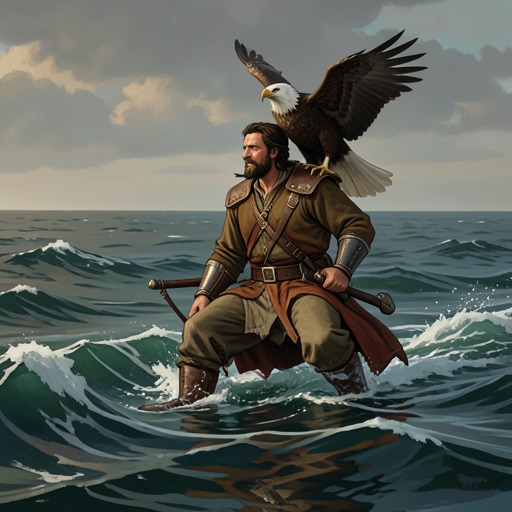
KalevalaWainamoinen—Louhi rivalry is a contest between Wainamoinen, the ancient minstrel of Wainola, and Louhi, hostess of the Northland and Pohyola. Its clearest grounds are the Sampo and, in a later encounter, Wainamoinen’s declared mission to the Northland for the Sun. Their conflict moves between direct address and the threat of force: Louhi speaks as a host with power over her people, while Wainamoinen presses her over an object whose possession is described as a source of joy. The relationship is therefore more than personal antagonism; it brings ownership, prestige, and competing claims into open confrontation.
The Sampo and the Terms of Rivalry
Wainamoinen addresses Louhi over whether the Sampo will be shared. His appeal makes the dispute a question of access as well as possession: the Sampo is associated with the joy of those who possess it, and he challenges Louhi about keeping it from others. The exchange presents the rivalry as a negotiation that has reached an impasse, though the surviving lines do not specify the terms of any proposed division. What they do establish is that Wainamoinen addresses Louhi directly rather than treating the Sampo as an abstract prize; the question of its use is bound to their relationship.
The Sampo’s setting intensifies that contest. It is described as concealed behind nine copper locks in a copper-bearing mountain at Pohyola. The image of the locked mountain gives possession a guarded, almost fortress-like form: access is not simply a matter of Louhi agreeing to share, but of reaching something held behind layered barriers. The description also clarifies why the struggle has consequences beyond the two speakers. The Sampo brings joy to its possessors, so the question of who controls it affects the wider community associated with that possession.
Louhi’s Retaliation and the Threat of Force
Louhi’s response is presented as anger and a call for vengeance. The narration links her reaction with her fame departing, placing wounded standing beside the dispute over the Sampo. Her authority is thus implicated in the conflict: the challenge concerns not only the object itself but also what losing or sharing it would mean for her reputation. This connection between possession and renown makes the confrontation harder to settle as a simple bargain.
Louhi’s answer to the challenge is collective preparation. She calls her tribes together and gives archers bows and arrows, shifting the rivalry from an exchange between leaders to a danger involving armed followers. The act establishes her capacity to mobilize force and shows that her authority extends beyond her personal encounter with Wainamoinen. The conflict’s scale changes accordingly: what began as a dispute about sharing becomes a confrontation in which the Sampo and the people gathered around its possession are exposed to violence.
Wainamoinen’s address to Louhi registers the danger of that escalation. He speaks of what may fall before her weapons and perish in the deep sea, drawing attention to the possibility that force could destroy or lose what the rivals are contesting. In this moment, the Sampo’s value complicates the struggle: it is an object worth pursuing, but the contest threatens the object itself. Louhi, in turn, speaks of other mighty measures. The exchange leaves the conflict open to further action rather than resolving it through agreement, and makes their rivalry a contest of countermoves as well as claims.
The Later Confrontation over the Sun
A later encounter gives the rivalry another object and a different immediate setting. Louhi hastens to her chamber window and looks toward the bay and river after black smoke rises toward Ukko’s home. Wainamoinen then addresses Louhi’s hosts and explains that he has come to the Northland for the Sun. The scene again places him in direct opposition to Louhi’s domain, but now his stated purpose is not to negotiate over the Sampo: he identifies the Sun as the reason for his arrival.
This return to confrontation broadens the pattern established by the Sampo dispute. The earlier exchange centers on sharing and possession; the later one gives Wainamoinen a declared mission involving the Sun. Louhi’s position as hostess makes her the person through whom the Northland is encountered, while her question about his mission makes the purpose of his arrival explicit. The two episodes do not erase their earlier conflict; they show its recurrence around another consequential object and keep the relationship organized around access, opposition, and claims that bring Wainamoinen back to Louhi’s territory.
Narrative Significance
The rivalry is shaped by opposed forms of power. Louhi’s authority appears in her role as hostess, in her ability to summon tribes and arm archers, and in her control of the guarded setting associated with the Sampo. Wainamoinen’s power in these encounters is expressed through direct address and declared purpose: he challenges the terms of possession and later names the Sun as the object of his mission. Neither figure is reduced to a silent obstacle or a passing challenger; the narrative gives each a speaking part in the contest.
The repeated confrontations also connect private exchange to collective consequence. A question put by Wainamoinen becomes a response from Louhi, then a gathering of armed people; later, his arrival for the Sun is addressed before Louhi’s hosts. Their rivalry consequently serves as a recurring point where the concerns of leaders, guarded possessions, and wider communities meet. Its defining tension is that claims made face to face can draw whole groups into conflict, while the objects at stake remain vulnerable to the very struggle meant to secure them.