Kullervo and Untamo
KalevalaKullervo and Untamo are uncle and nephew bound by a feud that outlives the destruction of Kullervo’s family. Untamo’s violence against Kalervo’s people makes the infant Kullervo a potential avenger; his survival, enslavement, and eventual attack on Untamo’s people turn the feud into a chain linking family loss to retaliatory violence. The relationship is marked by an imbalance: Untamo can dispose of the child and sell him into service, but cannot make him die or erase the grievance he carries.
Identity and Background
Untamo is Kullervo’s uncle and the enemy responsible for the wrong that shapes Kullervo’s early life. The feud reaches back to the murder of Kalervo and his people. When Kullervo declares that he will avenge their deaths, Untamo understands the threat as one directed against his own tribe. The family conflict therefore precedes Kullervo’s personal choices: he is born into a history of violence and identified, even as a child, with the possibility of answering it.
The narrative gives this inherited grievance a concrete human focus in the child. Kullervo is not simply an opponent whom Untamo encounters as an adult; he is a surviving member of the family Untamo has attacked. Their kinship does not soften the feud. Instead, the relation makes Untamo’s actions against the boy part of the same conflict that began with the destruction of Kalervo’s people, while Kullervo’s later revenge is presented as a response to that earlier injury.
The Child Untamo Cannot Destroy
Kullervo’s first resistance to Untamo is survival. After a boy is born to the virgin Untamala, he is placed in a basket secured with willow and taken to the reeds and rushes. Untamo’s efforts to eliminate or contain him do not succeed. When the child is subjected to fire, not a hair is burned and not a ringlet is singed. The repeated failure changes the balance between them: Untamo has the power to choose the child’s fate, but cannot make his intended destruction take effect.
Untamo’s response is not reconciliation. The narrative describes him as evil-humored as he turns again to his trusted heralds and asks where the boy should be taken. The episode presents Kullervo’s survival as a problem that Untamo tries to solve by removal rather than protection. For the future feud, this is decisive: the child is left alive, but not welcomed into a repaired family order. His endurance preserves the possibility of revenge without establishing any reconciliation between nephew and uncle.
Sale and the Unsettled Grievance
When Kullervo is older, Untamo sells him in distant Karyala to the blacksmith Ilmarinen, sending him away to swing the heavy hammer. This transfer changes the immediate form of their relationship. Untamo is no longer simply trying to rid himself of a child in his household; he makes Kullervo another person’s laborer, while the old family grievance remains unresolved. The sale places Kullervo far from Untamo, but it does not settle the account between them.
Later, Kullervo looks toward the hunting grounds and battlefields of Pohyola while recognizing that Untamo still lives, roams unmolested, and has not answered for his father’s grievance. The passage makes the delay explicit: separation has not become justice. Untamo’s continued life is a present fact for Kullervo, and the contrast between his own movement toward conflict and Untamo’s unmolested existence sharpens the sense of an unpaid debt. At this point, Kullervo’s anger is not only a memory of family destruction; it is also a response to the survival of the person he holds responsible.
Revenge Against Untamo’s People
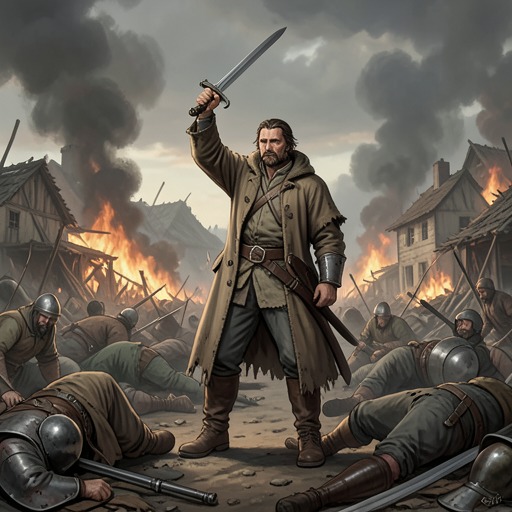
Kullervo’s eventual retaliation follows his receipt of a magically empowered blade from a wizard. Equipped with it, he kills Untamo’s people and burns their villages to ashes. The action reverses the earlier pattern of dispossession: the family whose people were murdered now answers with destruction directed at Untamo’s community. What had appeared in Untamo’s warning as a threat to his tribe becomes the outcome of the feud.
The account identifies the victims as Untamo’s people and the villages as the targets of the burning; it does not, in these details, establish Untamo’s individual fate during the attack. That distinction matters. The retaliatory violence clearly devastates his community, but the grievance is narrated as answered through collective slaughter rather than through a described reckoning between the two men. Kullervo’s revenge thus fulfills the threat Untamo once recognized without showing a restored family relation or a final personal settlement between uncle and nephew.
Narrative Role and Significance
The relation gives Kullervo’s violence a clear origin without turning revenge into repair. Untamo’s attack on Kalervo’s people initiates the feud; his attempts to dispose of Kullervo fail; the sale to Ilmarinen removes the boy from Untamo’s immediate reach; and the memory of Untamo’s impunity later leads Kullervo toward retaliation. Each change alters their circumstances, but none breaks the causal line between the original family loss and the destruction of Untamo’s people.
Kullervo and Untamo also embody contrasting forms of power. Untamo holds practical power over the child’s placement and labor, yet Kullervo’s extraordinary survival defeats his efforts to end the threat. Later, Kullervo’s blade gives him the means to attack Untamo’s people, but the outcome is not a reconciliation or a return to family life. Their story presents inherited vengeance as an action that can answer an injury by reproducing its violence, while leaving the personal relation at its center unresolved.