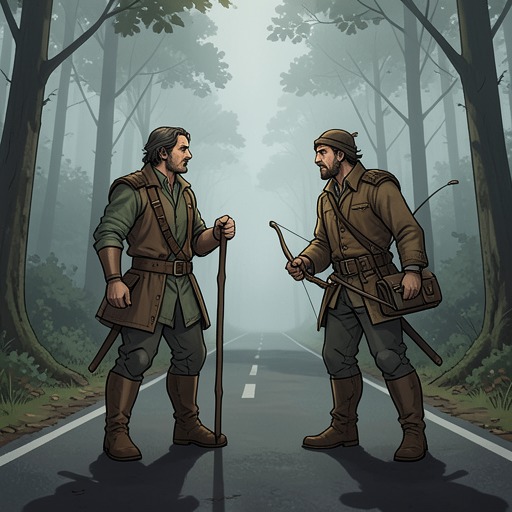
Lapland
KalevalaLapland is a remote northern landscape in the Kalevala, at once a place of residence, travel, hunting, and conflict. Its bleak shores and villages draw the heroes northward, while the preface enlarges the region into the territory of the Laplanders, the Finns’ opponents in the epic’s recurring contests. The poem’s geography is therefore both practical and interpretive: characters cross it in pursuit of specific aims, and the preface reads those journeys as part of a larger cultural and symbolic opposition.
Northern setting and inhabitants
The narrative introduces Lapland through Northland. Youkahainen is presented as a young, reckless minstrel who lives in dismal Northland; the description makes his home far from the central heroic world before his own story begins. In another scene, a traveller reaches a village on Lapland’s dismal shores on the evening of the third day. The detail gives the north a sense of distance measured through the time and hardship of travel, as well as through its repeated association with bleak settlements and remote coasts.
The names Northland and Lapland appear together in the poem’s descriptions of journeys and hostilities. A speaker declares the intention to hasten to Northland and its wars of Lapland, while another passage places Lemminkainen’s journey in Lapland. This overlapping language makes the region more than a fixed point on a map: it is the northern theatre toward which an expedition can be directed, and a place where the prospect of conflict shapes a character’s purpose. The poem’s descriptions establish remoteness and danger, but do not provide a detailed account of Lapland’s political or social structure.
A contested epic landscape
The preface describes the Kalevala as recounting the changing contests between the Finns and the darksome Laplanders, comparing this national opposition to the Greeks’ conflict with the Trojans in the Iliad. It also reports Castrén’s view that the enmity between Finns and Lapps was sung about before the Finns had left their Asiatic birthplace. This is a claim about the imagined antiquity of the tradition, not a dated event within the narrative; the preface presents the conflict as a deep inheritance preserved in song.
The preface offers a second, explicitly interpretive account of the same opposition: the Finns may represent Light and Good, and the Laplanders Darkness and Evil. In that reading, journeys into Lapland become more than incursions into an enemy’s country. They belong to a moral and mythic pattern in which the heroes confront forces figured as hostile darkness. The preface links these incursions to the effort to possess the Sampo, which it compares with the Golden Fleece sought by the Argonauts. That comparison belongs to the preface’s interpretation of the epic; it does not turn Lapland into a single, fully described location or explain every journey there.
Routes, warfare, and the hunt
Lapland’s narrative role is repeatedly expressed through movement toward it. Lemminkainen arms himself with heavy armor, a spear, and a broadsword before announcing his haste to Northland and the wars of Lapland. The poem connects his expedition with pride, and says that he goes despite his mother’s warning. His destination thus carries both a military threat and a personal risk: the journey is not merely a change of scenery, but a course he pursues against advice.
Other passages make distance tangible without making all the journeys identical. One traveller advances northward over three days before reaching the village on Lapland’s shore. Elsewhere a steed’s journey to the dismal homes of Lapland is described as not having been in vain, and the horse returns heavily laden. These are separate glimpses of Lapland as a destination reached through arduous travel, rather than a continuous itinerary shared by all the characters. Together they make the region a recurring endpoint for expeditions whose purposes include conflict and courtship.
Lapland is also a hunting ground. In its extensive northern borders, a hero travels on snowshoes toward distant woodlands to hunt the moose of Piru. The means of travel, the remote forest, and the named quarry give this episode a distinct physical setting: the hero moves from inhabited country into a difficult landscape in pursuit of a dangerous animal. Another search passage names the mountaineers of Lapland among the far-flung places where a sought figure might be found. Its broad geographical sweep reinforces the region’s place at the edge of the world traversed by the poem, without establishing that every named pursuit concerns the same quarry or belongs to the moose hunt.
Place in the poem and its transmission
Lapland’s significance depends partly on the way the Kalevala was preserved and assembled. The preface describes Finnish national poetry as passing unwritten from the mythical age through generations of minstrels, and explains that the published epic was organized from collected fragments. Topelius gathered eighty epic fragments by inviting itinerant Finnish merchants to sing at his bedside; Lönnrot travelled among communities, collected songs, and arranged material under the central idea of the Kalevala. The resulting epic’s repeated northern destinations belong to a work whose larger form gathers many songs and episodes, rather than to a single uninterrupted travel narrative.
That assembled structure helps explain why Lapland can recur in different narrative functions: it is Youkahainen’s remote home, a destination for armed travel, a setting for a hunt, and part of the broader geography of wooing and pursuit. The preface also characterizes the epic as a continuous whole containing almost independent parts, including the contest of Youkahainen. Lapland’s force consequently comes less from a detailed portrait of one settled place than from its recurrence across episodes—as a distant northland where journeys become trials and where the poem’s opposition between Finns and Laplanders takes shape.