Tapiola
KalevalaTapiola is the forest domain of Tapio, a place where woodland life is organized around a court and where its inhabitants can affect events beyond the forest. Its appearances connect the pursuit of game, the gathering of listeners around Wainamoinen’s harp, and appeals for help among the woodland powers. The realm is at once a landscape of firs, aspens, and moose and a social world of hosts, daughters, and rulers.
Setting and Court
The narrative first places Tapiola to the north-west, toward the Northland moors and marshes. There, Tapio’s mansion appears with golden-colored doors shining in the sunlight. The image makes the forest domain legible as a destination with an entrance and a seat of authority, rather than as an undifferentiated stretch of wilderness. Its brightness and gilded architecture distinguish the mansion within the northern landscape, although the surrounding moors and marshes remain part of the approach.
The court has recognizable thresholds and spaces. Lemminkainen hurries beneath snow-covered firs and aspens to Tapio’s courtyards, then stops at the windows and looks slyly into the mansion. This movement from woodland cover to courtyard and window gives the setting an inhabited, guarded quality: a visitor can reach the edge of the household without simply becoming one of its members. The scene does not explain the mansion’s construction or establish a fixed map of Tapiola; it presents the court through the route taken by someone approaching it.
The Forest as Hunting Ground
Tapiola and Metsola name the forest world in the episode of Lemminkainen’s pursuit of the moose. Its fair daughters set the herds of Lempo moving and start a wild moose from its shelter in the realm of Hisi. The forest is therefore not merely terrain through which the hunt passes. Its inhabitants participate in bringing the quarry out into the open, linking the movement of game to the actions of the woodland community.
When the herd reaches the castle, Lemminkainen throws his lasso over the antlers of the blue moose. He later goes to Pohyola and tells Louhi that he has caught the moose of Hisi in the dominions of Metsola, asking for her daughter. Tapiola’s forest thus becomes the setting and provenance of a feat presented in a marriage negotiation: Lemminkainen’s capture supplies evidence of his accomplishment, while Louhi is the person to whom he reports it. The sequence joins wild pursuit to the ordered business of courtship without making the forest itself the prize.
Music and Woodland Society
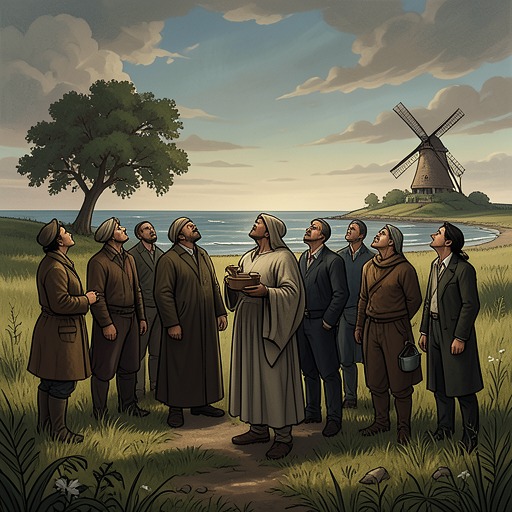
Tapiola also gathers an audience. When Wainamoinen plays his harp, the wisest senior of Tapiola and the most noble landlord of Metsola come to listen. The people of Tapio follow, young and old, men and maidens, running up the mountains like deer. The response makes music a force that draws the forest community out from its separate lives and toward a shared act of listening.
The hostess of the glen and forest dresses herself in blue and scarlet. Her appearance places a distinct figure at the head of this social scene, alongside the senior and landlord already named. The passage gives Tapiola more than an address or a household: it depicts a community whose members respond together to Wainamoinen’s playing, while retaining its own hosts and hierarchy. The harp’s audience is a marked contrast with Lemminkainen’s earlier, furtive approach to the mansion; Tapiola can be approached by stealth, but it can also open into a public gathering around music.
Appeals and the Sampo’s Fragments
The forest’s authority also appears in direct appeals for assistance. One speaker announces an intention to hasten into the forest and work with the woodland forces, then addresses the ruler of the Tapio forests for aid in becoming a conquering hero and clearing the boundless woodlands. The appeal treats the forest as a domain whose powers may be enlisted, not simply as an obstacle to human action. The passage does not identify the speaker in the supplied lines, so the request is best understood through its stated aim and addressee rather than assigned to a character without evidence.
After the Sampo is lost at sea, Mielikki is addressed as a woodland hostess and Tapio’s daughter. She takes fragments from the seaside, in a scene that also directs them toward the Woods of honey on a forest-covered island. The episode brings Tapiola’s household into the aftermath of the Sampo’s loss: a figure associated with Tapio acts upon what the sea has left behind. Across these appearances, Tapiola remains more than a backdrop. Its inhabitants move game, gather to hear music, receive appeals, and handle the fragments of a lost object, giving the forest realm a recurring presence in the poem’s human pursuits and reversals.