River of Tuoni
KalevalaThe River of Tuoni is a perilous threshold between the living world and the regions of death. Called a coal-black river and associated with the cataract, whirlpool, and sacred stream of death-land, it is both a route into Tuonela and the setting of Lemminkainen’s descent into death. Its distinct narrative roles—passage, violence, and search—make the river more than a backdrop: it is where movement between worlds becomes perilously concrete.
Setting and Character
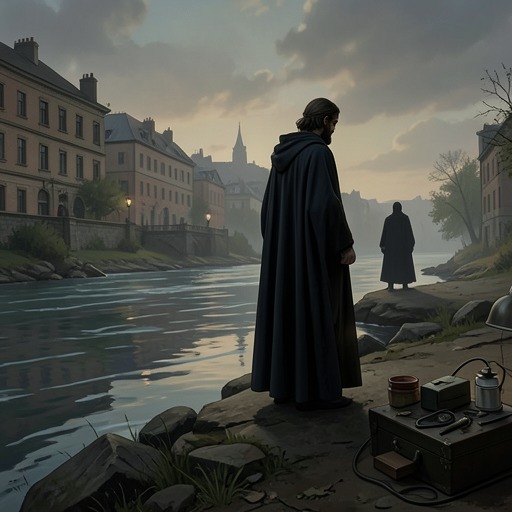
The river is named alongside the lower regions of Tuonela, and its imagery gathers several forms of danger. It is coal-black; nearby are a cataract of death-land and a sacred stream and whirlpool. These descriptions do not provide a map of the afterlife, but they make the river’s character unmistakable: it belongs to a landscape defined by death, and its waters offer no ordinary passage.
The poem gives the river different names and aspects as characters approach it, including Tuonela’s river, the death-stream, and the sacred stream and whirlpool. These names keep attention on its dual character. A river may be travelled, yet this one is also an edge of the death-land, where crossing is inseparable from danger. The changing descriptions make the setting feel less like a single landmark than a boundary encountered in different ways—as a destination, a means of attack, a place of loss, and a passage to be negotiated.
Lemminkainen’s Fall into the River
Lemminkainen reaches the river as a daring hunter, hurrying forward with fearless steps. The narrative’s quickening language makes his approach seem purposeful, but the setting turns that forward motion into exposure: at the death-stream, Nasshut, the wretched shepherd, sends a serpent from the water like an arrow from a crossbow. The image joins the river to the violence that overtakes the hero. The serpent comes from the death-stream, so the attack seems to emerge from the very boundary Lemminkainen has reached.
Nasshut, described as the despised protector of the flocks of Sariola, then throws the dying Lemminkainen into Tuonela’s river. The act completes the movement from attack to apparent death: the hero is not merely wounded beside the water but cast into it. The river thus receives him as the poem’s scene shifts from his peril to the search for what has been lost. Its role is active in the structure of the episode even though the immediate violence is carried out by Nasshut: it is the destination that makes his assault a descent into the realm of death.
The Mother’s Search
The river becomes the object of a determined search when Lemminkainen’s faithful mother takes a rake made of magic metals and rakes the bottom of the Tuoni river. The scene reverses the earlier downward movement. Nasshut threw her son into the water; the mother now reaches into those same depths, working against the river’s concealment of him. Her tool is specifically a magic-metal rake, and the action is directed not at the banks or the surface but at the river bottoms.
This change in action gives the river a second significance. It first receives Lemminkainen as he is thrown into it; later, its depths are where his mother searches. The contrast links the hero’s disappearance to maternal fidelity without making the water harmless or suggesting that passage through it can simply be undone. The scene establishes the river as the material obstacle her search must confront: the dead are not made accessible merely because they are loved, and the mother’s response is to enter the river’s depths with a tool suited to the task.
A Passage That Can Be Crossed
The river is not only the setting of Lemminkainen’s death and his mother’s search. Wainamoinen also reaches the death-river and asks a tiny maiden of Manala to row him across. Mana’s daughter brings her boat to him and rows him through the channel. The passage introduces a form of movement distinct from Lemminkainen’s fall: Wainamoinen is conveyed by boat, with a guide and a deliberate crossing, rather than being attacked and thrown into the water.
Together, the episodes define the river through contrasting encounters. Lemminkainen’s encounter ends in his being cast into its depths; his mother approaches those depths with her magic rake; Wainamoinen’s passage depends on a boat and the service of Mana’s daughter. The river is therefore neither an impassable wall nor an ordinary route. It is a threshold whose danger and difficulty shape what crossing means, separating a violent descent from a guided passage while making both part of the poem’s traffic with the world of death.