Pohyola's Copper Mountain
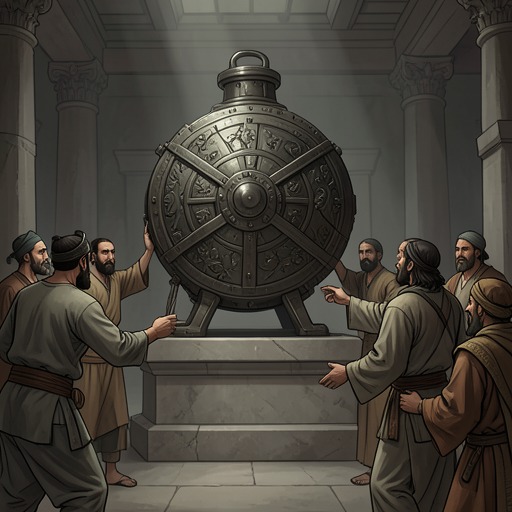
KalevalaPohyola's Copper Mountain is the stone stronghold where Louhi hides the Sampo, enclosing the treasure behind nine locks. It gives physical form to Pohyola's control of what others seek: the Sampo is not merely carried away, but placed within a mountain and secured against access. Later descriptions connect Pohyola's mountain landscape with the concealment of the Moon and Sun as well, extending the image from a guarded treasure vault to a place where sources of prosperity and light can be hidden.
Setting and Physical Form
The mountain is identified both as the stone-mount of Pohyola and as a copper mountain; a later reference calls it the stone-berg of Pohyola and describes its locks as copper. These details make it at once a feature of the northern landscape and a constructed-seeming barrier. The stone gives the hiding place mass and permanence, while the copper locks specify how its entrance is secured. The descriptions do not give a route through the mountain or explain its interior, keeping attention on the fact of enclosure rather than on a traversable setting.
The Sampo's hiding place is also surrounded by young roots. This brief image places new growth around the concealed object, joining the mountain's hard, locked enclosure to signs of living growth. It does not explain the roots' origin or establish how long the treasure has been hidden; its effect is to set the guarded Sampo within a landscape that is not wholly inert.
Louhi's Concealment of the Sampo
Louhi takes the Sampo away from Northland and carries its lid in colors to the stone-mount of Pohyola. She then hides it in the copper mountain, where nine locks secure the treasure. The sequence establishes both her possession of the object and her deliberate control over its location: removal is followed by concealment, and concealment by multiple barriers. The mountain thus protects the Sampo while making its recovery a problem of reaching what Louhi has made inaccessible.
The detail of the lid in colors preserves the Sampo's distinctive appearance even as the narrative withdraws it from view. The treasure is identified by the object carried into the mountain, then defined spatially by its locked hiding place. Concealment does not erase the Sampo from the story; it turns the mountain into the condition that later seekers must overcome.
The Mountain as an Obstacle to Recovery
A later reference frames the objective as procuring the lid in colors from the copper-bearing mountains, specifically from behind nine copper locks in Pohyola's stone-berg. The repeated details connect the expedition's goal to Louhi's earlier act: the sought object, its location, and its defenses remain recognizable across the separate accounts. The mountain is therefore not incidental scenery but a lasting obstacle in the Sampo's history.
Its narrative function rests on a contrast between the treasure's value and the difficulty of access. The Sampo has been carried into a place whose stone and locks stand between it and those who seek it. Naming the barriers gives the recovery quest a concrete shape without describing the mountain's interior or anticipating the quest's outcome.
Celestial Concealment
Pohyola's mountain imagery recurs in the account of Louhi hiding the Moon in a many-colored rock and the Sun in an iron-banded mountain. These descriptions connect her concealment of the Sampo with a wider pattern: objects of exceptional value or significance are removed from ordinary sight and enclosed in northern stone. The passages distinguish the hiding places by their details—the Sampo is secured behind nine copper locks, while the Moon and Sun are placed in a many-colored rock and an iron-banded mountain—so they should not be treated as a single, fully described chamber.
Together, these images make the mountain setting a locus of possession and withholding. The Sampo's locked enclosure belongs to the story of its recovery, while the hidden celestial lights broaden the stakes of concealment beyond the treasure itself. Pohyola's Copper Mountain consequently signifies more than a remote hiding place: it is the landscape form through which guarded power becomes visible as obstruction.