Alleged National Bolshevik plot against Kazakhstan
LimonovThe alleged National Bolshevik plot against Kazakhstan is presented less as a demonstrated military threat than as a disputed accusation that grew into a high-stakes criminal case. The book sets the Federal Security Service’s picture of a dangerous armed conspiracy against the modest reality Eduard Limonov describes: a handful of people in a remote Altai cabin, whose supposed capacity to destabilize a neighboring country seemed wildly out of proportion to their circumstances.
The Allegation and Its Setting
The accusation concerned crimes allegedly committed in Kazakhstan by Limonov and six accomplices. The book does not establish that they had a workable plan to destabilize the country. Instead, Limonov reflects on the disparity between the charge and the group’s situation: roughly half a dozen people roughing it in a log cabin in the Altai, about sixty miles from the Kazakh border, with no weapons beyond a couple of hunting rifles. He regards the idea that they could destabilize Kazakhstan—or provoke a nuclear war—as absurd, even as he acknowledges that the seriousness of the charges gives them a disturbing weight.
The episode belongs to a broader political environment in which the National Bolshevik Party made its presence felt through deliberately provocative symbols and actions. In the account of the party in Zakhar Prilepin’s novel Sankya, militants tag trains, unfurl banners on hard-to-reach monuments, and throw tomatoes at a governor during official events. Those stunts are described as courageous partly because conduct that might earn a fine in Western Europe could bring a prison sentence in Russia. This context helps explain why the party’s political identity could attract both committed followers and official suspicion, but it does not itself prove the separate allegations concerning Kazakhstan.
Charges and Limonov’s Defense
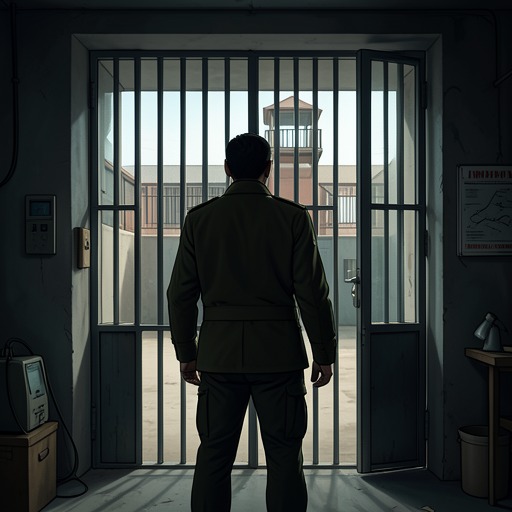
After fifteen months in strict isolation at Lefortovo Prison, Limonov was transferred in a government Antonov aircraft to Saratov for trial, under a police escort the narrator compares to the protection given to a major international terrorist. Saratov was selected because it was the Russian jurisdiction closest to Kazakhstan, where the alleged crimes were said to have taken place. On arrival, Limonov had to recite the charges attached to his imprisonment, including the relevant provisions of the criminal code.
The charges were Article 205 of the Russian Criminal Code for terrorism; Article 208 for organizing or participating in an illegal armed group; Article 222(3) for the illicit acquisition, transport, sale, or storage of firearms; and Article 280 for incitement to extremist activity. At the first hearing, the investigating judge set out the accusations and the severe sentences they carried. Limonov was caught between pride at being accused of such consequential crimes and the practical need to secure his acquittal. To avoid the prospect of twenty years in prison as a terrorist, he had to present himself as a bungling fool; yet the judge appeared unreceptive to his argument and adhered to the Federal Security Service’s portrayal of the group as a serious threat to national security.
The State’s Version and the Prison’s Response
The prosecution’s account reached beyond the courtroom. As Limonov arrived in Saratov, Channel One Russia broadcast a film titled “The Ghost Hunt.” It presented the National Bolshevik Party as an Al-Qaeda branch and the Altai hut as a secret training camp for hundreds of fanatical fighters. The book distinguishes this image from the much smaller reality of the camp, while noting that a large training camp had been Limonov’s own dream—one far removed from what actually existed.
The film’s reach was immediate inside the prison: everyone had seen it, knew Limonov was its central figure, and began calling him “bin Laden.” The nickname carried a double edge. It flattered the political prisoner’s appetite for a grand and dangerous identity, but it also made the state’s terrorist framing feel more concrete and potentially more perilous. The alleged plot thus acquired a public life that exceeded the facts the book describes, with television turning a disputed, limited undertaking into an image of international militancy.