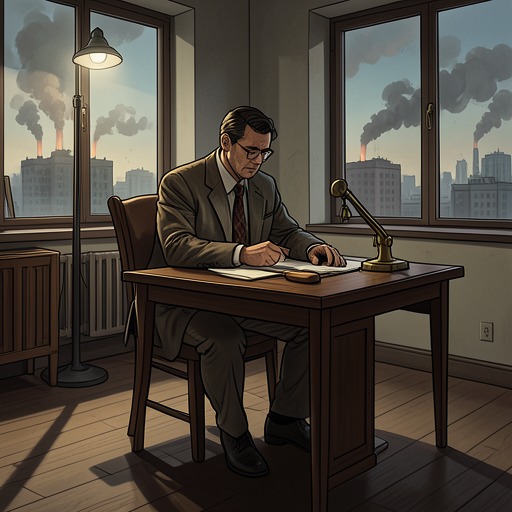
Eduard writes This Is Me, Eddie in Central Park
LimonovEduard Limonov’s writing of It’s Me, Eddie begins on the grass in Central Park, where the life he has lost and the uncertain life ahead of him become material for a book. Each morning he lies looking from the sky to the terraces of Fifth Avenue, observes the people around him, and writes down how he came to be there. The act turns his precarious present into a possible literary future: he knows the book is taking shape, and believes it is his only chance.
The Park as vantage point
Every morning, Limonov walks to Central Park and settles on the grass with a plastic bag holding his notebook as a cushion. He stays for hours. Above him is the sky; beneath it, the terraces of Fifth Avenue buildings, including the world of the Libermans. He has stopped seeing that world as part of his present. It seems to belong to a distant former life: only a year earlier, he had visited the Libermans as a promising young writer and the husband of Tanya, a beautiful woman on her way to becoming a famous model. Now he is a bum.
From this low position, he watches people and tries to calculate whether they can escape their circumstances. The bums, in his estimate, have no such prospect. Office employees and secretaries eating sandwiches on benches may be promoted, but will not go far—and, he assumes, never expected to. Two young intellectuals scribbling on typed screenplay pages seem to believe in their dialogue and characters; perhaps that belief will carry them as far as Hollywood, with its pools, starlets, and Oscars. His judgments make the park a social panorama, but also expose how uncertain his own predictions are: he is assessing the possible futures of strangers while unable to tell whether his own story is beginning or ending.
From observation to pages
The park’s other inhabitants resist easy classification. A group of Puerto Ricans has made a camp on the lawn with blankets, transistor radios, babies, and thermoses. Limonov assumes they will remain where they are, then immediately entertains a possibility that unsettles that certainty: perhaps the sacrifices of the present will help the crying baby, still in a soiled diaper, excel at school and eventually win a Nobel Prize in medicine or become secretary-general of the United Nations. The imagined future is extravagant, but it gives the scene its force. Even the people he first treats as fixed in place cannot be wholly separated from possibility.
He applies the same question to himself. Wearing white jeans and carrying what the narration calls black ideas, he wonders whether being a bum in New York is one chapter in a romantic life or the end of the book. He takes out his notebook, rests an elbow on the grass, and smokes a joint bought from one of the small-time dealers he knows. Then he begins recording the material already passing through his mind: the welfare office, the Winslow Hotel, the lost souls of the Russian émigré scene, Tanya, and the path that brought him to his present condition. He writes as things come to him, without worrying about style. The work continues into a second notebook and then a third.
The book as a possible future
The change is not that Limonov has escaped poverty or resolved his uncertainty. Rather, he has begun to convert both into writing. His observation of other people’s prospects gives way to the practical accumulation of his own past: places, relationships, and circumstances enter the notebooks as connected parts of a story. The contrast between his earlier social standing and his present life supplies the book with a sharp before and after, while his question about whether this is merely a chapter or the end remains unanswered.
Limonov recognizes that the notebooks are becoming a book, and assigns that book an unusually high stake: in his view, it is his only chance. The writing therefore matters both as the beginning of It’s Me, Eddie and as a response to the apparent closure of his former life. Central Park offers no promise of success; it offers a place from which he can watch, remember, and keep writing. What begins on the grass is not a completed manuscript but the accumulation of material through which a seemingly finished life may yet become a book.