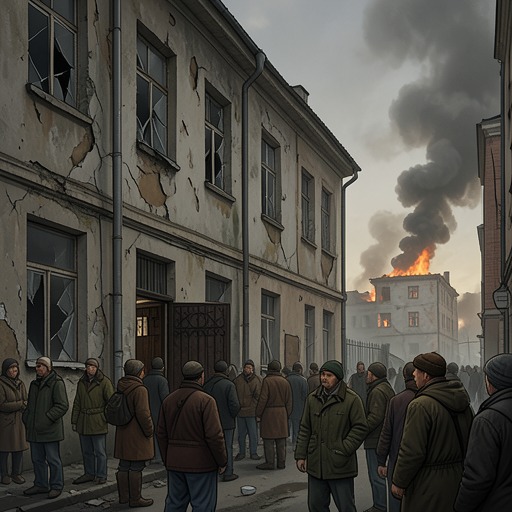
Either Yeltsin or chaos
LimonovEither Yeltsin or chaos is a campaign slogan that reduces Russia’s uncertain political future to a choice between Boris Yeltsin and catastrophe. Its significance in Emmanuel Carrère’s account lies in the tension between its persuasive simplicity and the political conflicts it suppresses: public anger at the post-Soviet order, rival claims to democratic legitimacy, and the oligarchs’ determination to keep Yeltsin in power.
A contested claim to legitimacy
The slogan’s background is a political struggle in which both sides claimed to defend the country’s constitutional order. During the confrontation at the White House, thousands of patriots supported opponents of Yeltsin, among them Ruslan Khasbulatov and Alexander Rutskoy. Some of the demonstrators were fascists, but Carrère notes that they presented themselves as defenders of constitutional government and accused the democrats of preparing dictatorship in democracy’s name. The scene makes the slogan’s binary look less like a neutral description than a bid to settle, in advance, which side could claim the words democracy and order.
Eduard Limonov participates in that competing argument. At the White House, he tells Rutskoy that Western governments support Yeltsin because they want Russia on its knees, and casts the parliament’s resistance as a democratically elected body’s refusal to accept dictatorship. He insists that the decisive struggle will be settled at the White House, not in diplomatic statements or military bases. His argument does not use the campaign slogan, but it exposes the same fight over political framing: each camp identifies its own cause with legitimacy and its opponent with a threat to the country.
The slogan as an electoral instrument
The phrase becomes a mass-media refrain in the run-up to the presidential election. Faced with the prospect that voters might turn to the Communists, Boris Berezovsky calls Russia’s six most powerful oligarchs and urges them to set aside their rivalries. The seven combine their financial and media power behind Yeltsin. Newspapers, radio stations, and television channels hammer home the choice as either Yeltsin or chaos, or, in a related formulation, either Yeltsin or the great leap backward.
The campaign gives the slogan a concrete supporting apparatus. Documentaries about the Gulag, the famine organized by Joseph Stalin in Ukraine, and the Katyn Massacre are broadcast around the clock; films about the purges are commissioned. These accounts of Soviet violence make the threatened return to the past vivid, while the slogan compresses the electoral decision into a warning: rejecting Yeltsin means inviting catastrophe. Its force comes not only from repetition but from the historical memories arranged around it.
The alternative the binary obscures
The danger invoked by the slogan was politically credible because the Communist Party had become a serious electoral alternative. Only five years after Yeltsin declared it illegal, polls indicated that voters were prepared to support it in large numbers. The public’s discontent was directed at democracy, the market, and the injustice accompanying the economic transition. Carrère emphasizes that the party’s leader, Gennady Zyuganov, was not promising to reopen the Gulag or rebuild the Berlin Wall. His campaign offered a cautious program centered on corruption, national pride, and Russian Orthodoxy, alongside a promise to reduce the gap between rich and poor.
The oligarchs had a specific stake in preventing that outcome. Through the loans-for-shares scheme, banks lent money to the state in return for shares in valuable, not-yet-privatized industries such as natural gas and petroleum. If the state failed to repay the loans within a year, the lenders could take the shares. Because the deadline fell after the election, keeping Yeltsin in power mattered to those who had arranged the deal. The slogan’s apparent choice between stability and chaos therefore also served the interests of men whose wealth depended on the electoral result.
A refrain within a wider argument
Carrère’s account does not make the slogan’s warning wholly fictitious: the electorate’s turn toward the Communists reflects real frustration, and the campaign recalls genuine Soviet violence. But the repeated binary leaves little room for understanding why voters might reject the post-Soviet order without seeking a return to Stalinism. In Zakhar Prilepin’s novel Sankya, a teacher similarly worries when young radicals invoke the fatherland, imperial greatness, and the sanctity of their cause, while the young man rejects the prospect of settling for ordinary comfort and protection from history. The exchange makes visible the clash between a desire for normal life and a politics that promises something more absolute.
Later, Carrère describes Vladimir Putin’s appeal through a different, restorative account of the Soviet past. Putin insists that communism cannot simply be equated with Nazism and that decades of people’s lives, beliefs, and sacrifices cannot be dismissed as worthless. Carrère argues that this language speaks to Russian memories of childhood and to the need for a meaningful past. That perspective complicates the slogan’s neat opposition: political allegiance is shaped not just by fear of a communist return or by media pressure, but by what people believe has been lost and what they need their history to mean.